Prep Tools
Fish Bone Tweezers (Pin Bone Pliers)
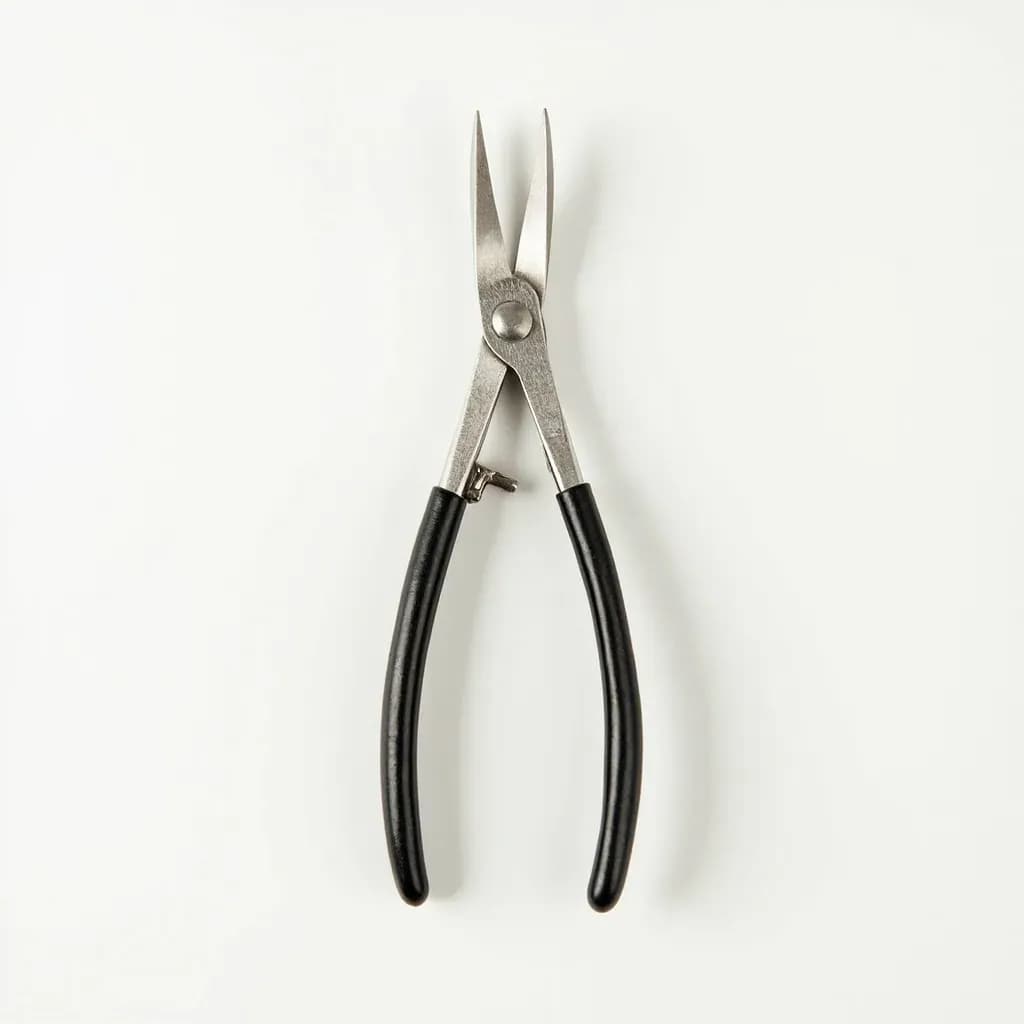
Broad-tipped tweezers that grip and pull the fine pin bones from fish fillets.
Fish bone tweezers are sturdy tweezers with a wide, flat gripping tip designed to pull the small pin bones from salmon, trout, and other fillets. The cook runs a finger along the flesh to find each bone, then grips and draws it out in the direction it points to avoid tearing. The flat tip gives a secure hold on slippery bones that fine tweezers would slip off.
Fish bone tweezers are a small, specialized tool built around one job: lifting the fine intramuscular pin bones out of a round-fish fillet without tearing the flesh. They look like oversized cosmetic tweezers, but the resemblance is misleading. The blades are deliberately wide, flat, and blunt — typically 2 to 4 mm across the gripping face — and finished smooth or with a faint cross-hatch so they hold a smooth bone by friction rather than puncturing it. Pressed lightly against a fillet, the closed blades push the flesh aside and pinch the bone at its midpoint, where a steady, low-angle pull draws it cleanly out with a whisper of meat still attached. That motion is the tool's reason for being, and it is why a paring knife or a pair of eyebrow tweezers cannot substitute for it at any speed.
The tool matters because most popular round fish — salmon, trout, sea bass, branzino, arctic char, snapper — are sold with a double row of pin bones running along the lateral line, and few diners will tolerate the prickle of even one. A cook who can debone a fillet cleanly in under two minutes gains a real edge in service. Beyond the obvious job, the tweezers fill a quiet secondary role: lifting fine garnishes, plucking pin feathers from poultry, and rescuing a guest who has found a stray bone at the table. It is one of the least expensive tools in a fish station and one of the most reached for.
The form has two distinct traditions. The Western pin bone plier is a short, springy, all-stainless tool of mid-twentieth-century butchery, built to be tossed in a drawer and run through a dishwasher. The Japanese hone-buki (骨抜き) is older, longer, and lighter, with a sharply offset tip suited to the fine, branching Y-bones of sea bream, yellowtail, and other fish eaten as sashimi. Most home cooks need only one Western pair; pros in a sushi or fine-dining fish station often keep both on hand.
Alternatives
Types & varieties
The everyday Western style: straight, broad, blunt blades with smooth or lightly cross-hatched gripping faces.
Tips offset at roughly 45°, keeping the knuckles clear of the fillet for better visibility — the preferred shape for salmon and trout.
Longer (15–18 cm), slender, with a sharply offset tip; designed for sashimi and kaiseki work on sea bream and yellowtail, where the bones are fine and branching.
Inner faces carry fine teeth for extra hold on slippery or short bones; can mark delicate flesh if pressed too hard.
Heavier-duty; useful for larger freshwater species such as pike, carp, and lake trout, whose pin bones are sturdier than those of salmonids.
Single-use, common in commercial sushi lines and airline catering for hygiene compliance.
Finding the bones before you pull
Half the job is knowing where to pinch. Pin bones run in two roughly parallel rows along the lateral line of a fillet, from just behind the gill plate to within a few centimeters of the tail. There are three reliable ways to locate them before the tweezers ever touch the flesh.
- Run a fingertip gently against the grain of the flesh — pin bones telegraph as a faint row of tiny bumps you can feel more than see.
- Lay the fillet skin-side down over a white or pale board; the bones cast small shadows you can pick up in raking light from a window or overhead lamp.
- Hold the fillet over a backlit surface (a phone flashlight laid flat works in a home kitchen) — the bones appear as dark lines against the translucent flesh, and you can mark their line with the flat of a knife before you start pulling.
- Start at the head end and work toward the tail; bones usually taper and become easier to miss near the tail, so do not stop early and assume you are finished.
Common uses
Tips & pitfalls
- Always pull the bone in the direction it points — toward the head. Pulling against the grain snaps the bone or tears a small flap of flesh loose with it.
- Grip the bone at its midpoint, not the tip. The middle is the strongest part and least likely to snap mid-pull.
- Keep the tweezer blades parallel to the fillet surface. Tilting the tips up cuts into the flesh instead of lifting the bone out, which is the most common home-cook mistake.
- Wipe accumulated bones off onto a damp towel or into a small bowl as you go. A pile left on the cutting board can be pressed back into the flesh by the next stroke and create more work.
- If a bone snaps and the tip is buried, lift the flesh with the very point of a paring knife to expose it, then re-grip with the tweezers. Do not dig with the tweezers themselves.
- Do not substitute cosmetic or slanted eyebrow tweezers. Their narrow points spear the flesh and snap bones rather than drawing them out cleanly, and they will leave a row of small holes in an otherwise pristine fillet.
- Replace tweezers whose tips have rounded over. Sharp, square edges are what grip the bone cleanly; rounded tips slide off and force you to grip harder, which then tears the flesh.
- Choose all-stainless models over plastic-handled ones for a working kitchen. Plastic joints can harbor bacteria at the seam and will not tolerate high-heat commercial dishwashing.
Good to know
- Also known as
- Pin bone pliers, fish bone pliers, deboning tweezers, needle-nose fish tweezers
- Primary material
- Spring-tempered stainless steel; some have plastic-coated grips
- Typical length
- 10–15 cm (4–6 in) for Western styles; hone-buki run 15–18 cm
- Tip style
- Wide, flat, blunt blades 2–4 mm across, often slightly cross-hatched — broader than cosmetic tweezers so they grip fine bones without cutting flesh
- Action
- Spring-loaded scissor or plier action that holds a single pin bone once gripped
- Origin
- Western professional butchery of the mid-20th century; the Japanese hone-buki (骨抜き) tradition is older and longer
- Cost range
- Approximately $8–$60 USD depending on brand and finish
- Dishwasher safe
- Yes, when fully stainless steel
- Care
- Rinse after use and dry to prevent water spots; resharpen tips only with a fine diamond file if they round off
Also called
Deboning Tweezers · Pin Bone Pliers · Fish Tweezers
Related

Peeler
Swift blade for stripping skin off fruit and vegetables

Grater
Sharp-toothed surface for shredding cheese and vegetables

Microplane
Ultra-fine rasp for citrus zest, garlic, and hard cheese

Mixing Bowl
All-purpose bowl for combining, whisking, and tossing

Whisk
Looped wires that beat air into eggs, cream, and sauces

Spatula
Flat blade for flipping, lifting, and scraping

Slotted Spoon
Pierced spoon that lifts solids and drains the liquid behind

Wooden Spoon
Gentle, heat-friendly spoon for stirring anything