Prep Tools
Fish Scaler
A serrated or toothed tool that strips scales off fish before cooking.
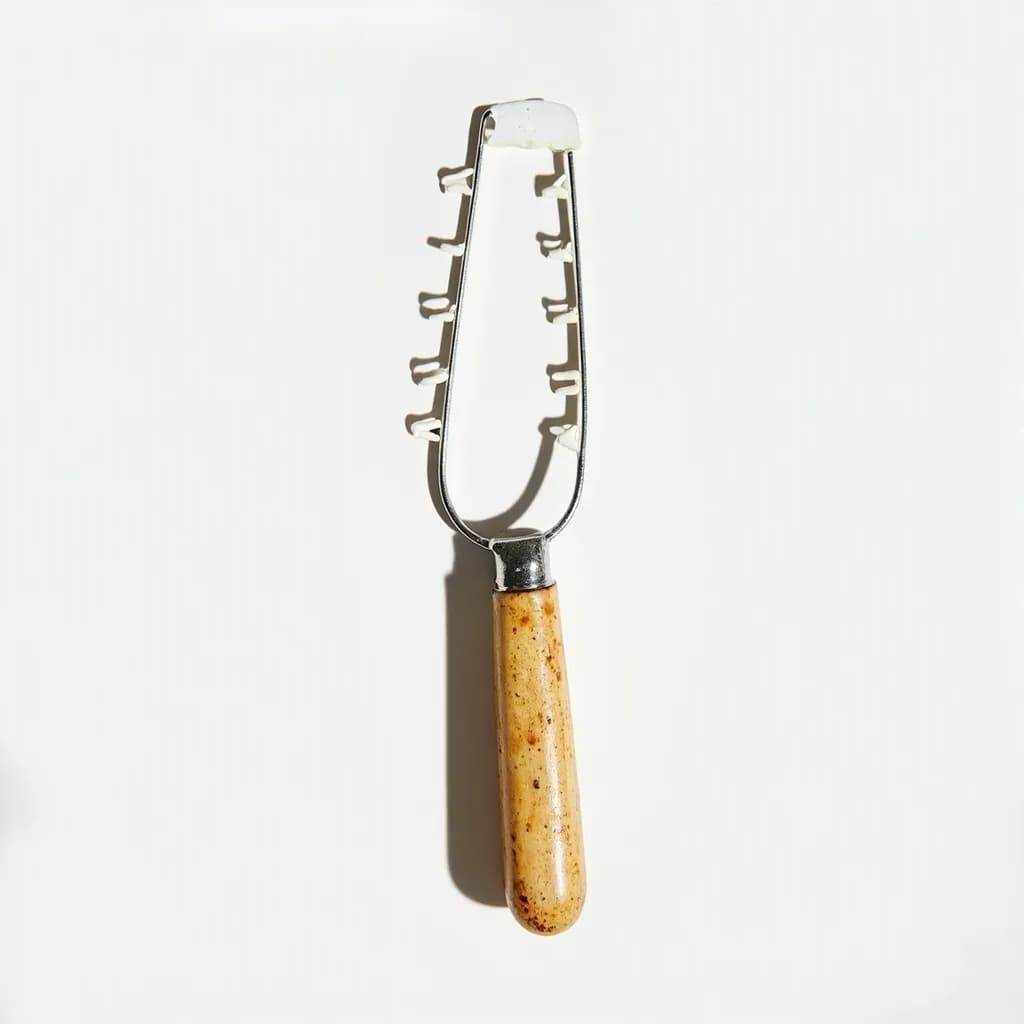
A fish scaler is a handheld tool with a serrated edge or rows of metal teeth used to scrape scales off a fish's skin before it is cooked. The cook drags it from tail to head against the grain of the scales, loosening them without tearing the flesh. Many designs have a guard or cupped head to keep flying scales contained over the sink.
A fish scaler is a small, specialized tool that does one job well: strip the bony, overlapping plates covering most scaled fish. Those plates are protective in life but turn gritty and unpleasant if left on during cooking, and they foul pans and grills. The scaler's toothed edge catches the trailing edge of each scale and lifts it cleanly from the skin without tearing the flesh — something a flat blade or spoon manages only clumsily.
The tool matters more than its size suggests. A clean, intact skin holds together during grilling, frying, or steaming and crisps beautifully when scored and patted dry. Rough scaling shreds the skin, pulls flesh with the scales, and leaves the cook with a ragged, partly-skinned fish that cooks unevenly. For a home cook buying whole fish only a few times a year, a simple serrated plate is enough; for a fishmonger handling dozens of fish a day, choices of tooth geometry, handle length, and edge orientation start to matter.
Timing matters too. Most cooks scale the fish before gutting, so the skin acts as a bag that keeps the cavity clean and keeps sharp tools and slippery innards away from the flesh. Done right, a medium snapper or trout is fully scaled in under a minute, with no more mess than a few wet flecks in the sink.
Alternatives
Types & varieties
Flat stainless or nickel-plated plate with a single serrated edge; the classic bar and restaurant tool.
Handle with a toothed head resembling a comb; offers better grip and leverage on larger fish.
Traditional block studded with sharp teeth or nails; still found in European and Asian fish markets, best on thick-skinned fish with large scales.
Serrated on both long edges so it works equally well for right- and left-handed users.
Stiff-bristled brush suited to fish with very fine, almost powdery scales such as some sea bass and bream.
Rotary or vibrating power tool for high-volume prep; genuinely speeds up large fish or big batches.
Combination fish grip, scaler, and gut hook in one implement — popular with anglers.
Scaling vs. skinning
Scaling and skinning are not interchangeable, and species dictates the right approach. Most round fish with obvious, overlapping plates — snapper, bass, trout, mackerel, carp, herring — are scaled, gutted, and cooked on the bone with the skin on for protection and crispness. A second group, including catfish, eel, monkfish, skate, and shark, has skin that is either scaleless or covered in scales so tightly attached that scalers cannot lift them effectively; these are typically skinned with a knife, pliers, or, in the case of eel, a dedicated skinning hook. Flatfish such as flounder and sole can go either way depending on the recipe: scaling leaves a delicate, edible skin for pan-frying; skinning gives a cleaner surface for stuffing.
Substitutes in a pinch
Most home cooks scale only a handful of fish a year, and a dedicated tool can feel like a one-job gadget. Several common items stand in reasonably well when a scaler isn't on hand, though none are quite as fast or gentle on the skin.
- The back of a chef's knife or a paring knife, held almost flat and scraped firmly tail-to-head — works well on medium scales, less so on fine ones.
- A butter or table knife, used the same way; gentler than a chef's knife and a good first choice.
- A metal spoon, bowl-down, dragged against the lay of the scales — surprisingly effective on large-scaled fish like snapper and carp.
- A vegetable peeler pulled against the grain; useful for very large scales but tends to take skin with them.
- A rough dish scrubber or stiff-bristled brush, in the style of a brush scaler, for fine-scaled fish.
Common uses
Tips & pitfalls
- Scale the fish before you gut it — the skin acts as a bag and keeps the cavity clean.
- Always work tail to head, against the direction the scales naturally lie; going the wrong way barely loosens them.
- Scale inside a deep sink, inside a plastic bag, or on a sheet of newspaper to contain the mess — wet scales stick to skin and fly everywhere.
- Keep both the fish and the tool wet; dry scales flake off and scatter through the kitchen.
- A short, firm stroke beats pressing hard — too much pressure tears the skin and pulls flesh with it.
- For very fine-scaled fish like snapper or bream, a knife held at a shallow angle often works better than a serrated scaler.
- Don't try to scale a frozen or nearly frozen fish; let it thaw until scales give easily, or the skin will shred.
- Rinse the scaler and the fish frequently as you work; built-up scales reduce grip and efficiency.
Good to know
- Primary purpose
- Removing the bony, overlapping scales from fish skin before cooking or filleting
- Working direction
- Tail to head, against the lay of the scales
- Best for
- Medium- to large-scaled fish such as snapper, sea bass, carp, mackerel, and trout
- Not needed for
- Catfish, eel, monkfish, skate, and shark — usually skinned rather than scaled
- Typical time per fish
- 30 seconds to 3 minutes, depending on species and size
- Common material
- Stainless steel head, often with a wooden or polymer handle
- Skill level
- Beginner-friendly; the main risk is tearing skin or scattering scales
- Care
- Hand wash and dry immediately; stainless steel resists rust but wooden handles do not
Also called
Fish Descaler · Scale Remover
Related

Peeler
Swift blade for stripping skin off fruit and vegetables

Grater
Sharp-toothed surface for shredding cheese and vegetables

Microplane
Ultra-fine rasp for citrus zest, garlic, and hard cheese

Mixing Bowl
All-purpose bowl for combining, whisking, and tossing

Whisk
Looped wires that beat air into eggs, cream, and sauces

Spatula
Flat blade for flipping, lifting, and scraping

Slotted Spoon
Pierced spoon that lifts solids and drains the liquid behind

Wooden Spoon
Gentle, heat-friendly spoon for stirring anything