Prep Tools
Fish Spatula
Thin, slotted, angled turner for flipping fish and delicate seared foods.
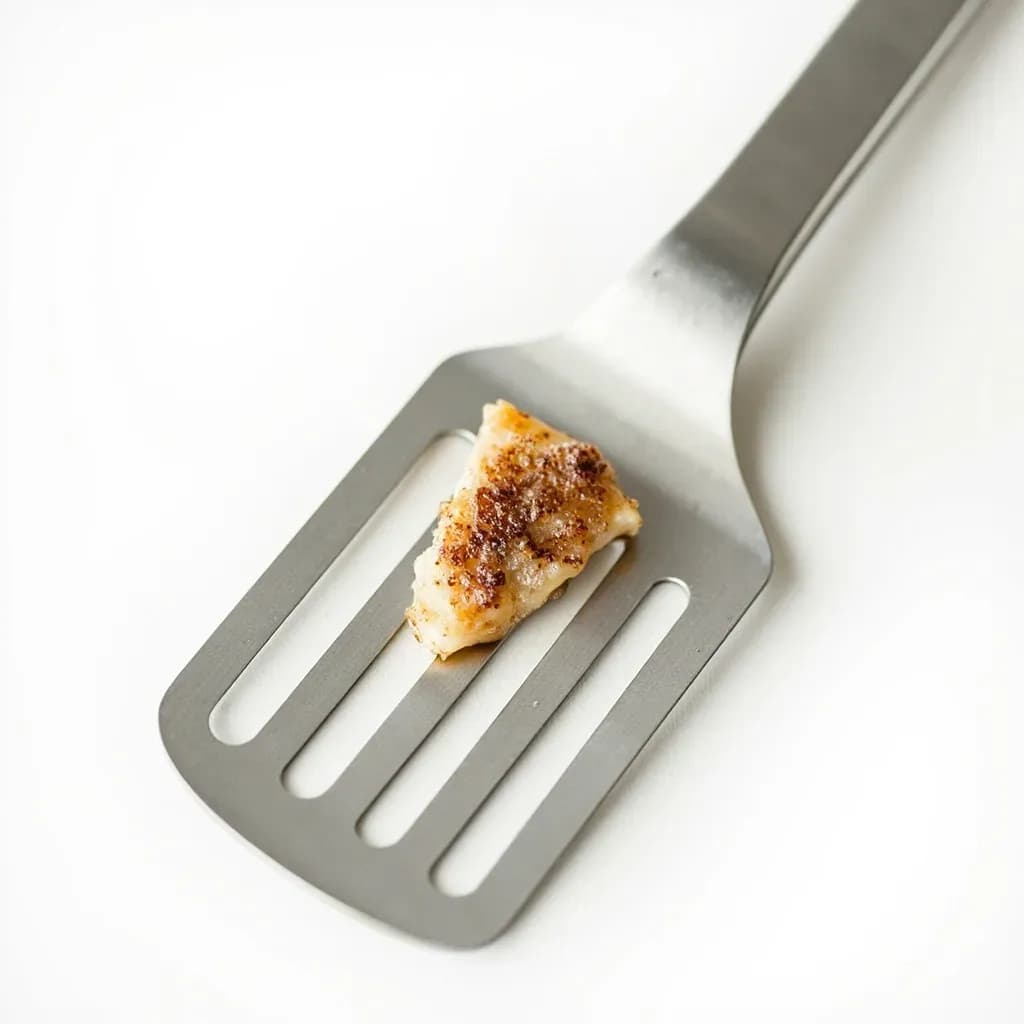
A fish spatula is a thin, flexible metal turner with a slanted, slotted head designed to slide under delicate foods and flip them without breaking. The thin front edge gets beneath crispy-skinned fish, fried eggs, and seared proteins, while the slots let fat and liquid drain away. Despite the name, it is a versatile everyday turner for many pan-cooked foods.
The fish spatula is the most specialized turner in the kitchen, designed around a single difficult job: lifting a fragile piece of food — usually a fillet — without tearing, sticking, or dropping it. Its identity is built on three details working together: a thin, beveled front edge that slides under a crusty surface, an upward-bent neck that keeps the cook's knuckles clear of the pan rim, and a wide, slotted blade that drains fat while supporting the food across its broadest face. Together these make it a precision tool, not just a wide pancake flipper with ambitions.
A good fish spatula feels almost weightless in the hand and slightly springy at the tip, with a blade thin enough to flex under your thumb. That thinness is the entire point: it lets the blade slip between the food and the pan in a single pass, which is what preserves a seared crust or the crackling skin on a piece of salmon. The slots, usually three or four elongated openings, are not only for drainage; they also reduce contact area so the metal is less likely to glue itself to the food's surface.
The tool is a long-standing professional workhorse, common in mid-20th-century American diner lines and French restaurant kitchens alike, where it handles everything from sole meunière to a sheet pan of roasted vegetables. The current market ranges from classic wood-handled turners to fully welded stainless models, plus nylon and silicone versions intended for nonstick cookware.
Alternatives
Types & varieties
Beveled stainless blade with offset neck; the everyday professional workhorse.
Holds a thinner, sharper front edge for sliding under crispy skin; requires thorough drying to avoid rust spots.
Classic American diner-style turner; comfortable and traditional, hand-wash only.
Fully welded stainless handle and blade; dishwasher-safe, the most durable choice, slightly heavier.
Plastic-bladed version safe for nonstick and ceramic pans; lower heat tolerance, can melt near 400°F.
Heat-resistant to roughly 600°F; pan-safe but less rigid, flexes more under heavy fillets.
Shorter, narrower blade (4–5 in) suited to lifting cookies, small pastries, and eggs.
Artisan-made in copper, bronze, or hammered steel; prized for aesthetics and rigidity, requires more care (avoid prolonged contact with acidic foods).
Extended handle (16 in or longer) for grilling; blade similar but reach clears the grate.
Anatomy of a fish spatula
Every part of the tool earns its keep. The neck is bent upward — typically 25 to 35 degrees — so the handle and your knuckles sit above the pan rim rather than crashing into it. The blade is wide and roughly triangular, with a thin, beveled front edge that does the actual sliding; the bevel is what lets the tip disappear under a piece of fish without scraping the fond or tearing the crust. The slots are functional, not decorative: they let hot fat run off as you lift, and they reduce the surface area that can vacuum-seal itself to a crispy crust. A thinner blade flexes slightly under pressure, which most cooks interpret as flimsy but is actually a sign of quality — it means the steel has been ground thin enough to slip rather than wedge. Wood handles are light, warm, and traditional; stainless handles are heavier, exceptionally durable, and the only choice if you want to run the tool through a dishwasher.
The slide-flip-lift motion
The technique that defines the tool is a three-part motion used to turn a skin-on fillet without tearing. The first mistake to unlearn is trying to dig the tip in from the side closest to you; the pan is hottest there and the food is most likely to stick.
- Slide the spatula in flat at the pan's far edge first, leading with the beveled tip, and work it about two-thirds of the way under the fillet.
- Tilt the blade up just enough to confirm contact, then slide the rest of the way in. The fillet should sit centered on the blade, not hanging off the front edge.
- In one continuous motion, rotate your wrist so the blade turns over and the fillet lands back in the pan skin-side (or presentation-side) up. Keep the blade perpendicular to the pan during the flip — angling it sideways is what drops the fish onto the burner.
- For a whole side of salmon or a long fish, brace the spine with a second spatula or a pair of fish bone tweezers; the thin blade alone can flex under the weight.
Choosing between metal, nylon, and silicone
The right material depends on the pan, not the food. A thin metal blade gives the cleanest slide and the most precise flip, but it will score any nonstick or ceramic coating within weeks. A nylon-bladed turner is gentler on coatings but softens near 400°F and can melt against the side of a screaming-hot skillet. Silicone sits in the middle: heat-resistant to roughly 600°F and pan-safe, but the blade flexes more, which makes it a less confident tool under a heavy fillet. The practical answer for most home cooks is to own two — a metal fish spatula for stainless steel and carbon steel, and a silicone one reserved for nonstick and ceramic.
Common uses
Tips & pitfalls
- Prioritize a thin, beveled front edge over brand name — a thin blade is what slides cleanly under crispy skin, while a thick one wedges and tears.
- Use a nylon or silicone version on nonstick and ceramic pans; a metal blade will score the coating in short order.
- Never pry or lever with a fish spatula; the thin blade is built for sliding, not scraping, and will bend or kink if twisted.
- Dry high-carbon stainless blades immediately after washing — a few drops of moisture left on the steel will bloom into rust spots overnight.
- Keep the blade perpendicular to the pan during the flip; angling it sideways is the most common cause of dropped fillets.
- Hand-wash wood-handled models and oil the handle occasionally with food-safe mineral oil to keep the wood from drying and splitting.
- Buy two: a metal one for stainless and carbon-steel pans, and a silicone or nylon one for nonstick — switching mid-recipe is what ruins coatings.
- Don't confuse 'offset' with 'angled'; a true fish spatula has the neck bent upward (toward the ceiling), not to the side, so the offset clears the pan rim across the entire blade.
Good to know
- Primary material
- High-carbon or stainless steel blade with wood or stainless handle
- Blade length
- Typically 6–7 in (15–18 cm)
- Overall length
- Usually 11–13 in (28–33 cm)
- Blade width
- Roughly 3–3.5 in (7.5–9 cm) at the widest point
- Blade thickness
- About 0.6–0.8 mm; quality versions are thinner and beveled at the front edge
- Offset angle
- Neck typically bent 25–35° upward so the handle clears the pan rim
- Slots
- Three or four elongated openings to release fat and reduce sticking
- Weight
- Roughly 4–7 oz (115–200 g) depending on handle
- Dishwasher safe
- All-stainless models only; wood-handled versions must be hand-washed and dried
- Typical price range
- $12–$60 for consumer and professional models
- Also called
- Fish turner, offset slotted turner, slotted fish spatula
Also called
fish-spatula · fish-turner · slotted-spatula
Related

Peeler
Swift blade for stripping skin off fruit and vegetables

Grater
Sharp-toothed surface for shredding cheese and vegetables

Microplane
Ultra-fine rasp for citrus zest, garlic, and hard cheese

Mixing Bowl
All-purpose bowl for combining, whisking, and tossing

Whisk
Looped wires that beat air into eggs, cream, and sauces

Spatula
Flat blade for flipping, lifting, and scraping

Slotted Spoon
Pierced spoon that lifts solids and drains the liquid behind

Wooden Spoon
Gentle, heat-friendly spoon for stirring anything