Prep Tools
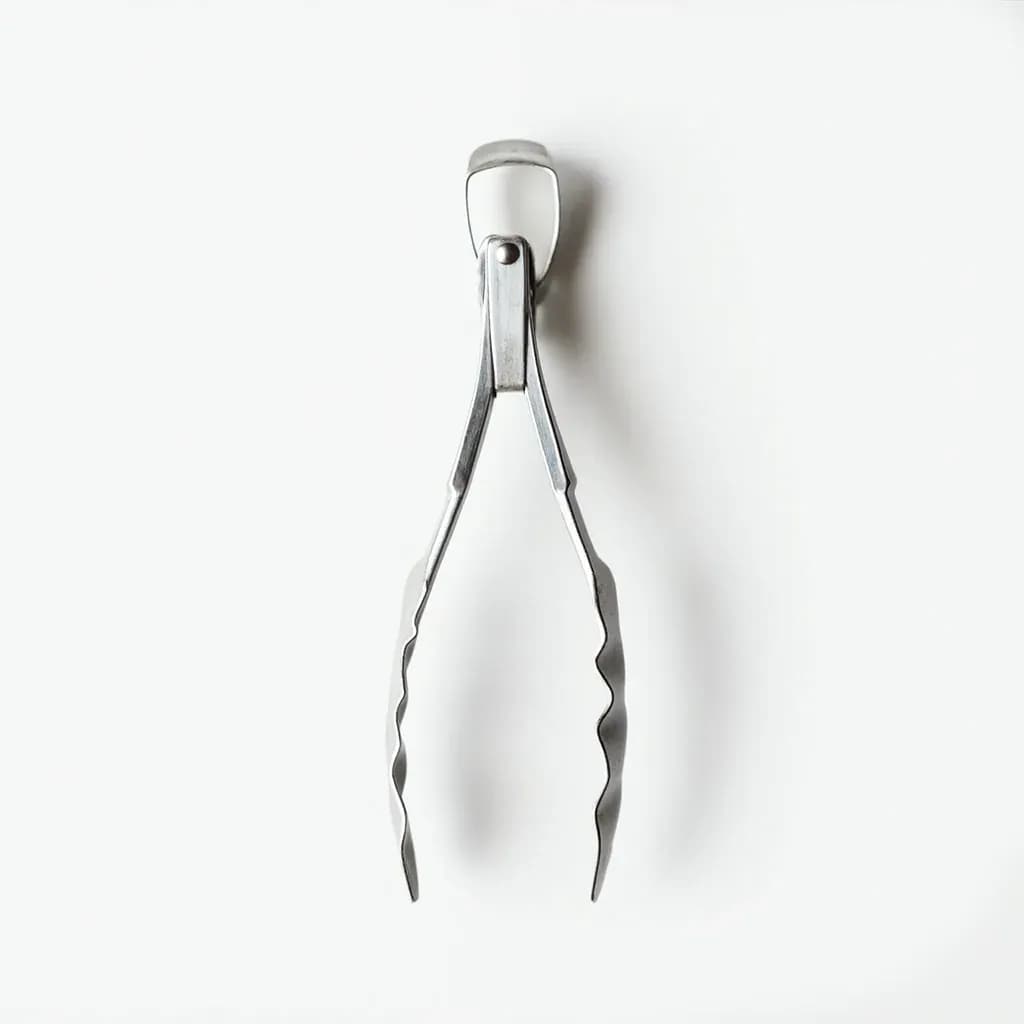
Fish Tongs
Wide, flat-bladed tongs for lifting and turning delicate fish without breaking it.
Fish tongs have broad, flat or slotted ends designed to cradle a fillet or whole fish so it can be turned and lifted without falling apart. The wide gripping surface spreads support across delicate flesh that regular tongs would tear. They are used at the grill, pan or fryer to handle fish gently and to plate it cleanly.
Fish tongs are a specialized lifting tool designed around the particular fragility of cooked fish. Where standard kitchen tongs meet at narrow, often scalloped tips that concentrate force on a small area, fish tongs close on broad, flat, slotted paddles—essentially a hybrid of tong and spatula—that distribute pressure across several square inches of flesh. That geometry is the whole point: a delicate poached salmon or grilled branzino will buckle, split, or shed its skin under the pinching force of an ordinary pair of tongs, but a wide paddle slides beneath and cradles it.
The tool is more common in professional fish cookery and European kitchens than in American home pantries, which is why many cooks discover it only after years of mangling whole fish with a regular pair of tongs or two slotted spoons. The modern slotted fish-clamp form is often credited to the German brand Rösle and similar European makers around the 1990s, though the basic idea of broad paddles for handling fish is older. A good pair feels almost like an extension of your hand: the long handles keep you away from heat and liquid, the slots drain broth and oil, and the spring tension is light enough that you can close the tongs with one hand while steadying the fish with a spatula in the other.
Modern fish tongs are most often stainless steel, with perforated or slotted paddles in either a narrow European style or a broader American style. They sit alongside the fish spatula as one of two tools worth owning if you cook whole fish more than a few times a year; the rest of the time, they live in a drawer and wait patiently for the next whole trout or side of salmon.
Alternatives
Types & varieties
The classic European style (Rösle, Matfer, Wüsthof); long, narrow, perforated paddles; ideal for poaching and court-bouillon work
Broader, more spatula-like heads (RSVP, OXO); better for lifting whole roasted or grilled fish off a sheet pan or grill
Plastic or silicone tips for use on nonstick pans where metal is forbidden; lower heat tolerance than metal
Angled handle keeps the hand away from high heat when grilling or frying
Some models (Dreamfarm Clongs, OXO Good Grips) fold between spatula and tongs; versatile but less specialized
16-inch or longer versions used in restaurant fish stations and poach setups
Choosing the Right Pair
Most cooks who buy fish tongs end up wishing they had thought harder about which style matched the kind of fish they actually cook. A narrow, long European model—Rösle, Matfer, Wüsthof—excels at sliding under a whole poached salmon in a fish poacher or court-bouillon: the length reaches deep into the pan, and the narrow head slips under the spine without scraping the sides. The broader American style, the kind sold by OXO and RSVP, shines for sheet-pan and grill work, where you are transferring whole fish or large fillets to a platter and want maximum surface area supporting the flesh. If you only ever cook on a nonstick surface, a nylon-headed pair avoids scratching the coating, though you give up the heat tolerance of metal. For high-heat grilling, an offset handle keeps the hand farther from the fire and is worth the extra cost.
- Cook mostly poached or sous-vide whole fish → narrow European style, 12 in or longer
- Cook mostly roasted or grilled whole fish → broader American style with a wider head
- Use nonstick pans → nylon or silicone-tipped model, heat-rated to roughly 400°F (200°C)
- Grill often over open flame → offset handle to protect your hand from conducted heat
- Want one tool that does many jobs → combination spatula/tongs (Dreamfarm Clongs, OXO)
- Look for a one-piece stamped head and a solid rivet—the pivot spring is the usual failure point on cheaper models
Common uses
Tips & pitfalls
- Always support the fish at its thickest, sturdiest point—usually just behind the gills or at the belly cavity. Pinching the tail or thin tail meat crushes it.
- Slide one paddle under the fish before closing the other on top; do not try to grip a fish from the sides like a sandwich.
- Pat the fish dry with a towel before lifting—wet fish slip out of even the best tongs.
- For whole poached fish, let excess liquid drain through the slots for a few seconds before transferring to a platter.
- Avoid using standard straight-handle fish tongs over a flaming grill—the long metal conducts heat back to your hand. Use an offset-handle or insulated version instead.
- Do not use them to lift heavy cast-iron skillets or roasts; the flat paddles can bend under loads they were not designed for.
- If the fish is too large for your tongs, reach for two spatulas or a fish basket instead of forcing one oversized grip.
- Lock the tongs closed when storing so the spring does not fatigue over time, and rinse and dry them after contact with saltwater or brine to prevent pitting on lower-grade stainless.
Good to know
- Type
- Specialized kitchen tongs with wide, flat, slotted blades designed for handling whole fish and large fillets
- Primary material
- Stainless steel (most common); some have silicone-coated or nylon heads for nonstick cookware
- Typical length
- 10–12 in (25–30 cm) for home use; 16 in (≈40 cm) and longer for commercial kitchens
- Mechanism
- Scissor-like pivot with spring tension; many have a finger-loop lock at the handle end
- Origin
- The modern slotted fish-clamp design is often credited to the German brand Rösle and similar European makers around the 1990s
- Key advantage over regular tongs
- Distributes pressure over a wide surface, preventing the flesh from breaking or puncturing
- Care
- Dishwasher-safe on stainless versions; hand-wash and dry to prevent water spots and pitting, especially after saltwater or brine contact
- Storage
- Drawer, magnetic strip, or hanging loop; lock closed so the spring does not fatigue
- Price range
- $15–$60 for home use; $40–$120 for professional/commercial grades
- Skill level
- Beginner-friendly; one of the easier specialty tools to master
Also called
fish spatula tongs · flat-blade tongs
Related

Peeler
Swift blade for stripping skin off fruit and vegetables

Grater
Sharp-toothed surface for shredding cheese and vegetables

Microplane
Ultra-fine rasp for citrus zest, garlic, and hard cheese

Mixing Bowl
All-purpose bowl for combining, whisking, and tossing

Whisk
Looped wires that beat air into eggs, cream, and sauces

Spatula
Flat blade for flipping, lifting, and scraping

Slotted Spoon
Pierced spoon that lifts solids and drains the liquid behind

Wooden Spoon
Gentle, heat-friendly spoon for stirring anything