Prep Tools
Flat Grinding Stone (Sil Batta)
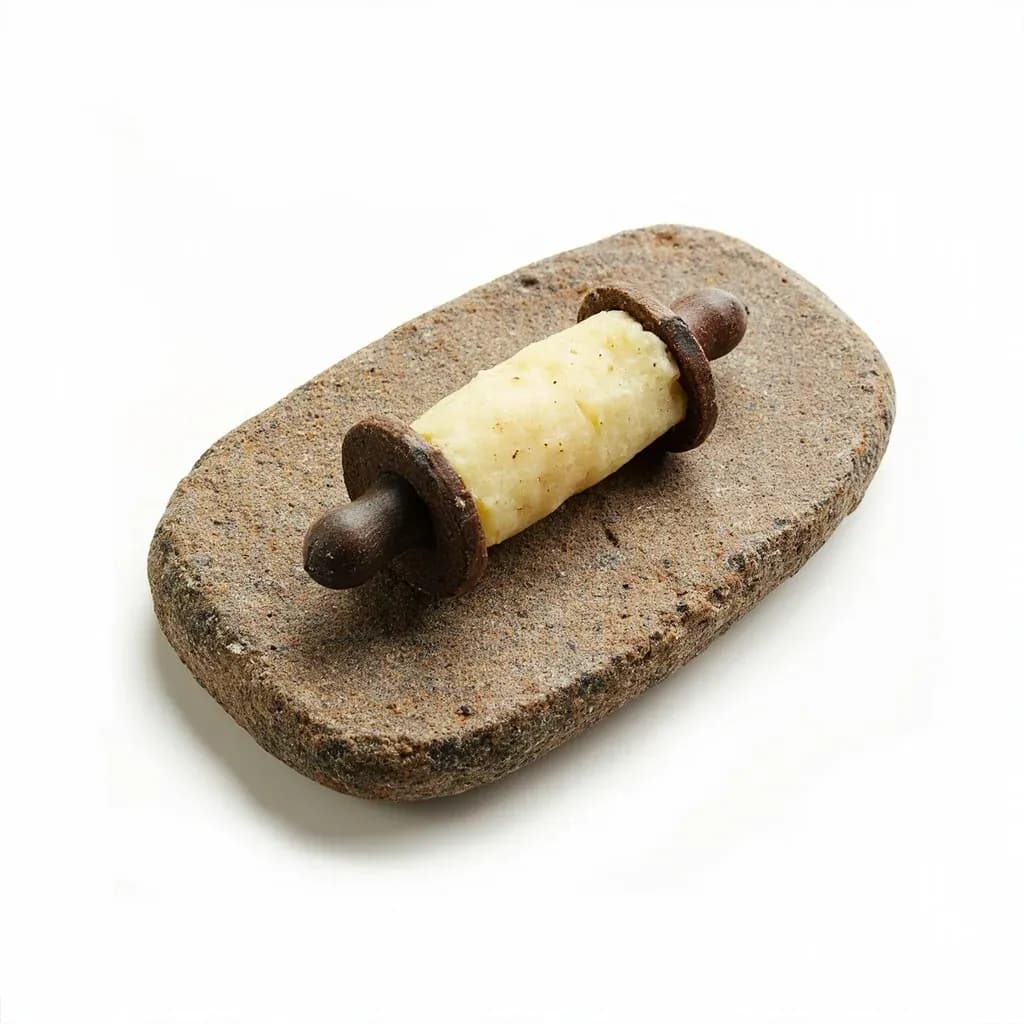
A flat stone slab and roller used in South Asian kitchens to crush spices and grind wet masala pastes.
A sil batta is a traditional Indian grinding set of a heavy flat stone base and a cylindrical hand stone rolled and pressed across it. Cooks use it to crush whole spices and grind soaked ingredients into coarse, aromatic wet masala pastes. The rough stone surface bruises ingredients rather than chopping them, releasing oils that a blade or blender cannot match.
The sil batta is the traditional South Asian grinding pair: a heavy, flat stone slab (the sil) on which a cook rolls a cylindrical stone weight (the batta) to crush and smear ingredients into a paste. Its action is closer to kneading than to chopping — the rolling, shearing motion breaks cell walls and emulsifies wet mixtures in a way that pounding cannot replicate, which is why it has survived in kitchens long after the blender arrived.
What sets it apart from an electric grinder is friction heat. The stone-on-stone rolling generates very little warmth, so volatile aromatics in ginger, garlic, green chili, curry leaves, and fresh coconut survive the grind. Many South Indian and Maharashtrian cooks insist a sil-batta paste tastes brighter and more alive than the same mixture processed in a blender jar, and they are not wrong.
A working sil batta is carved from fine-grained granite, dense and slightly porous so the surface grips the food rather than skating under it. Marble versions exist in some regions but are smoother, lighter, and less effective at the shearing job. New stones are seasoned before first use, and throughout their working life they are cleaned with water alone — never soap — because the porous surface holds onto flavor.
Alternatives
Types & varieties
The classic and most common form; dense, heavy, slightly rough surface that grips ingredients and shears them cleanly.
Smoother and lighter than granite; favored where marble is local, but it can be slippery under the batta and wears faster with regular use.
Some regional stones have shallow grooves or a slightly concave center that keeps wet pastes from running off the slab.
Compact (~15 cm) version sold for urban kitchens; sized for garlic-chili paste and single-batch chutneys rather than family-scale cooking.
A large, often two-person stone used traditionally for idli and dosa batter and for grinding big batches of wet masala.
How it differs from a mortar and pestle (and a wet grinder)
The sil batta is frequently lumped in with the mortar and pestle, but the two tools do different jobs. A pestle works by downward impact, crushing through collision; a batta works by sideways rolling and shearing, which opens cell walls and pulls wet ingredients into a smoother, more emulsified paste. For ginger-garlic, fresh coconut, and green chili, that rolling action is what gives a sil-batta paste its signature texture. A wet grinder, by contrast, is an electric tilting drum with stones inside, designed for unattended large batches of rice-lentil batter; it cannot crush a single chili efficiently, and a sil batta cannot grind a liter of rice. Imitation ceramic and wooden "rolling stones" sold in some markets are lighter and smoother than granite; they crush but do not shear in the same way and are widely considered inferior for serious wet grinding.
- Mortar and pestle: pounding — good for dry spices, whole seeds, and small quantities of tough ingredients.
- Sil batta: rolling and shearing — good for wet pastes where you want a smooth, emulsified texture and bright flavor.
- Wet grinder: electric, large-volume, designed for idli/dosa batter rather than small wet masalas.
- Ceramic or wooden imitations: crush but lack the weight and grit of granite; not recommended where paste quality matters.
Common uses
Tips & pitfalls
- Add a few drops of water — or rely on the ingredient's own moisture — before you start rolling; a dry sil will not grip and the paste will skate around uselessly.
- Tilt the batta slightly forward and use your body weight, not just your wrist; rolling steadily with pressure gives a smoother result than pressing straight down.
- Work in small batches spread in a thin, even layer rather than piling ingredients into a thick mound; the tool performs best when the batta contacts the slab through the food.
- Season a new stone by grinding raw rice with water into a milky slurry, rinsing, and air-drying; repeat two or three times before the first real use.
- Never wash with soap or dish detergent — the stone is porous and will absorb it, then flavor everything you grind afterward; use only water and a stiff bristle brush.
- If a paste ever picks up a gray, stony taste, re-season the surface by grinding a handful of tamarind pulp or sour curd over it, then rinse thoroughly.
- Keep a separate sil for strong-flavored pastes (garlic, chili, onion) if you also grind mild ones like coconut or mint; cross-flavor is the most common complaint from new owners.
- Dry the stone completely before putting it away — prop it on its edge so air circulates on both faces — and oil the surface lightly if you live in a humid climate, to discourage mildew.
Good to know
- Origin
- Indian subcontinent; in continuous domestic and professional use for centuries, and a historical precursor to the modern electric wet grinder.
- Components
- Two pieces: a flat (sometimes gently concave) stone slab called the sil, and a heavy cylindrical roller called the batta.
- Traditional material
- Fine-grained granite, chosen for hardness and slight porosity; marble versions exist but wear faster and tend to be slippery.
- Typical slab size
- Roughly 20–30 cm (8–12 in) long and 12–18 cm (5–7 in) wide for home use; commercial and floor-standing versions are considerably larger.
- Typical roller size
- Cylindrical batta around 15–20 cm (6–8 in) long with rounded ends, about 4–6 cm in diameter.
- Mechanism
- Rolling and shearing rather than pounding: the batta is pushed back and forth over ingredients on the sil, crushing and smearing them at the same time.
- Heat generation
- Very low friction heat compared with blade grinders, which preserves volatile aromatics in wet masalas.
- Best for
- Wet grinding of pastes — ginger-garlic, green chili, fresh coconut, mint-cilantro-curry-leaf chutney, poppy and melon seeds, small-batch masalas.
- Not ideal for
- Large volumes, very dry spices, or extremely hard whole seeds (e.g., nutmeg); those jobs belong to a mortar and pestle or an electric grinder.
- Regional names
- Sil batta (Hindi/Urdu), sil-batta (Gujarati/Marathi), pata-varat (Tamil), raallu-gunta (Telugu), ammi-kallu (Kannada, usually the large floor-standing household stone).
Also called
Stone Spice Grinder · Sil Batta · Sil Lodha
Related

Peeler
Swift blade for stripping skin off fruit and vegetables

Grater
Sharp-toothed surface for shredding cheese and vegetables

Microplane
Ultra-fine rasp for citrus zest, garlic, and hard cheese

Mixing Bowl
All-purpose bowl for combining, whisking, and tossing

Whisk
Looped wires that beat air into eggs, cream, and sauces

Spatula
Flat blade for flipping, lifting, and scraping

Slotted Spoon
Pierced spoon that lifts solids and drains the liquid behind

Wooden Spoon
Gentle, heat-friendly spoon for stirring anything