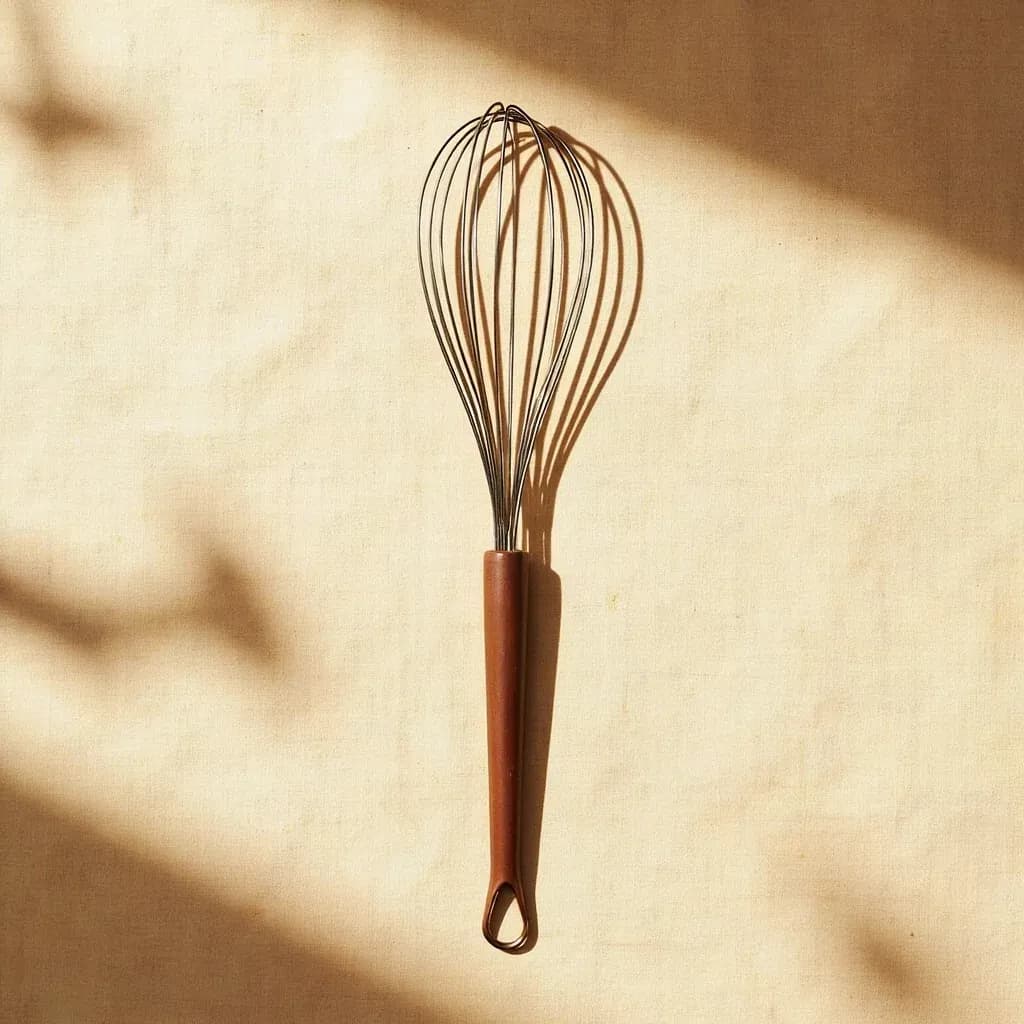
Prep Tools
Flat Whisk
Flattened wires in one plane that hug the bottom of a pan, the whisk for roux and gravy where you must scrape fond while stirring without a deep bowl getting in the way.
A flat whisk replaces the rounded wire cage of a balloon whisk with a row of straight wires arranged in a single flat plane. Where a balloon whisk is shaped to plunge into a deep bowl and pull air through liquid, the flat whisk is built to lie flush against the bottom of a shallow pan. Every stroke is simultaneously a stir and a scrape, which is why the tool lives in the hands of cooks making roux, pan sauces, and gravies. Its flat profile reaches into the corners of a sauté pan, saucier, or even a square grill pan, and makes direct contact with fond that a round whisk would simply ride over.
The flat whisk is a contact tool rather than an aerator, and that distinction is what makes it useful. Its job is to keep starch, fat, and liquid moving across the pan bottom while continuously lifting the browned bits that give a pan sauce its flavor. That is why it belongs in the same pan the meat was seared in: it can disperse butter or a flour-and-water slurry into a hot pan while scraping fond at the same moment, accomplishing in one motion what would otherwise need a wooden spoon plus a separate whisk. The trade-off is real — it cannot hold liquid, whip air, or fold in a deep bowl — so it is a specialist, not a replacement for the balloon whisk in your drawer.
Buy one alongside, not instead of, a balloon whisk, and reach for it whenever the cooking vessel is shallow, wide, or oddly shaped. A 25–30 cm model with three to five flat stainless wires is the workhorse; a silicone-coated head is worth seeking out if you cook on nonstick or enameled cast iron.
Alternatives
Types & varieties
The classic 3–5 flat-wire shape; the everyday workhorse for roux, gravy, and pan sauces.
A single flat wire coiled into a tight flattened-spring loop; flexible, and well-suited to curved pan bottoms.
A broader working end for large skillets, griddles, and sheet-pan deglazing jobs.
Flat wires wrapped or coated in silicone; safe for nonstick and enamel without scratching.
Wires set at a slight angle to the handle for better knuckle clearance against a tall pan rim.
How to move it
The motion is the opposite of a balloon whisk's. A balloon whisk wants you to whip in circles and lift; a flat whisk wants you to stay down and sweep.
- Hold the whisk so the wires lie flat against the pan bottom — a tilted, balloon-style grip defeats the geometry.
- Use small, brisk side-to-side or figure-8 strokes rather than wide circular ones; this keeps every wire in contact with the surface.
- Apply light downward pressure so the wire edges actually scrape the fond, not just stir the liquid above it.
- Resist the urge to lift the whisk between strokes; the contact is what does the work.
Choosing the right size and head
Match the whisk's working width to the pan's interior, not to the recipe's volume.
- A 10–12 cm working end fits most 25–30 cm skillets and sauciers; this is the default to buy first.
- For pans wider than 30 cm, griddles, or sheet pans set over two burners, choose a wide flat whisk — a narrow one leaves streaks of unmixed flour or starch along the edges.
- If you cook on nonstick, enameled cast iron, or porcelain, pick a silicone-coated head; the wire edges are sharp enough to mark soft surfaces over time.
- An offset head is worth it if your sauté pan has a tall, straight rim that would otherwise knock against your knuckles.
Common uses
Tips & pitfalls
- Don't try to whip cream or egg whites with it — the flat profile holds almost no liquid and cannot incorporate air.
- Rinse under hot running water immediately after use; flour- and starch-based mixtures dry rock-hard in the wire joints.
- Add slurry or cold liquid a little at a time and keep moving — the flat whisk has nowhere to hide lumps.
- If wires loosen over time, gently bend them back into a single plane; never twist them, which misaligns the flat geometry and ruins contact.
- For very wide pans or griddles, reach for the wide flat whisk; a standard one leaves streaks of unmixed flour along the edges.
- Wood-handled versions should not be left soaking; the tang will swell and loosen from the head.
- Dry between the wires after washing to prevent water spots and tarnish on stainless versions.
Good to know
- Also known as
- Roux whisk, pan whisk, gravy whisk
- Origin
- Modern Western kitchen tool, common in French and American cookware from the late 20th century onward; not tied to a single inventor
- Construction
- Multiple flat stainless-steel wires arranged in a single plane, joined at both ends to a handle
- Wire count
- Typically 3–5 flat wires, sometimes with thinner cross-wires for added stiffness
- Handle material
- Stainless steel, wood, or heat-resistant polymer
- Typical length
- 25–30 cm (10–12 in) overall; working end roughly 10–15 cm
- Best paired with
- Shallow skillets, sauté pans, saucier pans, and square or wide pans where a balloon whisk cannot reach
- Care
- Dishwasher-safe in stainless versions; rinse immediately and dry between the wires to prevent water spots and tarnish
- Not for
- Aerating egg whites, whipping cream, or any task needing volume and air incorporation
Also called
roux whisk · gravy whisk · flat coil whisk
