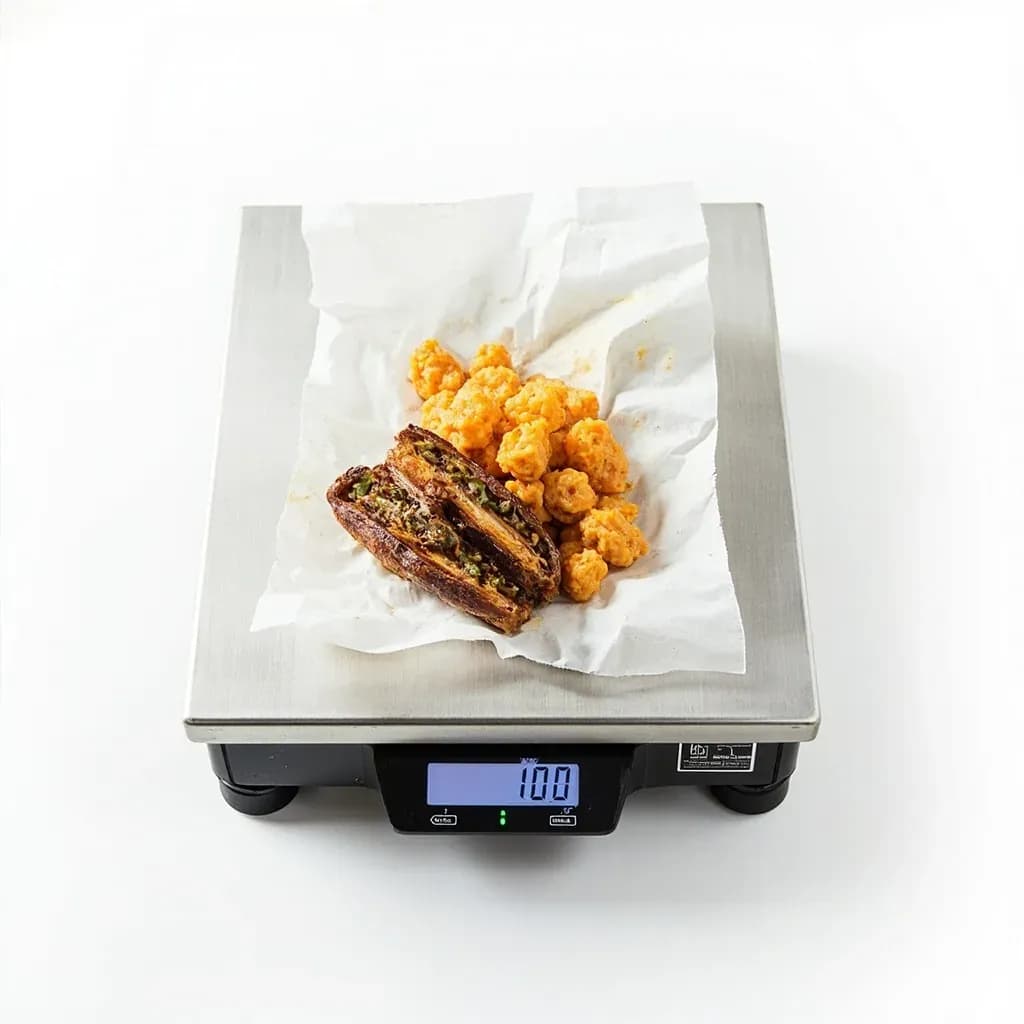
Prep Tools
Receiving Floor Scale
A large heavy-duty platform scale for weighing bulk deliveries, sacks, and full containers.
A receiving floor scale is a low, sturdy platform scale built to weigh heavy bulk items like sacks of flour, crates of produce, and full kegs or drums. Kitchens and producers use it at the loading dock to verify delivery quantities and to measure large batches by weight. Its rugged platform handles hundreds of kilograms with a clear digital readout.
A receiving floor scale is the back door's truth-teller. Physically it is a heavy steel or stainless platform, with sides ranging from about two feet on a compact drum scale up to roughly five by seven feet for pallet and drum work, sitting low to the floor (or flush in a pit) with one or more load cells underneath and a digital indicator on a column, wall, or desk nearby. You roll a sack, crate, drum, or loaded pallet onto the deck, read the weight, and either accept the delivery or send the driver back to the reweigh. In a working kitchen it is less a gadget than a fixed piece of receiving infrastructure — the one tool that quietly determines whether your food cost matches the invoice.
The argument for owning one is arithmetic, not romance. A two to three percent shortfall on a single produce or meat delivery is invisible to the eye but devastating to margin — such a discrepancy can quietly erase a week's profit. A calibrated platform scale catches the systematic under-weights, the wet corrugated case that has picked up moisture on the truck, the supplier who rounds down on every ticket. The 'receiving floor scale' is really a job description — capacities run from 500 lb bench-top units to 10,000 lb pit-mounted behemoths — but for most restaurants and small producers, a 1,000–3,000 lb stainless platform with a remote indicator and NTEP certification is the sweet spot.
What separates a floor scale from a kitchen bench scale is purpose-built toughness: a deck that takes a rolling hand truck, a load cell rated for thousands of cycles, a sealed indicator you can wipe down, and an optional printout or software feed that ties each weight to a purchase order. Pick the wrong capacity or the wrong deck size and the unit becomes a bottleneck; pick the right one and it disappears into the workflow.
Alternatives
Types & varieties
Flat open deck, the standard receiving-floor workhorse; available in many sizes and capacities
Side rails keep pallets and carts from rolling off; very low deck height to minimize lifting
Slim platform sized for standard GMA pallets (48 × 40 in) and pallet jacks, often with fork pockets
Smaller square platform sized for 30- and 55-gallon drums, totes, and bus tubs
Long, low platform that handcarts, trolleys, or pallet jacks roll across without lifting
Installed flush with the floor for cart roll-on access and to free up walkway space
Smaller units with built-in wheels and a handle for moving between stations
Old-style lever-and-weight design, still in use in some older facilities; needs no power but offers lower resolution
Receiving models with piece-counting or upper/lower limit alarms for case and portion control
Sizing the Scale to the Job
A floor scale is sized by three numbers, and getting all three right matters more than brand. Capacity should be roughly 25–50% above your heaviest realistic single load: if your biggest routine delivery is a 1,200 lb pallet of canned tomatoes, a 2,000 lb scale gives you headroom without making the indicator's resolution too coarse. Resolution — the smallest increment the indicator displays — usually tracks capacity: a 5,000 lb scale that reads in 1 lb increments is fine for pallets but useless for checking a 2 lb case of herbs, which is why many operations pair the floor scale with a smaller bench or counter scale for piece work. Deck size is set by what physically arrives: a 24 × 24 in drum scale handles 30- and 55-gallon containers, a 48 × 40 in pallet scale accepts standard GMA pallets, and anything in between (lugs, milk crates, bus tubs) wants a platform at least 6 in larger than the largest container on every side. Pit-mounting, ramps, and column heights all flow from those three decisions.
The Back-Door Routine
A scale only protects food cost if the receiving team actually uses it on every load. Build the workflow into the delivery path itself — the scale should sit where pallets and hand trucks already stop, not down the hall — and the discipline takes care of itself. A reliable routine runs in five beats:
- Check that the indicator reads zero with nothing on the deck; recalibrate or service if the empty reading drifts
- Tare the dolly, pallet, or tote first if it will travel with the product, so the printed weight is net
- Roll the load on gently — no dropping, no kicking the pallet jack onto the deck
- Wait for the reading to stabilize, then record it against the PO and the driver's ticket
- Discrepancies beyond your policy threshold (often 1–2%) trigger a reweigh with the driver present before the invoice is signed
Common uses
Tips & pitfalls
- Use a legal-for-trade (NTEP or OIML) model if the reading drives what you pay a supplier — non-certified weights can be challenged in a dispute
- Calibrate on a documented schedule (typically quarterly) with traceable test weights, and again after any hard impact or relocation
- Set the scale on a level, rigid floor; soft tile or raised access panels flex and read heavy when a load sits at one corner
- Tare the empty pallet, dolly, or tote first so the net product weight prints on the receiving ticket, not the gross
- Choose stainless decks and IP65-or-better sealed indicators for produce, fish, or beverage areas that get hosed down at the end of shift
- Add a low-profile ramp (4–6 in deck height) so hand trucks and pallet jacks roll on without lifting — it protects both backs and product
- Stay at or below 80% of nameplate capacity for daily use, and never shock-load: dropping a 50 kg sack from 6 in can permanently damage a load cell
- Route the reading to your receiving or inventory software so each weight logs against the PO automatically
- Post a printed or displayed tare chart for common containers (GMA pallet, milk crate, lug, bus tub) to speed up line checks
- Common mistake: relying on a bathroom or kitchen bench scale for case goods — the deck is too small, the capacity too low, and the resolution is wrong for invoicing
Good to know
- Tool type
- Heavy-duty platform scale, typically floor- or pit-mounted, for weighing inbound goods
- Typical capacity
- 500 lb / 250 kg up to 10,000 lb / 4,500 kg; most receiving-area models sit at 1,000–5,000 lb
- Typical platform size
- 24 × 24 in (60 × 60 cm) compact units up to 5 × 7 ft (150 × 210 cm) for pallet and drum work
- Readability
- 0.1 lb to 1 lb (0.05–0.5 kg) depending on capacity — fine for pallets, too coarse for piece work
- Construction
- Stainless or powder-coated carbon steel deck, often with diamond or tread plate; stainless is preferred in wet or food-contact areas
- Display
- Remote digital indicator on a column or wall mount with a large backlit LCD or LED; some models support wireless remote displays
- Power
- AC mains, rechargeable battery, or both; battery-only or battery-backup models allow placement away from outlets
- Connectivity
- RS-232, USB, Ethernet, or Wi-Fi on modern units, linking the reading to inventory, ERP, or receiving software
- Legal-for-trade
- NTEP (US) or OIML (international) certification is required when the reading determines what is paid to a supplier
- Sanitation
- Look for IP65, IP66, or IP68 ingress ratings and NSF-listed models for washdown or raw-produce areas
Also called
Bench Floor Scale · platform scale · dock scale
Related

Peeler
Swift blade for stripping skin off fruit and vegetables

Grater
Sharp-toothed surface for shredding cheese and vegetables

Microplane
Ultra-fine rasp for citrus zest, garlic, and hard cheese

Mixing Bowl
All-purpose bowl for combining, whisking, and tossing

Whisk
Looped wires that beat air into eggs, cream, and sauces

Spatula
Flat blade for flipping, lifting, and scraping

Slotted Spoon
Pierced spoon that lifts solids and drains the liquid behind

Wooden Spoon
Gentle, heat-friendly spoon for stirring anything