Prep Tools
Food Mill
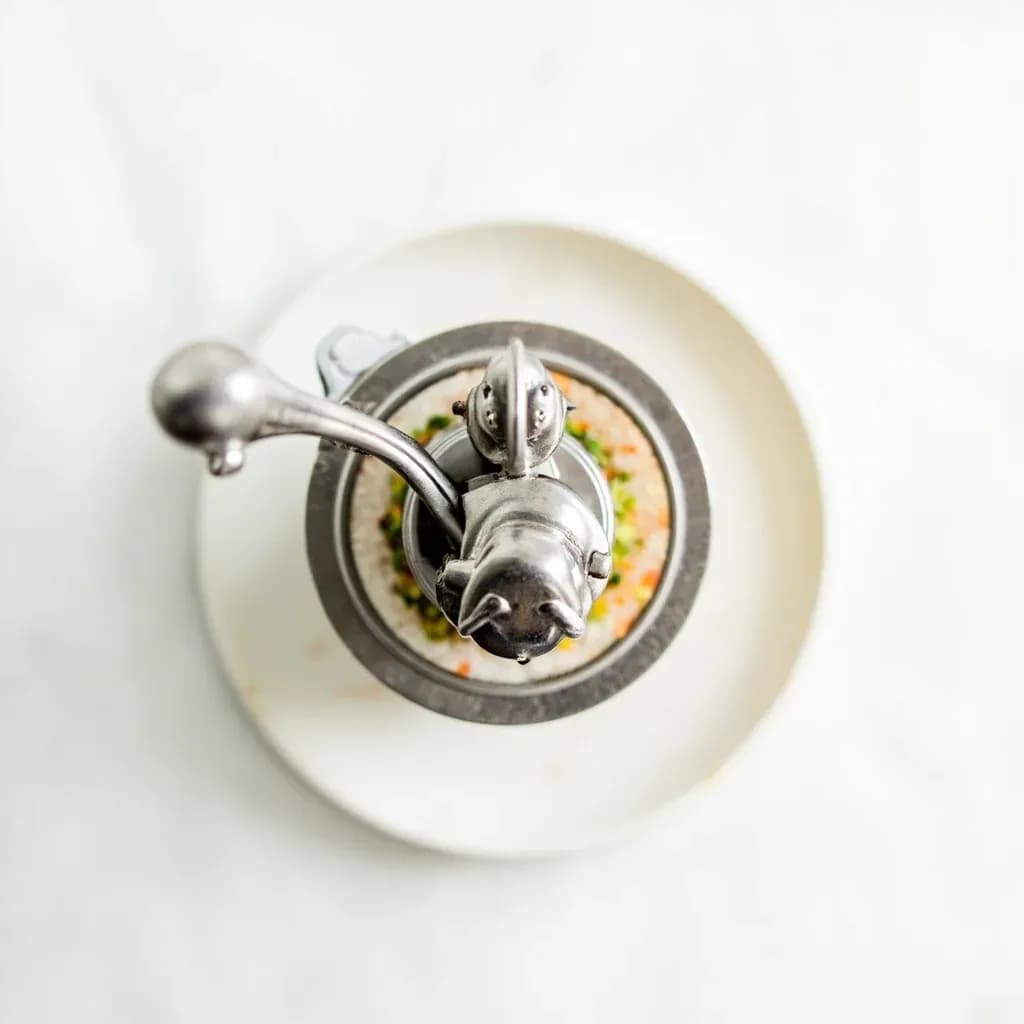
A hand-cranked mill that purees soft foods while straining out skins and seeds.
A food mill is a hand-cranked tool with a perforated disc and a rotating blade that pushes soft cooked food through the holes while holding back skins, seeds, and fibers. It is the classic way to make smooth tomato sauce, mashed potatoes, applesauce, and purees with a fine, even texture. Interchangeable discs let the cook choose coarse or fine results.
The food mill is a hand-cranked sieve-and-blade tool that does what no blender can: simultaneously puree soft cooked food and eject skins, seeds, and fibers in a single pass. Cooked food sits in a shallow hopper, a curved blade sweeps it across a perforated disk, and the puree passes through while refuse stays on top. The result is a velvety sauce, soup base, or applesauce that needs no further straining.
It earned its place in European kitchens in the 19th century and became a fixture of American home canning in the mid-20th century for jobs that are tedious by hand and impossible in a food processor: turning bushels of cooked tomatoes into smooth sauce without seeding them first, or producing seedless berry coulis without pressing through cheesecloth. In France the tool is the moulin à légumes, a staple of both restaurant and home pantries; in the United States the Foley brand in particular became a mid-century classic and remains widely sold.
Today the food mill remains the cleanest tool for straining jobs at home. An immersion blender or food processor will puree soft food but cannot discriminate between flesh and skin — they pulverize everything together. The mill's perforated disk is the key: coarse enough to let pulp through, tight enough to catch seeds and fibers. For canning tomatoes, making applesauce from unpeeled fruit, or finishing a potage to silken perfection, nothing else does the work in one motion.
Alternatives
Types & varieties
The classic form: hopper, curved blade, perforated disk, side handle. Mounts to a bowl or pot with a clamp or stabilizing feet.
A motor turns the blade; used in commercial kitchens or for very large home canning batches. Brands include Robot Coupe.
Larger hopper (often 4–8 qt) built for processing many pounds of tomatoes or apples at once.
Smaller capacity suited to single recipes or tight kitchen storage.
Traditional construction; still sought after, especially for tomato work, but requires careful drying to prevent rust.
Current standard; durable, non-reactive, and on most models dishwasher-safe.
Choosing the Right Disk
Most food mills ship with three disks, and the choice shapes the final texture more than any other decision. Start with the medium disk for everyday work, then reach for fine or coarse as the dish demands.
- Fine (~1 mm): tomato sauce, ketchup, consommé-finished soups, seedless berry coulis, baby food. Produces a silken, almost glossy puree.
- Medium (~1.5–2 mm): applesauce, fruit butters, smooth vegetable soups. The everyday choice — it catches seeds and most skins without making the puree pasty.
- Coarse (~3 mm or larger): rustic applesauce, chunky vegetable purees, pear or quince butter where you want some texture. Also useful as a first pass for very seedy tomatoes, followed by a re-pass through the fine disk.
Food Mill vs. Its Closest Cousins
Several tools look similar but produce distinctly different results. Knowing which one to reach for is half the craft.
- Potato ricer: extrudes food through small holes without a blade, yielding a light, fluffy, almost whipped texture. Milled potatoes are denser and smoother — better for croquettes or cake-like savory bakes than for a classic fluffy mash.
- Chinois or tamis: a cone-shaped fine-mesh strainer worked with a wooden pestle. Slower and more labor-intensive, but produces the silkiest possible texture — what professional kitchens use for consommé and the finest purées.
- Rotary sieve: the commercial ancestor of the home food mill, built on the same principle but larger and motorized (the original Hobart strainer is the classic example).
- Food processor or immersion blender: purees everything indiscriminately. Faster but cannot separate skins and seeds from flesh — that is the food mill's distinctive advantage.
Common uses
Tips & pitfalls
- Always cook the food fully soft first — a mill cannot break down raw or underdone ingredients; it only sweeps and strains what is already tender.
- Match disk to desired result: fine for sauces and coulis, medium for applesauce, coarse for rustic textures or as a first pass for very seedy tomatoes.
- Do not force the crank; let the blade sweep food across the disk at a steady, even pace. Powering through a clog compacts skins into the holes and makes the problem worse.
- Position a wide bowl beneath the mill before you begin, and have a second bowl ready for the dry discards (skins and seeds) — refuse accumulates fast.
- Scrape the underside of the disk periodically; puree collects there, not just through the perforations, and clearing it keeps throughput steady.
- If food is too thick or the disk clogs, stop and clear it, thinning with a splash of the cooking liquid, stock, milk, or water. Never push harder through a jam.
- Hand-wash disks and the blade and dry them immediately to prevent spotting or rust, especially on steel models.
- Do not run extremely fibrous or stringy foods (rhubarb strings, celery fibers) through the mill — they will wrap around the blade and clog the disk.
Good to know
- Operation
- Hand crank rotates a curved blade that sweeps cooked food across a perforated disk; puree passes through, refuse stays behind
- Typical capacity
- 1.5–2 qt hopper for home models; canning-size mills hold 4–8 qt
- Interchangeable disks
- Most models include three — fine (~1 mm), medium (~1.5–2 mm), and coarse (~3 mm)
- Mounting
- Clamp arm or stabilizing feet secure the mill over a bowl, pot, or rim
- Alternate names
- Moulin à légumes (French); purée mill; sauce mill
- Construction
- Modern mills are stainless steel; vintage models are tin-plated steel or cast iron, sometimes with wooden hoppers
- Origin
- Mechanical vegetable mills documented in 19th-century European kitchens; widely adopted in American home canning mid-20th century
- Closest relatives
- Potato ricer (extrudes without a blade, fluffier result); chinois/tamis (cone strainer with pestle, silkiest result); rotary sieve (commercial ancestor)
Also called
Food Mill / Pepper Roaster · Mouli · Passe-Vite
Related

Peeler
Swift blade for stripping skin off fruit and vegetables

Grater
Sharp-toothed surface for shredding cheese and vegetables

Microplane
Ultra-fine rasp for citrus zest, garlic, and hard cheese

Mixing Bowl
All-purpose bowl for combining, whisking, and tossing

Whisk
Looped wires that beat air into eggs, cream, and sauces

Spatula
Flat blade for flipping, lifting, and scraping

Slotted Spoon
Pierced spoon that lifts solids and drains the liquid behind

Wooden Spoon
Gentle, heat-friendly spoon for stirring anything