Prep Tools
Fufu Mortar and Pestle
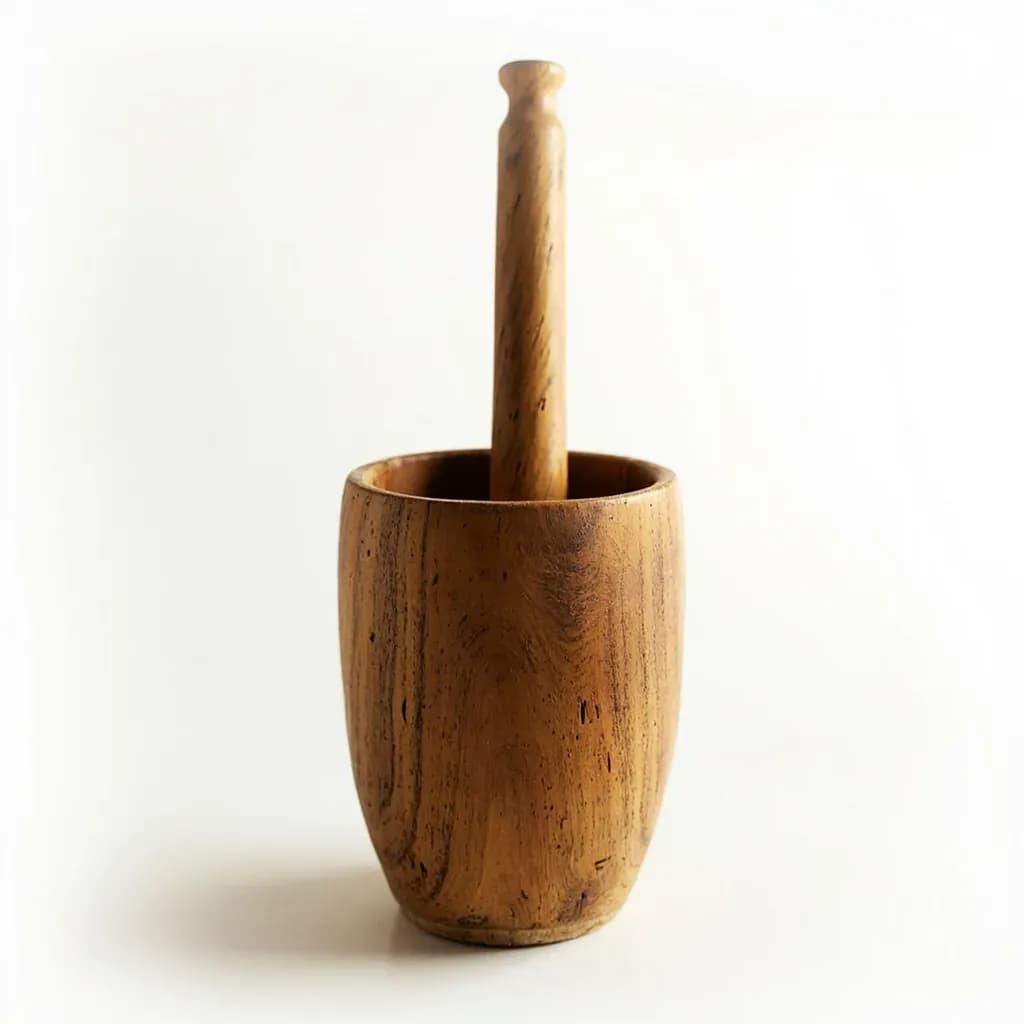
A tall wooden mortar and long pestle for pounding boiled tubers into smooth fufu.
A fufu mortar and pestle is an oversized wooden set, with a deep standing mortar (woduro) and a long, heavy pestle (woma), used across West Africa to pound boiled cassava, yam, or plantain. One person pounds with the tall pestle while another turns and folds the dough between strokes until it becomes smooth, stretchy fufu. The hard wood and depth let the cook apply forceful, repeated blows without splashing.
The fufu mortar and pestle is a tall, heavy wooden grinding set built for one specific job: turning boiled starchy tubers — cassava, yam, plantain, cocoyam — into the smooth, elastic dough that accompanies soups and stews across West and Central Africa. The mortar is carved from a single hardwood log, traditionally iroko or mahogany, standing two to three feet tall with a deep, flared bowl; the matching pestle is a club-like shaft four to six feet in length, sized so the working end can be lifted and dropped by gravity rather than arm strength. Together the set weighs 15 to 30 kilograms and is built to be operated by two people in a steady pound-and-turn rhythm.
In many communities the largest mortars are family or village heirlooms, passed down for generations, and pounding fufu is a social occasion as much as a culinary one — conversation flows while the pestle falls. The wood matters more than it might appear: the open grain of seasoned hardwood holds a thin film of starch and water that lets the pestle glide over the dough rather than catch and tear it, and cooks insist the result stretches more cleanly than dough worked on metal. Modern electric fufu machines have spread in cities, but they have not displaced the traditional mortar, partly because the cadence of the pounding is part of how the dough is shaped.
Alternatives
Types & varieties
Carved from one hardwood tree; the most authentic form and the one most cooks insist produces the best fufu.
Modern, lighter, and easier to sanitize; common in urban markets, though some cooks find the dough tears more easily on metal.
Shorter and more squat with a wider bowl; doubles for banku and kenkey as well as fufu.
Very tall, narrow profile built for deep pounding of large batches of cassava or yam.
Extra-large mortars, sometimes a meter tall, owned by families or villages and shared during gatherings and ceremonies.
A much smaller version, often with a separate short pestle, used for grinding dried chilies, spices, and seed pastes.
Why the wood matters
A seasoned hardwood mortar is not just a container — it is part of the tool. The open grain of the wood holds a thin film of starch and water that helps the pestle glide over the dough rather than catch and tear it, and experienced cooks say fufu pounded in a wooden mortar stretches further and snaps back more cleanly than the same dough worked in metal. A new mortar must be broken in: pound boiled plantain or rice in it and discard the result before the first real batch. This seals the grain, removes any woody taste, and gives the surface the slight polish it needs.
The two-person rhythm
Pounding fufu is a conversation between two bodies. The pounder stands over the mortar, lifts the pestle, and lets it fall in a steady beat; the turner stands to the side with a wet hand or wooden spatula and rotates, folds, and pushes the hot mass back under the pestle between strikes. The cadence is a steady pound-and-turn pattern — faster than it looks, and harder to fake. Solo pounding is possible but slow and uneven, because one person cannot both deliver force and reposition the dough quickly enough to keep it from clumping at the bottom.
Caring for a wooden mortar
A well-kept mortar lasts for decades. After each use it should be rinsed with warm water (no soap, which the wood will absorb), scraped clean with a wooden spatula or a wet hand, and set upright in a ventilated spot to dry fully. Standing water in the bowl is the most common cause of cracking, so the mortar should never be left soaking. Metal utensils should be kept away from the interior — a metal spoon wedged against the wall can split the grain.
Common uses
Tips & pitfalls
- Always pound while the tubers are very hot; fufu that cools in the mortar turns rubbery and loses its stretch.
- Wet your hands and the pestle head frequently with water or the cooking liquid to keep the dough from sticking and tearing.
- Let gravity do the work — lift the pestle and let it fall rather than driving it down with arm strength.
- Add boiled pieces gradually; a mortar more than one-third full is almost impossible to pound evenly.
- Stand with feet shoulder-width and knees soft to absorb the impact and protect your back during long sessions.
- Never scrape the bowl with metal — use a wooden spatula or your wet hand, because metal can split the wood grain.
- Let the mortar dry fully after washing; standing water inside the bowl is the fastest way to crack it.
- Season a new wooden mortar before first use by pounding boiled plantain or rice in it, then discard the result.
Good to know
- Origin
- West and Central Africa; used across Ghana, Nigeria, Cameroon, Côte d'Ivoire, and neighboring countries for centuries
- Also called
- Asanka (Ghana), mortier et pilon (Francophone Africa), oduha (Cameroon), and region-specific names across the region
- Primary material
- Single hardwood log — traditionally iroko, mahogany, or other dense tropical hardwoods; cast aluminum and steel are modern alternatives
- Mortar dimensions
- 60–90 cm (24–36 in) tall, with a flared base and an interior bowl roughly 20–30 cm (8–12 in) deep
- Pestle length
- 1.2–1.8 m (4–6 ft), heavy enough to fall under its own weight
- Set weight
- 15–30 kg (35–65 lb) for a wooden set; the mortar alone can weigh 10–20 kg
- Operating method
- A two-person task: one pounds while the other rotates and folds the mass between strikes
- Output
- Smooth, elastic, starchy dough that stretches without breaking
Also called
Fufu Mortar (Woduro) · Fufu Pestle (Woma) · Fufu Pounding Stick · Wooden Grinding Pestle (Tapoli) · Woduro
Related

Peeler
Swift blade for stripping skin off fruit and vegetables

Grater
Sharp-toothed surface for shredding cheese and vegetables

Microplane
Ultra-fine rasp for citrus zest, garlic, and hard cheese

Mixing Bowl
All-purpose bowl for combining, whisking, and tossing

Whisk
Looped wires that beat air into eggs, cream, and sauces

Spatula
Flat blade for flipping, lifting, and scraping

Slotted Spoon
Pierced spoon that lifts solids and drains the liquid behind

Wooden Spoon
Gentle, heat-friendly spoon for stirring anything