Prep Tools
Grain Flaker (Oat Roller)
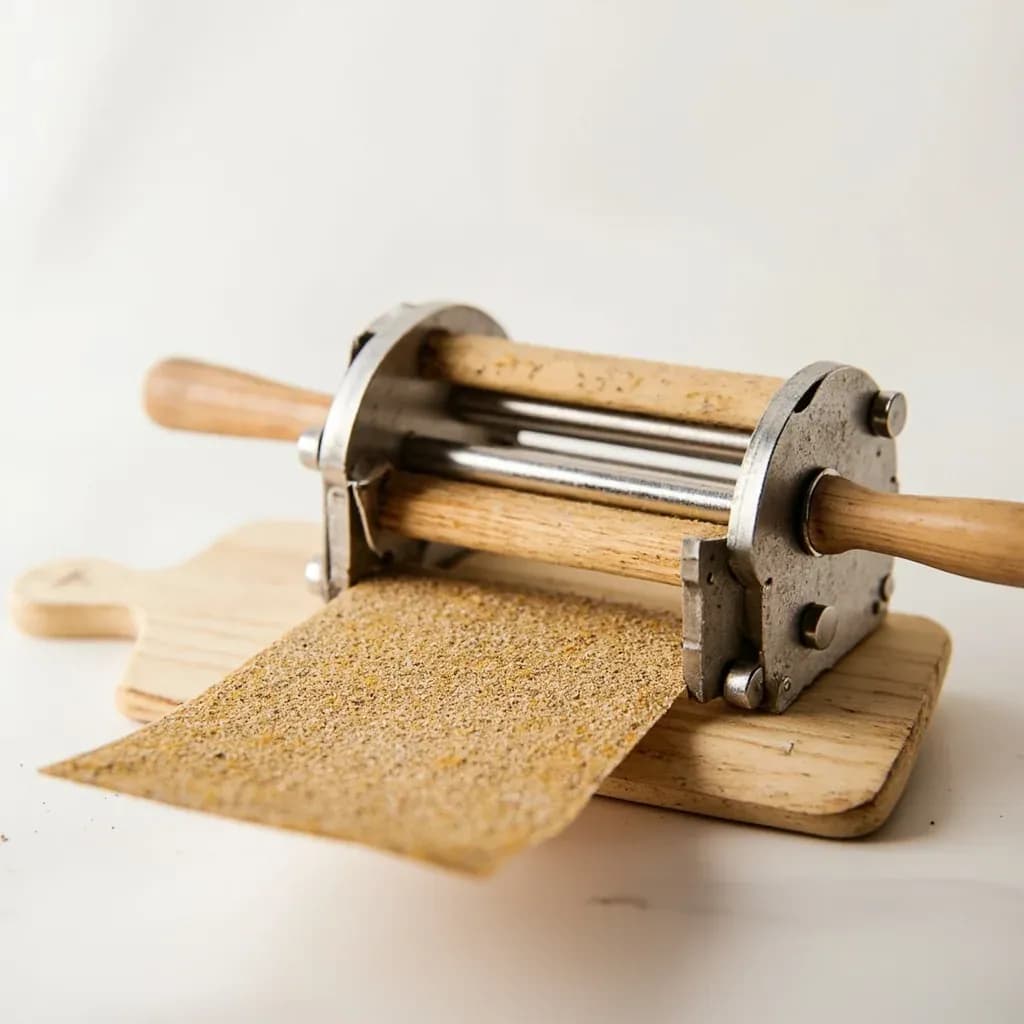
A hand-crank or motorized mill that presses whole grains into fresh flakes like rolled oats.
A grain flaker rolls whole cereal grains between adjustable rollers to produce thin flakes such as rolled oats, rye, or barley. Home bakers and millers use it to make fresh flakes for muesli, porridge, and bread just before use, when flavor and nutrition are at their peak. The roller gap can be tightened or loosened to control flake thickness.
A grain flaker — also called an oat roller, oat flaker, or flaker mill — is a small countertop mill that presses whole, dehulled grains between two smooth rollers to produce fresh flakes. The two rollers turn at matched surface speed, so the grain is gently pressed flat rather than sheared, ground, or pulverized the way it would be in a stone-burr flour mill. This leaves the bran layer largely intact and the germ uncrushed, which is the mechanical reason fresh flakes smell and taste richer than anything from a canister.
For a cook, the practical appeal is freshness and choice. Whole oat groats keep for years in a sealed jar with no special handling; the moment they pass between the rollers, the natural oils in the germ are exposed to air and start to oxidize. The flakes are noticeably more fragrant and nutty, especially in porridge, muesli, and multi-grain breads, but they will not sit on a shelf for a year. You also get to choose the thickness of the flake and which grain to press — oats, wheat, rye, spelt, buckwheat, barley, quinoa, and millet all work well — and you control how recently it was rolled.
The category splits cleanly between hand-crank and electric models. A clamp-on hand flaker is small, quiet, and stores in a drawer; it earns its keep for a household using roughly a pound of oats per week or less. Beyond that, the wrist fatigue and time cost of cranking make an electric countertop unit worth the price, especially if you bake frequently with fresh flakes. Commercial machines with 4-inch-plus rollers exist for bakeries and farm stands, but they are oversized and expensive for most home kitchens.
Alternatives
Types & varieties
Bolts to a thick countertop or table edge; smallest and quietest; good for occasional use and small batches.
Sits on the counter with suction or rubber feet; more portable than clamp models; usually a larger hopper.
Plugs into a wall outlet and rolls continuously via a gear motor; best for households using a pound or more per week.
Single base with interchangeable heads — a stone or steel mill for flour and a flaker head for flakes; examples include Mockmill, Wondermill Harvest, and KoMo.
Larger rollers (4+ inches) and higher throughput, sized for small bakeries and farm stands; rare in home kitchens.
Working with grains beyond oats
Oats are the default grain for any flaker, but the same machine handles a useful range of whole kernels, and each behaves a little differently. Wheat berries, rye, and spelt roll into flakes that are slightly more brittle than oats and work particularly well in soak-method bread doughs and sprouted-grain levains. Buckwheat, quinoa, and millet are gluten-free and press into small, dense flakes that add texture to bread doughs, crackers, and sprinkled toppings — though the smaller seeds need a slightly tighter roller gap and a slower feed to pass through cleanly.
- Keep grains clean and bone-dry; chaff and moisture are the most common cause of jams and sour batches.
- Tighten the roller gap in small increments for tiny seeds like millet and amaranth — they pass through a setting that would just crush an oat groat.
- Run a sacrificial cup of buckwheat, rice, or another gluten-free grain through the rollers after a wheat batch if you bake for someone with celiac disease.
Common uses
Tips & pitfalls
- Always start with clean, fully dried grain; even a trace of chaff or moisture will jam the rollers or sour the batch.
- After any gap adjustment, do a test pass with a tablespoon of grain — the flake should hold together without being powdery or cracked.
- Crank slowly on hand models. Forcing grain through at speed creates dust and heat, which shortens flake life and stresses the mechanism.
- Flake only what you will use in a week; keep the rest of the grain whole in an airtight container and roll fresh each time.
- Store freshly flaked grains in the fridge or freezer — the natural oils in the bran turn rancid within days at room temperature.
- Keep a dedicated brush or small vacuum at the machine. Flour and bran build-up around the hopper attracts pantry moths.
- Avoid oily seeds such as flax, sunflower, and hemp — they smear on the rollers and usually require disassembly to clean.
- Mount clamp models to a real butcher-block edge, not a hollow-counter or thin table; vibration will walk a clamp loose on a flimsy surface.
- Treat the rollers as a matched set. If one is damaged, replace both together to keep the roller gap even.
Good to know
- Also called
- Oat roller, oat flaker, grain crusher, flaker mill
- Primary function
- Presses whole, dehulled grains between two smooth rollers to produce fresh flakes — no grinding or pulverizing
- Roller material
- Stainless steel (most common); some entry models use hardened or coated steel
- Power source
- Hand-crank (clamp-on or freestanding) or electric gear motor on 110/220V
- Roller adjustment
- Adjustable gap typically from about 0.3 mm to 1.5 mm to set flake thickness
- Throughput (hand-crank)
- Roughly 1–1.5 lb (450–680 g) of oats per 10 minutes at a comfortable crank pace
- Throughput (electric)
- Approximately 3–4 lb (1.4–1.8 kg) of oats per minute on mid-sized home machines
- Hopper capacity
- Typically 1.5–2.5 cups (350–600 ml) on most home models
- Compatible grains
- Oats, wheat berries, spelt, rye, barley, triticale, buckwheat, quinoa, millet, amaranth
- Incompatible grains
- Corn, soybeans, sunflower seeds, and other high-oil or very hard kernels — they jam or gum the rollers
- Fresh-flake shelf life
- Best within 3–5 days at room temperature; 2–3 weeks refrigerated; up to 3 months frozen
- Cleaning
- Vacuum or brush the hopper; some roller sets are removable for wiping. Never wash rollers with water unless the manual explicitly says so
- Typical price range
- Hand-crank models roughly $80–$250; motorized countertop units $250–$600; combo mill+flaker units $400–$700
Also called
oat roller · flaking mill · roller mill
Related

Peeler
Swift blade for stripping skin off fruit and vegetables

Grater
Sharp-toothed surface for shredding cheese and vegetables

Microplane
Ultra-fine rasp for citrus zest, garlic, and hard cheese

Mixing Bowl
All-purpose bowl for combining, whisking, and tossing

Whisk
Looped wires that beat air into eggs, cream, and sauces

Spatula
Flat blade for flipping, lifting, and scraping

Slotted Spoon
Pierced spoon that lifts solids and drains the liquid behind

Wooden Spoon
Gentle, heat-friendly spoon for stirring anything