Prep Tools
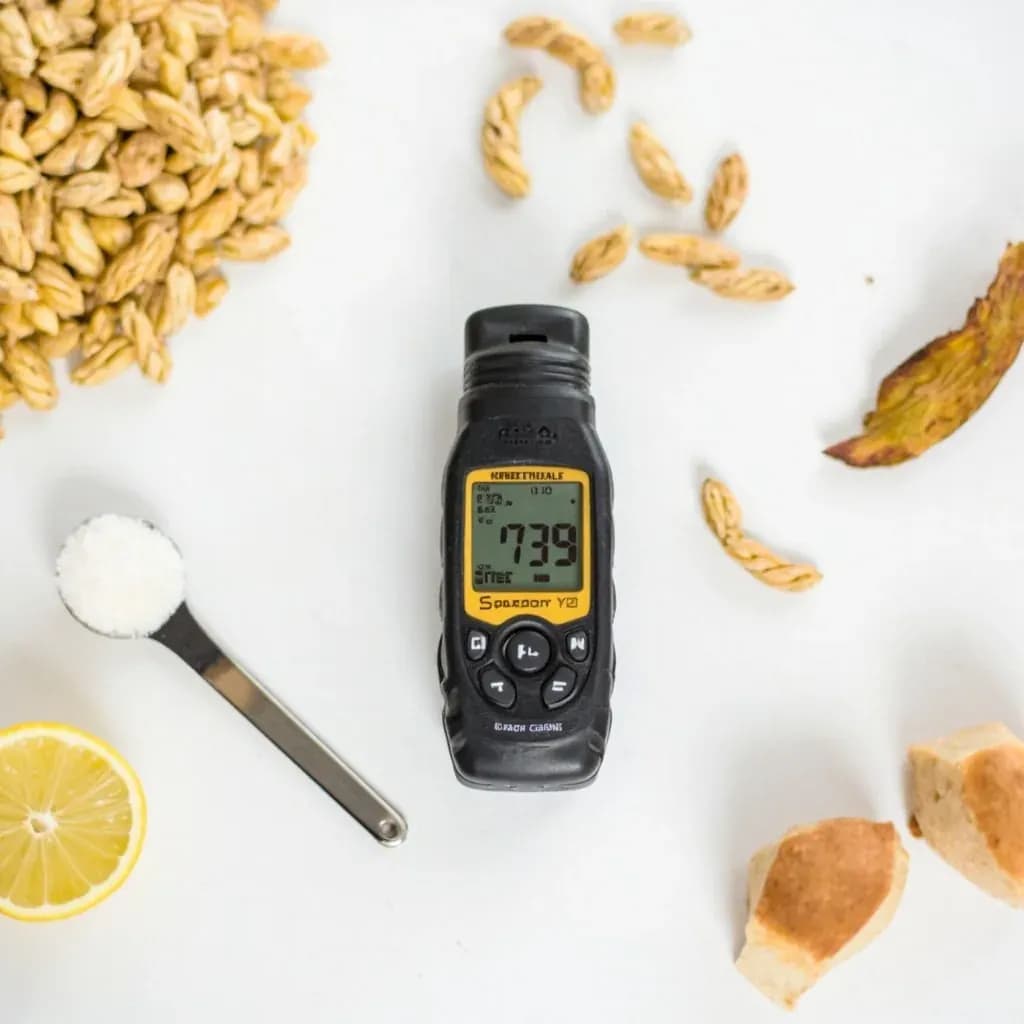
Grain Moisture Meter
A handheld probe that reads the moisture percentage of grains and flours.
A grain moisture meter measures the water content of cereal grains, beans, and flours, usually by inserting a probe or sampling a small amount. It is used by millers, brewers, and serious bakers to confirm grain is dry enough to store safely or hydrated correctly for milling. Accurate moisture readings prevent spoilage and help dial in consistent dough hydration.
A grain moisture meter is a small handheld instrument that quantifies the water content of whole grains, seeds, ground flours, and similar dry goods, typically reading in the 5–40% range. Most kitchen- and farm-friendly units work by one of two principles: pin-type meters pass a tiny electrical current between two metal probes pressed into the sample (electrical resistance drops as moisture rises), while pinless meters read moisture via an electromagnetic field that passes through the sample without piercing it (capacitance). Benchtop and laboratory instruments — halogen moisture balances and NIR spectrometers — are the reference methods that mills and labs use to verify handheld readings.
For a baker, a moisture meter is less about the number itself than about what the number implies for dough hydration and storage. Commercial bread flour is usually labeled at 13.5%–14.5% moisture, but the actual water in your bag shifts the dry mass available to absorb added liquid. A swing of three percentage points in flour moisture changes the dry matter in a 1 kg bag by roughly 25–30 g, enough to move a 65% hydration dough noticeably toward slack or stiff. For a grain grower, miller, or maltster, the meter is a routine tool for keeping cereals below the roughly 14% threshold that separates safe long-term storage from conditions ripe for mold and insect activity.
Handheld units typically run on a 9 V or AA battery, weigh a few hundred grams, and accept either a compression cup of whole kernels or a small cell of flour or meal. The user selects a commodity code — wheat, corn, barley, oats, rye, rice, and so on — because the meter's calibration curve is tuned to each grain's density and electrical behavior. Picking the wrong code can skew a reading by one to two percentage points, which is the single most common error in casual use.
Alternatives
Types & varieties
Two metal pins are pressed into the sample; the reading is based on electrical resistance, which drops as moisture rises. Most affordable, good for whole kernels and rough field use.
Sits on top of the sample and reads moisture via an electromagnetic field; no piercing, less sample damage, useful for bagged grain and inspection.
Combines moisture reading with a measured, compressed sample cup; common for grain elevators and buying stations because test weight matters for grading.
Pre-programmed for a specific commodity — wheat, corn, barley, oats, rye, rice, sorghum, soybean, etc. — selectable on the dial or menu.
Covers a broad list of crops plus oilseeds; some accept user-entered custom calibrations.
Small sample cell designed for ground products (flour, semolina, malt, coffee); reads at lower moisture ranges where whole-grain units are less accurate.
Loss-on-drying balances and NIR spectrometers are the high-precision reference methods used by mills and commercial bakeries to verify handheld readings.
Moisture and the Baker's Percentage
A baker working in true baker's percentages assumes a reference flour moisture — usually 14% — and treats the rest as dry matter that absorbs added water. If the flour in hand is actually 15.5%, the bag contains 1.5 percentage points less dry matter per 100 g than the formula expects, and the dough will slacken. As a workable rule of thumb, adjust dough water by about 1% of flour weight for every 2 percentage points of flour-moisture difference. That single correction often resolves mystery batch-to-batch variation in loaves that look identical on paper but behave differently on the bench.
- Label moisture is a target, not a guarantee — verify it for serious work.
- Whole-grain flours milled at home frequently sit above 15% for the first day or two; test before bagging for storage.
- A 65% hydration dough can swing from open-crumb to tight and tough on a 2-point moisture drift.
Choosing the Right Meter
For a home baker buying one device, a pinless flour tester is usually the most forgiving choice: it doesn't crush or contaminate the sample, it can read through the wall of a thin sealed bag, and it stays accurate on ground products. A pin-type unit is better for a grower or maltster who handles whole kernels by the bucket and needs a quick, cheap reading in the field. A benchtop halogen balance is the right tool for a small mill, bakery lab, or anyone who wants a number traceable to a reference method.
- Pin-type: destructive to the sample, fast, cheap, ideal for whole kernels in the field.
- Pinless: non-destructive, sensitive to surface moisture and to air gaps under the sensor.
- Halogen / NIR: reference accuracy, larger sample prep, lab-grade cost.
Storage Safety and the 14% Rule
Mold growth, respiration heating, and insect activity in stored grain track closely with moisture content. Cereals held at or below roughly 14% moisture stay dormant and stable for months; above 15% the biology wakes up, and above 17% spoilage can run away within days. A moisture meter is the cheapest insurance a grain buyer, maltster, or home miller can buy, because a single wet pocket in an otherwise dry bin can heat the whole lot and ruin it.
- Test subsamples from the top, middle, and bottom of a bin — moisture stratifies.
- Re-test any grain that feels warm or smells faintly sour; both are warning signs of active microbial heating.
- For long storage, dry cereals to 12%–13% if the bin is large or the season is warm.
Common uses
Tips & pitfalls
- Always select the correct grain calibration on the meter — readings can swing by 1–2 points if you use the wrong commodity code.
- Let hot or cold samples come to room temperature before reading; most meters only compensate correctly between roughly 10 °C and 30 °C.
- Test multiple subsamples from different parts of a bag or bin and average them; moisture is rarely uniform in a lot.
- For flour, pack the sample cell consistently — loose packing reads drier than firmly packed flour of the same moisture.
- Clean and dry the pins or sensor surface between samples; residual dust or moisture skews the next reading.
- Re-check calibration with the manufacturer's reference standard or a sealed sample of known moisture every few months; pin contacts can drift.
- Do not crush or grind the sample before testing a whole-grain meter — broken kernels release internal moisture and read artificially high.
- Store the meter in a dry, stable environment; extreme humidity and heat shorten sensor life and battery life.
Good to know
- Primary function
- Measures the percentage of moisture (water) in whole grains, ground flours, seeds, and similar dry goods
- Operating principle
- Pin-type (electrical resistance) and pinless (capacitance) for handhelds; halogen loss-on-drying and NIR for lab reference
- Typical accuracy
- ±0.2% to ±0.5% under calibrated conditions; consumer units often ±0.5%–1%
- Common sample size
- Whole-grain chambers hold roughly 100–300 g; flour/meal cells take 5–50 g
- Safe storage benchmark
- Wheat and most cereals keep well at roughly 13%–14% moisture; spoilage risk rises sharply above 15%
- Typical flour moisture
- Commercial bread flours sit between 13%–15%; stone-milled whole-grain flours can run higher right after milling
- Why bakers care
- A 3-point swing in flour moisture changes the true dry matter in a 1 kg bag by roughly 25–30 g, which materially shifts dough hydration
- Power source
- 9 V or AA batteries on handheld units; AC on benchtop and lab models
Also called
moisture meter · grain tester
Related

Peeler
Swift blade for stripping skin off fruit and vegetables

Grater
Sharp-toothed surface for shredding cheese and vegetables

Microplane
Ultra-fine rasp for citrus zest, garlic, and hard cheese

Mixing Bowl
All-purpose bowl for combining, whisking, and tossing

Whisk
Looped wires that beat air into eggs, cream, and sauces

Spatula
Flat blade for flipping, lifting, and scraping

Slotted Spoon
Pierced spoon that lifts solids and drains the liquid behind

Wooden Spoon
Gentle, heat-friendly spoon for stirring anything