Prep Tools
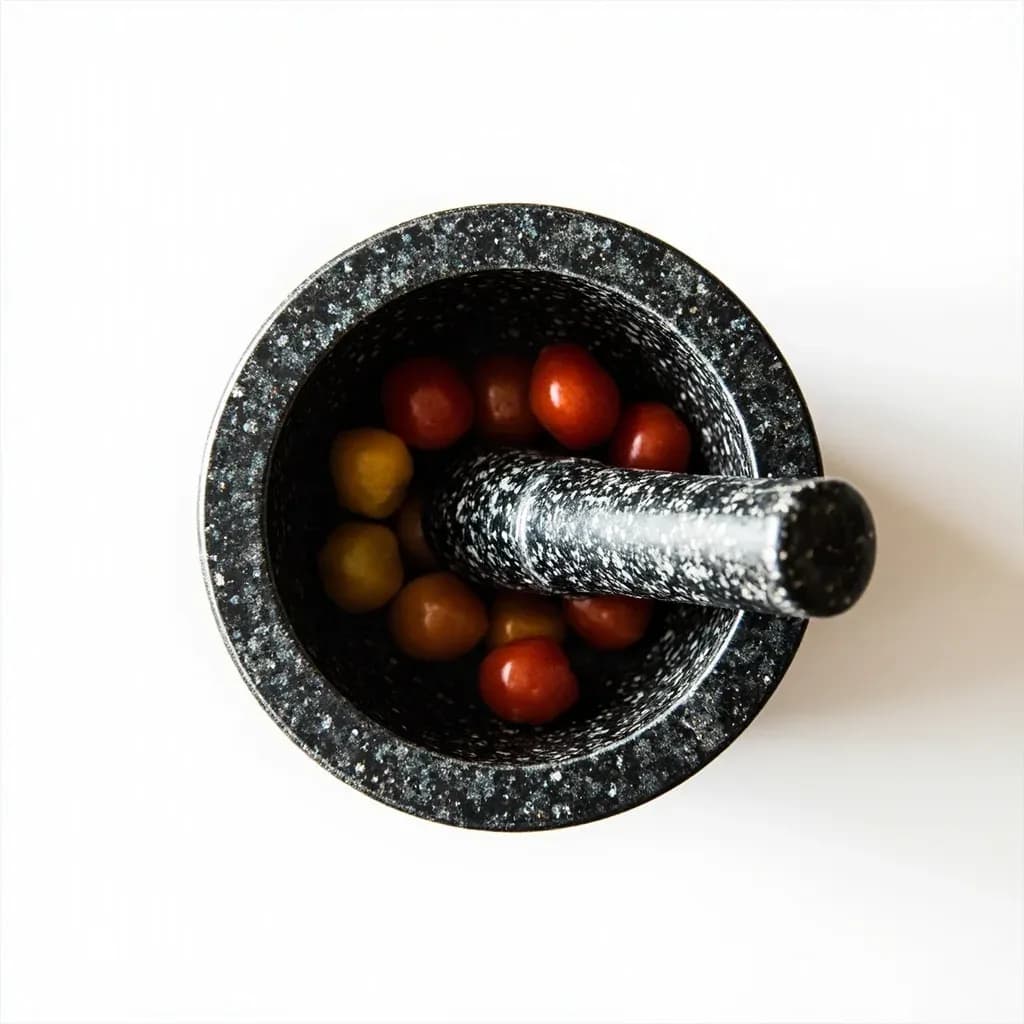
Granite Mortar and Pestle
A heavy stone bowl and club used to pound spices, herbs, and pastes into deeply released flavor.
A granite mortar and pestle is a dense stone bowl with a matching grinding club, used to crush and pound dry spices, herbs, garlic, and pastes. Its weight and rough surface bruise ingredients to release oils and aromas more fully than a blade. It is favored for spice blends, curry pastes, pesto, and grinding delicate threads like saffron.
A granite mortar and pestle is the modern global standard for hand-grinding spices, herbs, and aromatics — a heavy stone bowl paired with a club-shaped stone grinder, used in one form or another since the kitchens of ancient Egypt, Greece, Rome, India, and Mesoamerica. The tool works by fracturing rather than slicing: the rough interior surface grips the ingredient while the weight of the pestle crushes it, breaking cell walls in a way that releases volatile oils and aromatics more completely than a blade-driven grinder or food processor. The result is a coarser, more variable texture and a brighter, more layered flavor in the finished paste or powder.
Granite — a coarse-grained igneous rock of quartz, feldspar, and mica, sitting around 6–7 on the Mohs hardness scale — is chosen for three reasons working in concert. Its mass is the first: a 6- to 8-inch bowl typically weighs 6 to 12 pounds, and that weight does work that arm strength alone cannot. Second, its rough grinding surface actually bites into seeds and pods rather than skating over them. Third, complete chemical inertness — it tolerates hot ingredients, holds no flavor from previous batches, and will not react with acids, salt, or strong aromatics. A quality set is genuinely generational; a chip in the rim is cosmetic, not fatal.
What separates granite from other mortar materials is range. Where marble excels at bruising soft herbs but stumbles on whole spices, and wood and metal have their own niche uses, granite handles both ends of the spectrum — a single cardamom pod and a full batch of Thai curry paste — with equal authority. That versatility is the reason the tool has remained essentially unchanged for several thousand years.
Alternatives
Types & varieties
Traditionally carved from volcanic basalt (cantera) rather than true granite; deeper three-legged bowl with a tejolote pestle; standard for salsa molcajeteada, guacamole, and moles.
Smaller rounded bowl with a wooden-handled stone pestle; the standard tool for som tom, prik gaeng, and other Thai curry pastes.
Granite or soapstone, used with a vertical pounding (not rolling) motion; the everyday tool for ginger-garlic paste and freshly ground whole-spice blends.
Heavier, polished exterior, coarser interior grind surface; sized for laboratory-style single-spice work and widely sold for kitchen use.
Short, stout granite mortar with a chunky pestle; designed for pounding lemongrass, chili, and fermented shrimp paste.
Modern granite sets with silicone or rubber feet to keep the bowl from skating on the countertop during hard pounding.
Sizing and Selection
The single most common beginner mistake is buying a mortar that is too small. A 4-inch bowl will handle a single cardamom pod, but it is useless for a proper pesto or curry paste — there simply is not enough room for the pestle to gain momentum or for ingredients to circulate. Aim for a 6- to 8-inch bowl as the everyday workhorse; a 9- to 12-inch bowl becomes worthwhile only if you regularly make batch guacamole or serve pesto to a crowd. The second most common mistake is buying a set with a wooden or plastic pestle: a wooden pestle only bruises and cannot fracture cumin or coriander, and the texture of finished pastes will be visibly inferior. When shopping, lift the set — a quality granite mortar should feel uncomfortably heavy for its size, and that mass is the entire point of the tool.
- Small (4–5 in): single spices, salt blends, finishing powders. Buy only as a supplement to a larger set.
- Medium (6–8 in): the everyday workhorse — pastes, pesto, curry paste, guacamole for two to four.
- Large (9–12 in): batch work, large pestos, salsa for a party. Heavy enough to stay put on its own.
- Pestle length: short and heavy beats long and light. A 6-inch pestle on a 7-inch bowl is more efficient than a 9-inch pestle on the same bowl — leverage favors compactness.
- Surface finish: the interior should be honed but visibly granular, never glazed. A glassy interior looks attractive and grinds almost nothing.
Granite vs. Other Mortar Materials
Marble and granite look similar and are often sold side by side, but they behave very differently. Marble is similar in density but considerably smoother, so it crushes and smears rather than fractures. A marble mortar is the right choice for delicate herb work — basil into pesto, a small quantity of garlic into aïoli — and the wrong choice for whole-spice grinding, where it leaves you with bruised, oily seeds instead of a clean fracture. Cast-iron and brass mortars appear in some regional cuisines and develop a seasoned patina over time, but they react with acids (lemon, tomato, tamarind) and can lend a metallic note to delicate sauces. Wood mortars are reserved for the gentlest herb bruising; they cannot fracture a coriander seed and they absorb oils and aromatics over time. Granite is the rare material that handles both the brittle and the soft with equal authority.
- Granite: rough surface, hard enough to fracture whole spices, non-reactive — the all-purpose standard.
- Marble: smoother, better for bruising herbs than grinding spices; not ideal for cumin, coriander, or pepper.
- Cast iron / brass: heavy and seasoned, used in some regional cuisines, but reactive with acids and needs careful maintenance.
- Wood: limited to gentle herb bruising; absorbs oil and aroma, cannot fracture seeds.
- Ceramic (suribachi): grooved earthenware, excellent for sesame and small seeds, but a different tool with a different motion.
Seasoning Before First Use
A new granite mortar — particularly the rough-finished sort — arrives with fine grit and dust in the pores of the stone. Grind it out before you cook with it, or you will taste rock dust in your first batch of pesto. The traditional method is simple: a handful of dry white rice, ground to powder and discarded, repeated two or three times until the powder comes out pale and clean. Follow with a tablespoon of coarse salt, ground the same way, which both polishes the surface and seasons it. Rinse briefly with hot water, brush with a stiff non-metallic brush, and air-dry upside down. The mortar is now ready and will hold its seasoning for the rest of its life.
- Step 1: grind a handful of dry rice to powder, discard, repeat until the powder runs clean white.
- Step 2: grind a tablespoon of coarse salt the same way, discard, and rinse briefly.
- Step 3: brush with a stiff brush under hot water; air-dry upside down. Skip dish soap — it can leave a film on rough granite that affects flavor.
- Step 4: never put a newly seasoned or rough-finished granite mortar in the dishwasher; the prolonged soaking and detergent will undo everything.
Common uses
Tips & pitfalls
- Season a new mortar by grinding dry rice to powder, discarding it, and repeating with coarse salt — this removes loose grit and preps the surface.
- Use a downward press-and-twist motion rather than pure rolling; the pestle's weight should do most of the work, and grinding is fracturing, not crushing.
- Toast whole spices in a dry pan until fragrant before grinding; residual heat and brittle structure give a finer, more aromatic result.
- Add ingredients in stages from hardest and driest to softest and wettest — peppercorns, then cumin, then garlic, then herbs — to keep the grind moving.
- Stop and scrape the sides down with a rubber spatula every 30–45 seconds; material clings to the walls and stops the pestle from making contact.
- Do not pound very hard items like whole nutmeg, large ice cubes, or rock candy — these can chip the pestle tip or crack the bowl.
- Skip dish soap on a rough-finished or newly seasoned mortar; hot water and a stiff brush are enough, and soap can leave a film that affects flavor.
- Expect permanent yellow staining from turmeric-heavy pastes — it is cosmetic only and does not affect performance.
- Work in small batches, no more than a quarter to a third of the bowl's capacity; overfilling leads to uneven grind and spills.
- For emulsified sauces like pistou and pesto, add oil in a thin stream while constantly pounding; the rough surface helps the emulsion set.
- Let the mortar rest ten minutes after pouring in very hot toasted spices; sudden extreme heat on cold stone can risk a hairline crack.
Good to know
- Material
- Granite — coarse-grained igneous rock of quartz, feldspar, and mica; Mohs hardness ~6–7.
- Weight
- Roughly 4–25 lb (2–11 kg) depending on size; a 6–8 in bowl typically runs 6–12 lb.
- Pestle
- Solid club-shape, 6–9 in (15–23 cm) long, with a rounded grinding tip and palm-friendly grip.
- Standard sizes
- Small 4–5 in (single-spice), medium 6–8 in (pastes, pesto, curry paste), large 9–12 in (batch guacamole, large pestos).
- Heat tolerance
- Excellent — accepts charred chiles and freshly toasted spices without cracking under normal kitchen thermal shock.
- Reactivity
- Non-reactive with acids, salt, and aromatics; imparts no flavor and leaches nothing.
- Cleaning
- Hand-rinse with warm water, air-dry upside down; no dishwashers, no prolonged soaking.
- Lifespan
- Generational — a quality set will outlast its owner with ordinary care.
Also called
Saffron Grinding Set · Stone Mortar and Pestle · Molcajete
Related

Peeler
Swift blade for stripping skin off fruit and vegetables

Grater
Sharp-toothed surface for shredding cheese and vegetables

Microplane
Ultra-fine rasp for citrus zest, garlic, and hard cheese

Mixing Bowl
All-purpose bowl for combining, whisking, and tossing

Whisk
Looped wires that beat air into eggs, cream, and sauces

Spatula
Flat blade for flipping, lifting, and scraping

Slotted Spoon
Pierced spoon that lifts solids and drains the liquid behind

Wooden Spoon
Gentle, heat-friendly spoon for stirring anything