Prep Tools
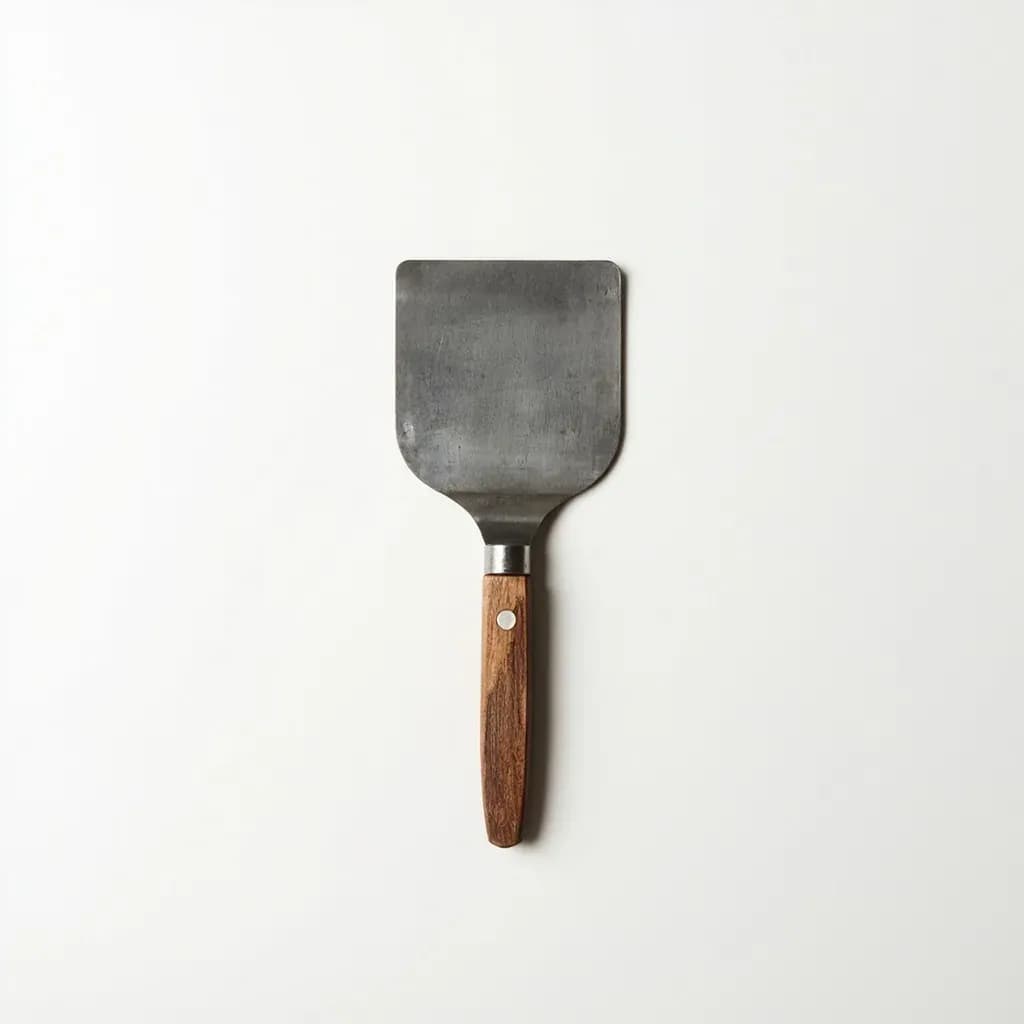
Griddle Scraper
Flat metal blade for cleaning flat-top griddles and scraping browned bits while cooking.
A griddle scraper is a wide, flat-edged metal tool used to clean and maintain a flat-top griddle. During cooking it pushes drippings and scrapes up browned residue, and after service it clears grease and food off the hot surface so it can be wiped and seasoned. The broad rigid edge covers the cooktop quickly in a few passes.
The griddle scraper is the unsung workhorse of every flat-top kitchen. At its core it is a simple object: a rigid rectangular blade, usually carbon or stainless steel, seated in a heat-tolerant handle, with a straight or lightly grooved working edge. That plainness is the point. The tool does two jobs that look different but share a single motion — pushing firmly across a hot steel surface. In its cleaning role, it shears off the layer of carbonized fat and protein that builds up between batches on a flat top. In its cooking role, the same push-and-chop motion breaks up a hash, smashes a burger, or sweeps browned onions into a neat rectangle for plating. Diners and short-order cooks depend on the scraper through every minute of service, not just at cleanup.
Construction matters more than the tool's modest appearance suggests. The blade is typically 0.04 to 0.06 inch thick — slim enough to glide at a low angle, rigid enough to take firm pressure without buckling. Handheld blades run three to six inches across; commercial long-handle versions stretch the blade to two feet and add an eighteen- to thirty-inch handle so a cook can reach the far side of a 36-inch griddle without hovering a hand over 350°F steel. Handles are phenolic, heat-resistant plastic, or turned wood, sized to be gripped in a fist for an entire shift. The edge is what actually does the work: keen enough to skim residue cleanly, blunt enough that a slip will not draw blood.
Conceptually, the griddle scraper is the flat top's answer to the wok spatula — a tool that earns its keep by being useful in a dozen small ways rather than by being specialized for one. It is sometimes confused with a bench scraper (dough scraper), but the griddle version is heavier, oil-tolerant, and built for heat rather than cold dough.
Alternatives
Types & varieties
Short handle, 4–6 inch rectangular steel blade; the everyday diner-style model
Wide blade with an extended handle for reaching across a 24–36 inch flat top while keeping the hand off the heat
Dough-scraper shape adapted for griddles; narrower blade, often wood handle, favored by smaller kitchens
Handle accepts fresh blades; common in high-volume operations where blades wear or chip
Rigid polymer blade that will not score chrome-plated griddle surfaces
Edge profile lifts residue into the grooves rather than smearing it; also helps grip carbon
Not a blade scraper, but commonly grouped with scrapers; an abrasive block for seasoning buildup
A live cooking tool, not just a cleanup tool
A common mistake among home cooks is to treat the griddle scraper as something that comes out at the end of the night. On a working flat top, it rarely leaves the cook's hand. The push-and-chop motion doubles as the diner cook's answer to a spatula and tongs combined: one stroke breaks a beef patty into crumbles for a chopped cheese, the next sweep pushes a hill of caramelized onions into a neat rectangle for plating, the third clears a band of fond into the grease well. Used this way, the scraper behaves more like a wok spatula or a chef's bench scraper pressed into service on the line than any cleaning implement.
- Chop and portion: diced onions, home fries, hash, and eggs go straight from board to griddle and stay on the griddle until plated.
- Consolidate: a long pull gathers loose bits and fond into a single mound so nothing is lost to the catch tray.
- Smash and crust: a hard, flat press with the broad side of the blade sears a smash-burger patty against the steel for maximum Maillard.
- Reset between batches: a two-second scrape clears the work zone so the next ticket starts on clean, hot metal.
The chrome-griddle exception
Chrome-plated flat tops cook more evenly than raw steel and resist rust, which is why many mid-range commercial griddles ship with a chrome surface. The plating is thin and easily scored. A steel scraper dragged across it leaves grooves that fill with carbon, ruin the surface's release, and eventually expose the steel underneath to corrosion. Operators with chrome plates spec plastic-edge scrapers and pair them with pumice blocks or mild non-metal scrub pads rather than chainmail. The same caution applies to the polished surfaces on many home flat-top griddles — check the manual before reaching for a metal blade.
End-of-service routine on a steel flat top
A commercial steel griddle is cleaned in a fixed sequence that begins with the scraper and ends with a thin film of oil. Skipping steps, or reversing them, is what makes a flat top go from seasoned to ruined over a season.
- Scrape bulk residue off the warm (not cold) surface with the steel scraper, working at a 15–30° angle.
- Degrease with a mild detergent or food-safe griddle cleaner; avoid flooding the surface while it is still very hot.
- Finish stubborn carbon with a pumice-style cleaning block or, on steel only, a chainmail scrubber — never on chrome.
- Wipe dry, then apply a thin coat of oil (grapeseed or canola) and buff lightly to recondition the seasoning.
- Store the scraper itself dry with the edge guarded so it does not flash-rust or nick anything in the drawer.
Common uses
Tips & pitfalls
- Hold the scraper at a low angle — roughly 15–30° — so it glides across the steel instead of digging in and gouging.
- Scrape while the griddle is warm, not cold and not screaming-hot: a cold surface lets the blade skip, while a searing one burns residue onto the scraper.
- For chrome-plated griddles, switch to a plastic-edge scraper to protect the plating from scoring.
- Push with broad, even pressure across the whole blade rather than jabbing at hot spots — the edge does the work, not the force.
- Replace the blade as soon as the edge rounds; a sharp scraper is actually safer and more effective than a dull one because it requires less pressure.
- Pair the scraper with a chainmail scrubber for the sticky residue the blade alone cannot lift, but only on steel, never on chrome.
- Wipe the scraper clean at the end of service; food films baked onto the blade transfer back to the next cook.
- Do not use a griddle scraper on non-stick pans, glass cooktops, or a cast-iron skillet — it will strip seasoning and scratch coatings.
Good to know
- Type
- Hand tool for cleaning and managing flat-top cooking surfaces
- Also called
- Griddle cleaning tool, flat-top scraper, griddle knife (informal)
- Blade material
- Carbon steel or stainless steel; some models use rigid food-grade plastic
- Handle material
- Heat-resistant plastic, phenolic resin, or turned wood
- Handheld blade size
- 3–6 inches wide, roughly 0.04–0.06 inch thick
- Commercial long-handle size
- Blades 12–24 inches wide, handle 18–30 inches to keep the hand off the hot surface
- Operating temperature range
- Most effective at 275–400°F; usable on warm or hot griddles, not cold
- Compatible surfaces
- Steel flat tops, cast iron griddle plates, chrome-plated griddles (with plastic-edged scraper)
- Maintenance
- Hand-wash, dry immediately for steel blades; replace blades when the edge rounds over
Also called
Flat-Top Scraper · Grill Grate Scraper · Grill Scraper
Related

Peeler
Swift blade for stripping skin off fruit and vegetables

Grater
Sharp-toothed surface for shredding cheese and vegetables

Microplane
Ultra-fine rasp for citrus zest, garlic, and hard cheese

Mixing Bowl
All-purpose bowl for combining, whisking, and tossing

Whisk
Looped wires that beat air into eggs, cream, and sauces

Spatula
Flat blade for flipping, lifting, and scraping

Slotted Spoon
Pierced spoon that lifts solids and drains the liquid behind

Wooden Spoon
Gentle, heat-friendly spoon for stirring anything