Prep Tools
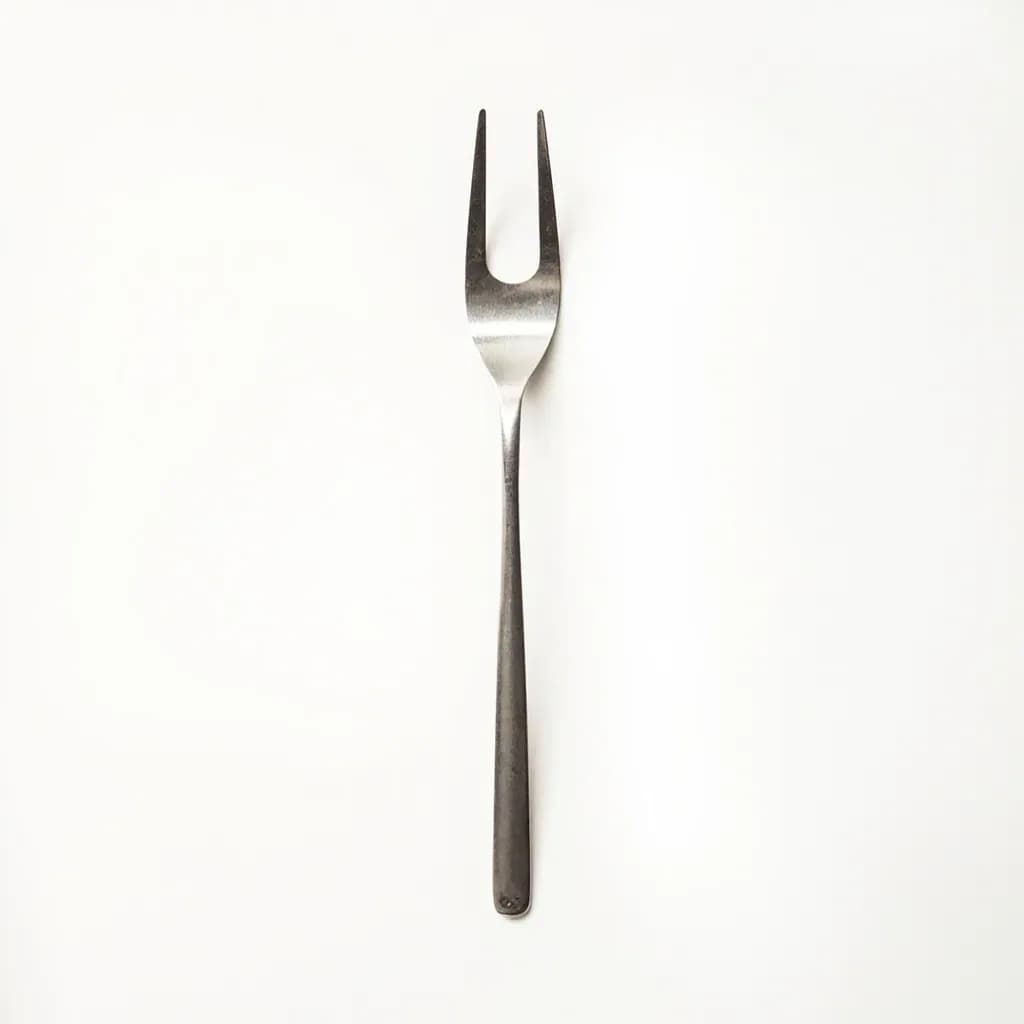
Grill Fork
A long two-pronged fork for turning, steadying, and lifting food over a hot grill or griddle.
A grill fork is a long-handled two-tined fork used to turn, hold, and lift large cuts of meat and other food on a grill or teppan without burning the hand. The long handle keeps the cook clear of the flames and heat. It pairs with tongs and a spatula; cooks often avoid piercing tender cuts with it to keep juices in.
A grill fork is a long-handled, two-pronged fork designed to work over a hot grate, griddle, or open fire. It descends directly from the long roasting forks that turned whole animals on spits at open hearths for centuries, and the two-tine head is its defining feature: with only two tines, the fork bites firmly into meat and holds it securely, where a four-tine table fork would slip and tear. The long handle — typically 18 to 24 inches for home use, longer for competition cooking — keeps the cook's hand a safe distance from radiant heat.
The grill fork has a reputation problem, and not without reason. Every time the tines pierce a steak or chop, a small amount of juice escapes onto the coals, and most modern pitmasters and grilling authorities recommend tongs or a spatula for turning precisely to avoid this loss. But the fork still earns its place for tasks where piercing is inherent or unavoidable: lifting a hot rack of ribs off the grate, steadying a whole bird while you carve it on a board, transferring a whole fish to a platter, or rearranging coals on a charcoal grill. Used with intention — slid in from the side rather than stabbed down — it does far less damage than its critics suggest.
A grill fork is also one of the most secure ways to carry hot food short distances from grill to table, because impaled food cannot slip the way a gripped piece can. The trade-off is real, though: tines pointed out are a puncture hazard, and the tool demands more care in handling than tongs. In a well-equipped outdoor kitchen it is a complement to tongs and a spatula, not a replacement for them.
Alternatives
Types & varieties
The standard home form: straight handle with two parallel tines, used for general turning and lifting.
Tines bend slightly downward at the tip so the fork slides cleanly under steaks, chops, and fillets without driving juices out the top.
Classic styling with a hardwood grip that stays cooler in the hand; must never be rested over coals or flame.
Single-piece or riveted stainless build; dishwasher-safe and more durable for heavy or commercial use.
Longer (24–36 in) and heavier all-stainless fork used in restaurants, catering, and BBQ competition turn-in boxes.
A related one- or two-tine long fork used at a fireplace or campfire for bread and marshmallows; same lineage, lighter duty.
Tines, tongs, and the grilling debate
The most common question about a grill fork is whether it belongs in the kit at all. The argument against it is straightforward: every puncture releases juice that drips onto the hot coals and burns off, taking flavor with it. Steven Raichlen, Meathead Goldwyn, and most competition teams have moved decisively to long tongs or a stiff spatula for turning steaks, chops, and burgers.
The case for keeping a fork is equally straightforward. Some jobs require piercing. You cannot lift a floppy whole trout off a grate without sliding something under or through it, and a fork does it in one motion. You cannot steady a standing rib roast while you carve it without anchoring the bones. And when you walk a sizzling platter of kebabs from grill to table, an impaled kebab is a more secure carry than a gripped one because it cannot slip. The right answer for most cooks is a small kit: tongs for turning, a spatula for smashing and lifting crusty things, and a fork for the tasks only it can do well.
Choosing the right length
Length is the single biggest practical decision when buying a grill fork, and it should match the heat source you actually cook over.
- 18–20 in: comfortable for a home gas grill where the fire is contained and burn-back is minimal.
- 22–24 in: a good all-purpose length for charcoal kettles and most offset smokers, keeping the hand a full 12 inches from the grate.
- 30–36 in: reserved for large offset smokers, whole-hog pits, and BBQ competition work where reaching across a long bed of coals is routine.
- Shorter carving forks (10–12 in) share the two-tine head but are designed to hold roasts on a cutting board, not to work over a fire.
Care and maintenance
A grill fork is one of the simplest tools to keep in good shape, but the handle is usually the weak link.
- Hand-wash wooden-handle forks in warm soapy water, dry them upright, and never soak them.
- Once or twice a year, rub a thin coat of food-grade mineral oil into a wood handle to keep it from drying and splitting.
- All-stainless forks can go in the dishwasher, though hand-washing is gentler on riveted joints.
- Sharpen the tine tips occasionally on a fine file or diamond hone — sharp tines penetrate with less force and less tearing.
- After contact with raw poultry, wash and sanitize the tines thoroughly before they touch cooked food.
Common uses
Tips & pitfalls
- Use tongs or a spatula to turn steaks, chops, and burgers; reserve the fork for lifting, steadying, and transferring, where piercing is unavoidable.
- Slide the tines in from the side, parallel to the grate, rather than stabbing straight down — a shallow angled entry lets less juice escape.
- Never rest the fork on the grate or across the edge of the grill: wooden and plastic handles scorch, melt, or catch fire, and even stainless handles conduct heat back to the grip.
- Point the tines downward and slightly forward whenever you walk with the fork loaded; it is a genuine puncture hazard.
- Wash the fork thoroughly between raw and cooked contact, especially with poultry, to prevent cross-contamination.
- Dry wooden handles after washing and rub them with food-grade mineral oil once or twice a year to prevent splitting.
- Choose a length that keeps your hand at least 12 inches from the heat source — longer is almost always safer for outdoor work.
- For competition or large-format BBQ, a 30-inch-plus fork lets you maneuver briskets and whole shoulders on offset smokers without leaning over the firebox.
Good to know
- Type
- Long-handled, two-pronged cooking fork used over a hot grill, griddle, or open fire
- Also called
- Grilling fork, barbecue fork, toasting fork, hearth fork, roasting fork (older term)
- Typical length
- 18–24 in (45–60 cm) for home use; 24–36 in (60–90 cm) for commercial or competition use
- Tines
- Two flat, slightly curved or tapered tines, 2.5–3.5 in long, usually sharpened at the tip
- Materials
- Stainless or nickel-plated steel tines; hardwood, stainless, or heat-resistant plastic handle
- Origin
- Descended from long-handled roasting forks used at open hearths from the medieval period onward; modern two-tine barbecue form dates to the 20th-century rise of backyard grilling
- Dishwasher safe
- All-stainless versions usually are; wooden-handle versions must be hand-washed
- Heat tolerance
- Tines tolerate direct grill heat; wood and plastic handles do not and must be kept off the cooking surface
Also called
Long-Handled Cooking Fork · Teppan Fork · Barbecue Fork · Carving Fork
Related

Peeler
Swift blade for stripping skin off fruit and vegetables

Grater
Sharp-toothed surface for shredding cheese and vegetables

Microplane
Ultra-fine rasp for citrus zest, garlic, and hard cheese

Mixing Bowl
All-purpose bowl for combining, whisking, and tossing

Whisk
Looped wires that beat air into eggs, cream, and sauces

Spatula
Flat blade for flipping, lifting, and scraping

Slotted Spoon
Pierced spoon that lifts solids and drains the liquid behind

Wooden Spoon
Gentle, heat-friendly spoon for stirring anything