Prep Tools
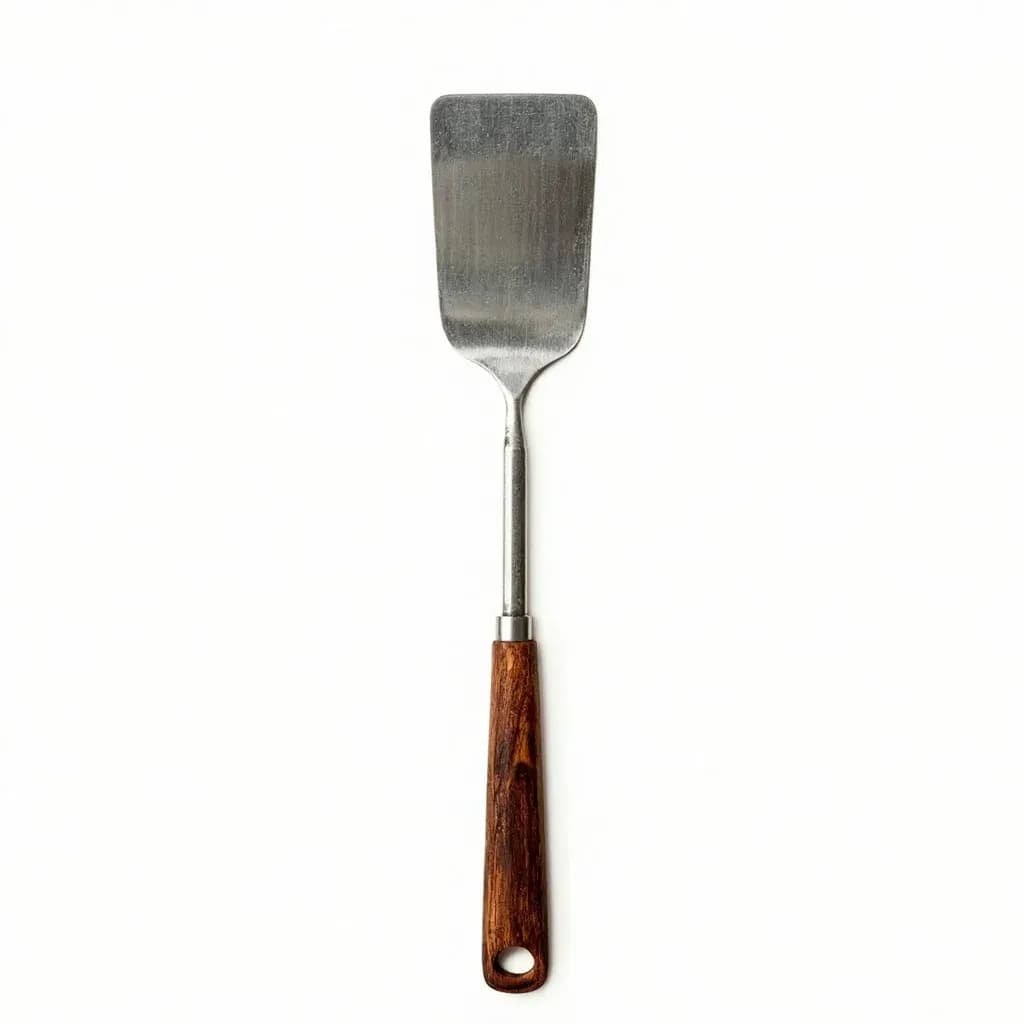
Grill Spatula
A wide, long-handled metal turner built to flip and lift food on a hot grill or griddle.
A grill spatula is a broad metal turner with a long handle that flips burgers, fish, and vegetables on a grill or flat-top while keeping the cook away from the heat. The wide, often beveled blade slides under food and supports large or fragile pieces. Many include a serrated edge for cutting and an offset handle for leverage.
A grill spatula is the long-handled workhorse of outdoor cooking, purpose-built for the demands of a hot grate: distance from radiant heat, leverage under heavy cuts, and a thin leading edge that slides under a seared crust without tearing it. While it shares DNA with the cake turner and the fish spatula, it is stiffer, wider, and almost always longer, sized so a cook can flip a thick burger from the edge of the grill without leaning in. The head is typically offset — bent downward from the handle — so knuckles stay clear of the cooking surface and the blade sits flat against the grates.
What separates a good grill spatula from a mediocre one is the geometry of the blade. The leading edge is ground to a shallow bevel so it slips between food and metal rather than digging in, and the thickness is chosen to match the load: a thin blade flexes around a delicate fillet, while a thick, rigid blade can pry up a bone-in pork chop without flexing at all. The handle — wood, stainless, high-heat plastic, or silicone-wrapped — is sized for safe distance from a grill running at 500°F or more and to keep the hand out of the rising plume of smoke.
Choosing one comes down to three trade-offs: blade thickness for the food you cook most, handle length for your grill's working radius, and head angle for knuckle clearance. A cook who grills fish on the weekend and a ribeye midweek needs two different tools; a cook who only flips burgers can get away with one sturdy standard.
Alternatives
Types & varieties
Rectangular stainless blade, beveled front edge, long handle; the all-purpose workhorse for burgers, chicken, and vegetables.
Thin, slightly flexible, often slotted or perforated blade with a long sloping front edge; slides cleanly under delicate fish and eggs on a griddle.
Slots or holes in the blade let grease drip away while flipping; useful for bacon and fatty meats.
Unperforated blade for maximum strength when lifting heavy cuts or pressing down for defined grill marks.
Head is bent downward from the handle so knuckles clear the grill; the most ergonomic grilling shape.
One edge serrated or notched to score tenderloins or scrape grates; the opposite edge turns food.
Shorter handle (10–14 in) for tabletop grills, griddles, cast-iron pans, and kebab work where extra reach is not needed.
Traditional hardwood grip that stays cooler in the hand; must not be soaked and is hand-wash only.
Stainless core with a thin silicone or nylon tip; safe for nonstick griddles while still rigid enough for the grill.
Grill spatula vs. fish spatula
The two are routinely confused, even on retail shelves, but they are tuned for different jobs. A true fish spatula has a very thin, springy blade with an exceptionally long beveled front and is meant to glide under a fragile fillet on a flat surface. A grill spatula is stiffer, wider, longer in the handle, and designed to lift a pound of meat off an open grate. If you do more delicate work, buy the fish-style tool; if you cook over flame, buy the stiffer, longer one — and ideally both.
Common uses
Tips & pitfalls
- Pre-heat the spatula on the grate for a few seconds before sliding it under cold protein — warm metal releases meat faster and tears fewer crusty bits.
- Always lead with the beveled edge and slide at a shallow angle; levering straight down bends the blade and shoves food into the grates.
- Match blade thickness to the job: thin and springy for fish, thick and rigid for a 1-lb burger or bone-in chop.
- Keep the leading edge flat on the grate — don't let it dig in, especially on porcelain-enameled grates where it can chip the coating.
- Oil the food, not the spatula, when using a perforated turner, so oil doesn't pool and burn on the blade.
- Hand-wash wood-handled versions; prolonged soaking swells the tang and loosens the rivets.
- Store hanging or blade-up in a drawer so the thin leading edge doesn't get dinged — a rolled edge will catch and tear food on the next flip.
- Never use a plastic or standard kitchen turner on a hot grill — the head will soften, melt, or shed plastic onto the food.
- If food is truly stuck, give it another 30 seconds; it usually releases on its own rather than needing force.
Good to know
- Also called
- Grill turner, BBQ spatula, long-handled turner, offset spatula
- Total length
- 16–22 in overall; handle 12–18 in, blade 3–6 in
- Blade width
- Roughly 3–4 in for standard models; 5–6 in for burger turners
- Blade thickness
- 1–1.5 mm general use; ≈0.8 mm for fish; thicker and stiffer for steak or burger
- Head shape
- Rectangular with a beveled or chamfered leading edge; usually offset (angled down) from the handle
- Primary materials
- Stainless steel head with wood, high-heat plastic, silicone, or riveted metal handle
- Care
- All-stainless and silicone-handled versions are dishwasher-safe; wood handles must be hand-washed
- Heat tolerance
- Stainless head tolerates direct grate heat; wood or plastic handles should not rest over open flames
Also called
Grill Turner · BBQ Spatula · Griddle Spatula
Related

Peeler
Swift blade for stripping skin off fruit and vegetables

Grater
Sharp-toothed surface for shredding cheese and vegetables

Microplane
Ultra-fine rasp for citrus zest, garlic, and hard cheese

Mixing Bowl
All-purpose bowl for combining, whisking, and tossing

Whisk
Looped wires that beat air into eggs, cream, and sauces

Spatula
Flat blade for flipping, lifting, and scraping

Slotted Spoon
Pierced spoon that lifts solids and drains the liquid behind

Wooden Spoon
Gentle, heat-friendly spoon for stirring anything