Prep Tools
Grill Tongs
Long-armed tongs for turning and lifting food over hot grills and open fire.
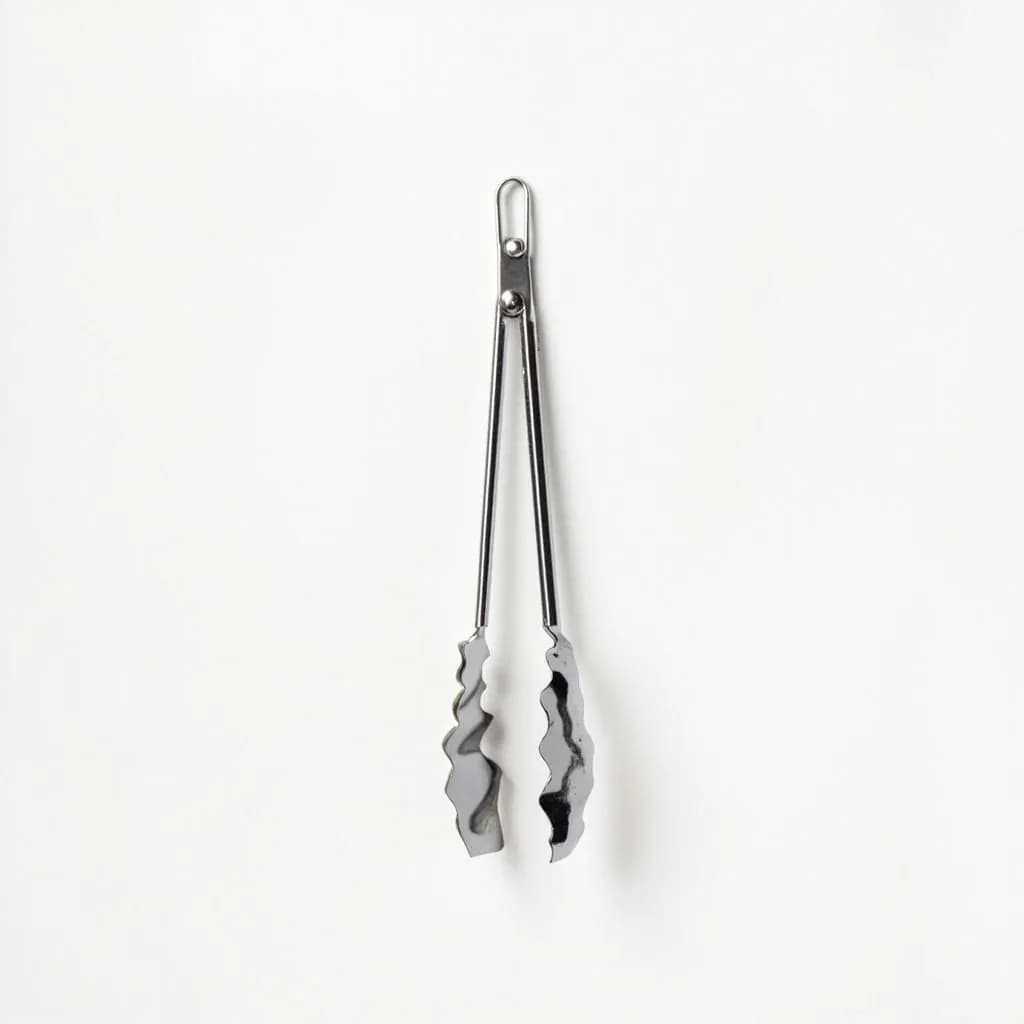
Grill tongs are extra-long, sprung tongs that let a cook grip, flip, and arrange food over a grill or fire while keeping hands away from the heat. The length and firm jaws handle steaks, skewers, vegetables, and burning embers safely. Scalloped or notched tips give a secure hold on slippery or heavy items.
Grill tongs are the workhorse hand tool of live-fire cooking: a two-armed lever that pinches, lifts, and turns food at a safe distance from radiant heat. Their defining feature is reach — a long handle keeps knuckles and forearms out of the heat rising off a grill, and the longer the tongs, the further the cook stands from a sear. Beyond length, the design choices that matter are the tip material (which contacts the food and the grate), the pivot style (which determines how the arms move), and the locking mechanism (which determines how they sit in a drawer or on a rail.
In use, good grill tongs behave like an extension of the thumb and forefinger. The arms should spring open on their own and close with light pressure, and the tips should meet squarely without crossing. Heavier food — bone-in chicken, ribeyes, whole fish — is gripped at two points and rolled or flipped in a single motion; delicate food is held by the tips alone so the skin doesn't tear. A pair that is too short forces the cook to hover over the fire, and a pair that is too long sacrifices control. Eighteen inches is the practical sweet spot for a home kettle grill; deep smokers and offset pits call for 24 inches or more.
The other quiet decision is the tip. Stainless steel tolerates any heat but will score a non-stick or porcelain grate. Food-grade silicone is gentle on coated surfaces and rated to roughly 600°F, making it the best general-purpose choice. Nylon is softer still but scorches around 400°F and is best reserved for stovetop griddles rather than open flame.
Alternatives
Types & varieties
Single pivot with a fat external spring at the handle that holds the tips closed; a light squeeze on the handles opens them. The American backyard default — quick to flip, easy to spot in a drawer.
Double-pivot, scissor-like action with a ring or tab lock. The restaurant-kitchen workhorse: one-handed operation, lies flat when locked, no external coil spring to stretch out.
Stainless body with food-grade silicone pads on the arms. Gentle on non-stick and porcelain-coated grates, rated to roughly 600°F, and the most versatile home-grill choice.
Lower-heat plastic pads, usually capped to about 400°F. Fine for stovetop griddles and non-stick pans, but they scorch and melt quickly over open flame or sear burners.
24–36 in handles, sometimes with angled or offset heads, for reaching into deep offset smokers, kamados, and competition cookers without burning forearms.
Cut from a single sheet of stainless with no rivets or springs. The most durable construction, favored in professional kitchens because nothing loosens in the dish pit.
Stainless head with a wooden grip that stays cool in the hand. Pleasant to use but must be hand-washed and kept clear of direct flame to avoid charring the wood.
Choosing the right length and tip
Length is the first decision because it is the hardest to change later. A 16-inch pair works on a small gas grill where the lid sits low and the firebox is shallow. Eighteen inches is the practical floor for a standard kettle: long enough that the hand clears the lid edge when reaching to the back of the grate, short enough to still feel precise. Twenty to twenty-four inches is right for large gas grills with deep lids and for most kamados. Anything past 24 inches belongs in offset smokers, upright cabinets, and over open fire pits, where the extra reach protects the cook from radiant heat.
Tip material follows the cooking surface. Stainless tips on a stainless or cast-iron grate are fine — bare metal on bare metal. Stainless on a porcelain-enameled or non-stick grate will eventually scratch the coating, so silicone is the better match. Nylon belongs off the open grill; it is a stovetop and griddle tool.
- Kettle, small gas: 16–18 in, silicone tips
- Large gas, kamado, ceramic: 20–24 in, silicone or stainless tips
- Offset smoker, fire pit, open hearth: 24–36 in, stainless tips, angled head if available
- Non-stick or porcelain grate: silicone-tipped, never bare stainless
- Sear station or infrared burner: stainless tips only — sustained radiant heat can exceed silicone's rating
Two-pair discipline for safe grilling
The single biggest upgrade a home griller can make is buying a second pair of tongs. One pair is designated for raw protein — it touches the meat as it goes on, repositions it during the cook, and never returns to a finished plate. The second pair is the 'clean' pair: it lives on a side towel or a plate and only handles cooked food. Cross-contamination from a single pair that moves from raw chicken to a finished steak is the most common tong-related food-safety failure at a backyard grill.
Color-coding solves the problem. A wrap of colored electrical tape near the pivot, or two visibly different pairs (one all-stainless, one with black silicone), makes the distinction obvious. Restaurants do this with color-coded handles; at home, any consistent marker works as long as it is visible at a glance.
- Pair A (raw): handles raw meat, fish, and poultry from bag to grate
- Pair B (clean): handles only cooked food and moves it from grate to plate
- Mark the handles so the distinction survives a dim evening grill session
- Never lay a raw pair on a serving platter, even briefly
Common uses
Tips & pitfalls
- Pick the longest comfortable length — 18 in is the practical minimum for a backyard grill so your hand clears the lid edge.
- Choose silicone or all-stainless tips over nylon for high-heat grilling; nylon scorches within minutes over open flame.
- Squeeze, don't pinch: hold the handles loosely so the tips conform to the food; a death-grip throws off placement and tires the hand.
- Use the flat side of the closed tongs to press a steak for doneness feel and to test burger firmness, instead of poking with a fork, which loses juices.
- Store them locked and hanging — a grill-side hook or a drawer divider keeps the spring from wearing out and the tips from bending.
- Avoid riveted tongs with wobbly arms; rivets loosen with heat cycles and the head will start to flop over time.
- Clean tips between batches by dragging them across an empty hot grate to burn off residue, or wipe with a wet brush — do not soak wooden handles.
- If the spring feels stiff, place a tiny drop of food-grade mineral oil at the pivot; never use cooking oil, which turns rancid.
Good to know
- Typical length
- 16–20 in (40–50 cm) for backyard grilling; 24–36 in (60–90 cm) for deep smokers and offset pits
- Common materials
- 18/8 or 18/10 stainless steel body with stainless, silicone, or nylon tips; riveted or one-piece stamped construction
- Tip heat tolerance
- Stainless: very high; food-grade silicone: ~600°F (315°C); nylon: ~400°F (204°C)
- Pivot style
- Single-pivot with a scalloped spring (classic backyard shape) or double-pivot scissor action (restaurant standard)
- Locking
- Pull-ring, thumb tab, or sliding ring lock so the arms store closed
- Hand orientation
- Symmetric designs work for left- and right-handers; some scalloped-spring models are biased toward one hand
- Recommended hand clearance
- At least 12 in (30 cm) of handle beyond the food zone; longer for sear stations and lid edges
- Care
- All-stainless and silicone-tipped pairs are dishwasher-safe; wooden handles must be hand-washed and kept off direct flame
- Origin
- Tongs descend from the late-19th-century ice and sugar tongs of Victorian service; long-handled grill tongs became standard in mid-20th-century American backyard grilling
Also called
umu-tongs · BBQ Tongs · Barbecue Tongs
Related

Peeler
Swift blade for stripping skin off fruit and vegetables

Grater
Sharp-toothed surface for shredding cheese and vegetables

Microplane
Ultra-fine rasp for citrus zest, garlic, and hard cheese

Mixing Bowl
All-purpose bowl for combining, whisking, and tossing

Whisk
Looped wires that beat air into eggs, cream, and sauces

Spatula
Flat blade for flipping, lifting, and scraping

Slotted Spoon
Pierced spoon that lifts solids and drains the liquid behind

Wooden Spoon
Gentle, heat-friendly spoon for stirring anything