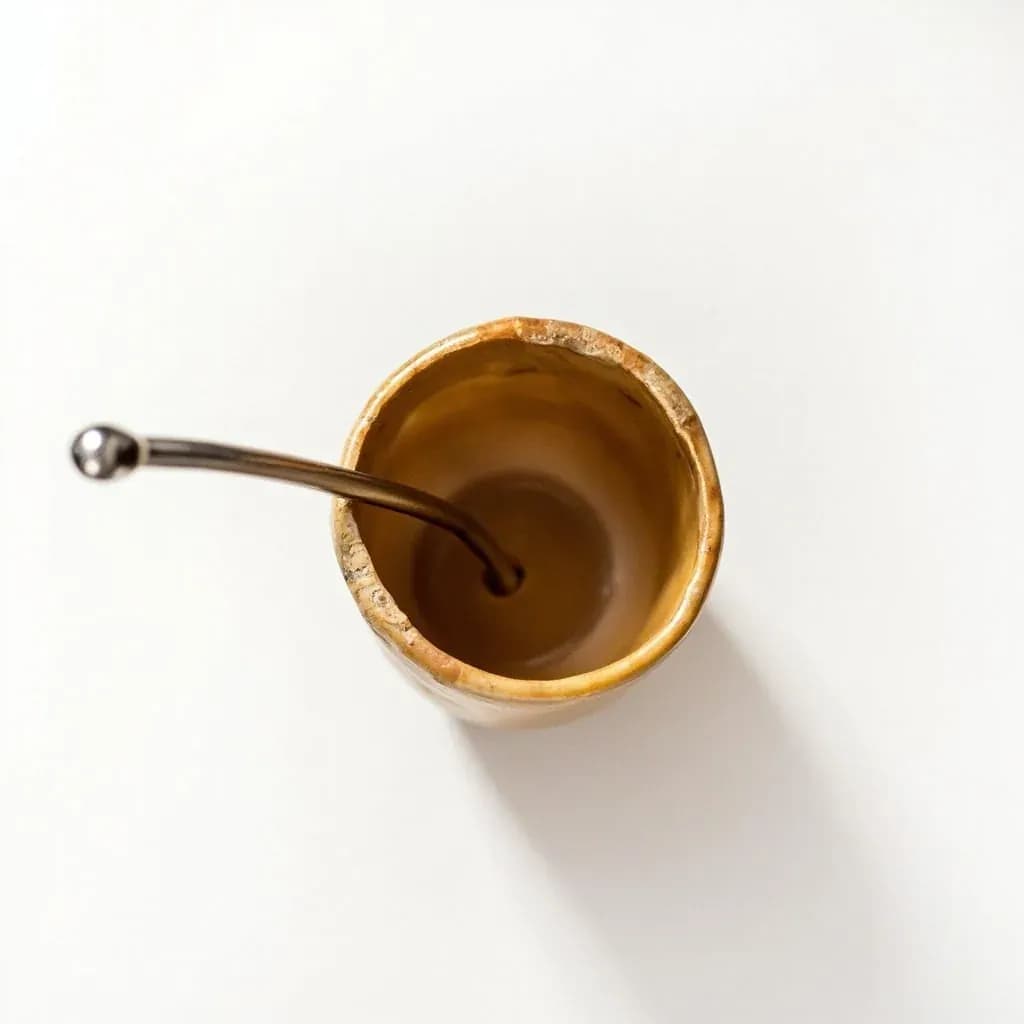
Prep Tools
Guampa and Bombilla (Tereré Cup & Straw)
A horn or wood cup and metal filter-straw used to drink yerba mate and tereré.
The guampa is a cup, often carved from horn, wood, or made of metal, and the bombilla is a metal straw with a filtered end. Together they are used in South America to steep and sip yerba mate hot or, as tereré, with iced water. The bombilla's perforated tip strains the loose mate leaves so only the infusion is drawn up.
The guampa and bombilla are a paired South American drinking set: a horn-, wood-, or metal cup and a filtered metal straw, used primarily to drink tereré (cold yerba mate) and, across much of Paraguay, southern Brazil, and northeastern Argentina, hot mate as well. The two parts are inseparable in practice — the guampa holds the packed yerba and water, while the bombilla strains the leaves so the infusion can be sipped directly from the vessel. Together they define a social drinking ritual in which a cebador fills the cup for each drinker in turn, refilling it many times from the same load of leaves before the yerba is finally changed.
The guampa's wide mouth and tapered body — often literally a cow horn, which is what the Guaraní word guampa means — suits a generous hand-packed bed of yerba, while the bombilla's perforated tip acts as a built-in strainer. Different filter geometries (spoon, pear, spring, flat disc, parrot-beak) are matched to either hot or cold brewing, and choosing the right one matters more than choosing the guampa material. A fine pear filter will clog the moment you add crushed herbs and ice to a tereré, while a parrot-beak or spring bombilla is engineered to hold back coarse debris while letting cold water flow freely.
The vessel-and-straw pair distinguishes itself from the round gourd-and-bombilla set of Uruguay and central Argentina: the guampa is the signature form of Paraguay, Mato Grosso do Sul, Corrientes, and Misiones. Treat the set as one tool, and a single load of yerba will yield eight to fifteen refills — enough to keep a circle of friends drinking through a long summer afternoon.
Alternatives
Types & varieties
Real cow horn, the classic Paraguayan form, tapered with a narrow base. Must be cured with yerba or coffee before first use to seal pores and remove any animal odor.
Carved from palo santo, algarrobo, or quebracho; prized for the subtle resinous note it lends to the mate. Requires the same curing as the horn version.
Dried gourd, similar in shape to a traditional mate gourd but typically with a wider mouth and straighter walls; lighter and more fragile than horn.
Common tourist and gift version; durable, decorative, often engraved with Gaucho or Guaraní motifs.
Modern, unbreakable, often fitted with a screw-on lid pierced for the bombilla; standard at outdoor events and football matches in Paraguay and Brazil.
Classic spoon-shaped perforated end; the most common style and a good all-rounder for hot mate and standard tereré.
Bulb-shaped strainer with very fine holes; holds back even small leaf particles, best for hot mate rather than tereré with herbs.
Coiled metal spring at the tip; flexible and self-adjusting, traditional in Paraguay and easy to clean.
Flat perforated disc; common in Argentina and Uruguay, simple to rinse out and less prone to clogging.
Curved beak with a flattened, slotted spoon end, designed specifically for tereré so ice and herb pieces are trapped while cold water flows freely.
Pre-Columbian style: a hollow cane segment with a small filtering plug; still used in rural Paraguay and among Guaraní communities.
Choosing the Right Bombilla Filter
The filter is the defining engineering feature of the bombilla, and matching its geometry to what you are drinking is the single most important decision. Cold preparations with ice and chopped yuyos demand large, open slots — a parrot-beak, spring, or wide spoon filter — because fine perforations will clog within a sip. Hot mate, by contrast, benefits from the dense screening of a pear or fine spoon filter, which keeps the small polvillo from climbing up the straw and turning the infusion cloudy and bitter.
- Tereré with herbs and ice: pico de loro, resorte (spring), or wide cuchara with open slots.
- Hot mate with finely cut yerba: pera (pear) or dense cuchara for a clean sip.
- Everyday or travel use: stainless steel resorte or disco is the easiest to rinse and least prone to clogging.
- Traditional or ceremonial service: alpaca or silver spoon or pear filter, paired with a horn or wood guampa.
Curing a New Horn or Wood Guampa
A raw horn or carved hardwood guampa smells and tastes of the material itself, and its porous walls will leach flavor into the first rounds of mate. Paraguayan and Guaraní tradition cures the vessel by steeping it in used yerba, coffee, or coconut water to seal the pores and neutralize any animal or resinous note. Two to three cycles are enough; after that, the guampa should be rinsed by hand only and never put in a dishwasher, since harsh detergents and prolonged heat will crack horn and warp wood.
- Fill with used (already brewed) yerba mate, cover with warm water, and rest 12–24 hours.
- Empty, rinse, and repeat 2–3 times. Coffee or coconut water can substitute for the yerba cure.
- After curing, rinse by hand and dry upside down; never use a dishwasher.
- Refresh an older guampa with an occasional overnight soak in baking-soda water to lift built-up tannins.
Common uses
Tips & pitfalls
- Cure a new horn or wood guampa before first use: fill with used yerba mate, cover with warm water, rest 12–24 hours, rinse, and repeat 2–3 times. Coffee or coconut water works as a substitute cure.
- When loading yerba, fill the guampa about two-thirds to three-quarters full, then tilt and tap so the yerba settles on one side and stays loose on the other; this creates a clear channel for the bombilla and keeps leaves from clogging the filter.
- Place the bombilla against the empty (loose) side with a finger over the mouthpiece, then wedge it gently into the yerba. Do not stir and do not move it once positioned, or you will clog the filter and release bitter polvillo.
- For tereré, use very cold water and plenty of ice; the cold prevents the yerba from releasing bitter tannins the way hot water does, allowing 8 to 15 refills from the same load.
- The first cold-water pour is considered the cleanest, sweetest sip (sometimes called the cariño); drink it quickly before the ice melts too much and the mate turns flat.
- Common mistake: using a bombilla with tiny filter holes (a pear filter) for tereré. Fine holes clog almost immediately with ice chips and herb fragments; choose a pico de loro, resorte, or wide-slot bombilla for cold preparations.
- Common mistake: pouring hot water into a guampa meant for tereré, or thermal-shocking a cold guampa with boiling water. The temperature swing can crack wooden or horn vessels.
- Clean the bombilla by running water back through it from the mouthpiece; avoid soap inside the filter, since residue will flavor future mate. Boil the bombilla occasionally with baking soda to strip built-up tannins.
- To keep tereré cold longer outdoors, nest the guampa in a styrofoam or leather kambuchi (insulated holder) and refill from a thermos of ice water rather than topping up with warm liquid.
Good to know
- Origin
- Guaraní-speaking regions of South America (Paraguay, southern Brazil, northeastern Argentina, Uruguay, southeastern Bolivia); 'guampa' comes from Guaraní for 'horn.'
- Traditional guampa materials
- Cow horn, hardwoods (palo santo, algarrobo, quebracho), gourd (porongo/calabaza), alpaca or silver alloy, stainless steel, ceramic, glass.
- Traditional bombilla materials
- Alpaca (nickel-silver alloy), sterling silver, stainless steel, gold; traditional variants also made from bamboo or carved bone.
- Typical guampa capacity
- Roughly 150–400 ml; horn and porongo guampas tend toward 200–300 ml, stainless steel ones often larger.
- Bombilla length
- Around 15–20 cm, with a flared mouthpiece and a filter end shaped like a spoon, pear, flat disc, or coiled spring.
- Primary use
- Drinking tereré (cold yerba mate infusion) in the Chaco and lowland regions; the same vessels are also used for hot mate in Paraguay, parts of Brazil, and northeastern Argentina.
- Cultural role
- Tereré is the national drink of Paraguay and was inscribed on UNESCO's Representative List of the Intangible Cultural Heritage of Humanity in 2021, jointly nominated by Paraguay and Argentina; the guampa is shared in a round, refilled by a single cebador.
- Distinguishing from the mate gourd
- The horn- or wood-shaped guampa is typical of Paraguay, Mato Grosso do Sul, and Corrientes/Misiones; the round calabaza dominates Uruguay and central Argentina.
Also called
guampa · bombilla · mate cup and straw · terere cup
Related

Peeler
Swift blade for stripping skin off fruit and vegetables

Grater
Sharp-toothed surface for shredding cheese and vegetables

Microplane
Ultra-fine rasp for citrus zest, garlic, and hard cheese

Mixing Bowl
All-purpose bowl for combining, whisking, and tossing

Whisk
Looped wires that beat air into eggs, cream, and sauces

Spatula
Flat blade for flipping, lifting, and scraping

Slotted Spoon
Pierced spoon that lifts solids and drains the liquid behind

Wooden Spoon
Gentle, heat-friendly spoon for stirring anything