Prep Tools
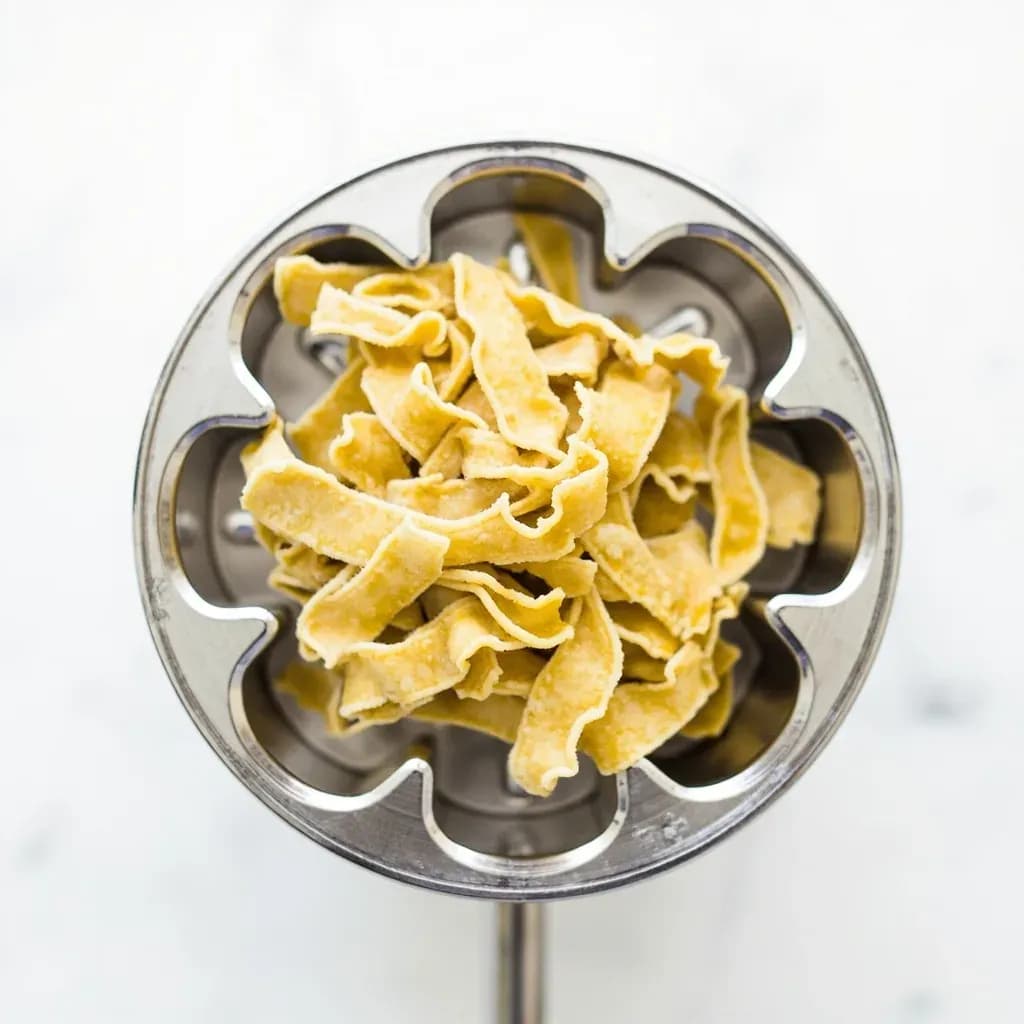
Halušky / Spätzle Maker
A perforated tool that pushes soft dough into boiling water to form little dumplings.
A halušky or spätzle maker is a perforated plate, board, or hopper that forces soft batter-like dough through holes directly into boiling water, where it sets into small, irregular dumplings. It produces the tender egg-dough drops of Slovak halušky and German spätzle in seconds. The slider-hopper version glides batter back and forth, while the board-and-knife method scrapes it off by hand.
A Spätzle or halušky maker is the modern home cook's answer to a centuries-old Central European problem: how to turn a soft, sticky flour-and-egg batter into hundreds of tiny dumplings quickly and uniformly. At its core it is a perforated plate attached to a hopper, with a hand lever or plunger that forces batter through the holes or slots and into a pot of boiling salted water below. The result is a steady shower of small dumplings or short noodles that cook in a minute or two and form the backbone of dishes like Swabian Spätzle, Austrian Knöpfle, and Slovak bryndzové halušky.
What sets the dedicated press apart from a colander or coarse strainer is control. A proper Spätzlepresse delivers batter in even, metered portions, so every dumpling is roughly the same size and cooks at the same rate — important when you are finishing a hundred pieces in a single batch. The shape of the perforations defines the dish: round holes (typically 3–4 mm for classic Spätzle, 5–8 mm for halušky) yield the button-shaped dumplings prized in Slovakia and parts of Austria, while long rectangular slots produce the longer, noodle-like strands classic to Swabia and the rest of southern Germany. Better presses accept interchangeable discs, so one tool can do both jobs.
The press is a delivery system, and its behavior is governed almost entirely by batter consistency. Wet enough to flow through the holes under pressure, thick enough to hold together on contact with boiling water — that balance is the entire craft. Get it right, keep the water at a hard rolling boil, and a full hopper empties in under a minute, yielding enough dumplings for a family in seconds of actual work.
Alternatives
Types & varieties
Pot-shaped hopper with a perforated disc at the bottom and a hand lever or plunger to push batter through. The classic, fastest modern style and the one most home cooks buy today.
Produces short, button-like dumplings. Standard for Slovak halušky, Austrian Knöpfle, and Hungarian galuska; also the better choice for beginners because the thicker cross-section is more forgiving of batter consistency.
Yields longer, noodle-like Spätzle strands. Preferred for classic Swabian and Austrian preparations where the sauce clings to the strands.
Wooden board with a small rim; batter is spread thinly across the surface and scraped off in strips with a wooden scraper. The traditional, pre-industrial method still common in rural Austria, Switzerland, and the Czech/Slovak countryside.
Handheld grater-like tool with a perforated metal plate; the cook slides batter across the plate so it falls through as small pieces. More compact than a board, faster than a spoon, slower than a press.
A large perforated spoon, skimmer, or flat grater held over the pot — a low-tech approach that works in a pinch but gives less uniform pieces than a dedicated maker.
A large-hole ricer will produce spätzle-like pieces, though the shape and texture differ from a true Spätzle maker.
Choosing a press: round holes vs. slots
The single most important decision when buying is which disc(s) the press accepts. Round holes are the right call for halušky, Knöpfle, and galuska; slot discs are what you want for the long, sauce-catching Spätzle strands of Swabia and Austria. If you only buy one disc, round holes are the safer choice — the dumplings are sturdier, more forgiving of batter mistakes, and cover most recipes. The best presses take a bayonet-mounted disc that swaps out in seconds; cheaper models may be fixed to a single hole style.
- Round holes (3–4 mm): classic Spätzle and Knöpfle. Larger (5–8 mm): halušky and galuska.
- Slot holes: long Swabian Spätzle, Austrian noodles that hold creamy or buttery sauces.
- Look for stainless discs with cleanly punched, burr-free edges — torn edges catch batter and clog.
- A bayonet-mount or screw-off disc is worth paying extra for; it lets you make both styles with one tool.
Batter consistency: the variable that matters most
The press is a delivery system; the result is determined by the batter. A proper Spätzle or halušky batter should fall off a wooden spoon in a thick, glossy ribbon that briefly holds its shape on the surface of the water before dissolving into separate dumplings. If it pours like pancake batter, it is too thin and will disintegrate; if it has to be forced or scraped through the holes, it is too stiff and the dumplings will be tough and rubbery. The rest period after mixing — 15 to 30 minutes at room temperature — is equally important, because it lets the flour fully hydrate and the gluten relax, which is what gives the dumplings their characteristic tender-with-a-bite texture.
- Aim for the texture of a thick, glossy ribbon that slowly dissolves in hot water — heavier than pancake batter.
- Rest 15–30 minutes before pressing; skip this and the dumplings are likelier to crumble.
- If the first test dumpling breaks apart in the water, whisk in a tablespoon of flour and rest again.
- If the batter feels heavy on the lever, whisk in a splash of water, milk, or beaten egg until it flows.
Cooking and serving in batches
Salt the water generously — it should taste like sea water — and keep it at a hard rolling boil throughout. A vigorous boil sets the dumplings the instant they hit the water and prevents clumping at the surface. Work in batches small enough that the pot never stops boiling; an overcrowded pot drops in temperature, and the dumplings turn gummy and stick together. Fish them out with a slotted spoon or spider the moment they float, give them another minute, then drain and toss with a little melted butter or neutral oil to keep them from matting while you finish the rest.
- Use a pot wider than it is tall so dumplings have room to spread out as they press in.
- Use plenty of water per batch — enough that the temperature barely drops when the dumplings go in.
- Toss finished dumplings with butter or oil in a warm bowl before adding sauce.
- For bryndzové halušky, work fast: hot dumplings tossed with bryndza melt the cheese into a creamy coat in seconds.
Care and cleaning
A Spätzle maker is mostly stainless steel and will outlast most other kitchen tools if you treat it well. The single biggest enemy is dried batter, which hardens inside the perforations and is miserable to chip out later. A quick rinse under hot running water immediately after pressing, or a brief soak if the batter has set, is all that is needed. Wooden boards and planes need hand-washing and should be dried upright so water does not pool in the working surface.
- Rinse or soak the disc the moment you finish pressing — never let batter dry in the holes.
- Stainless presses go in the dishwasher; wooden components do not.
- A stiff nylon brush clears residual batter from small holes faster than running water alone.
- Store wooden boards and planes dry and upright so the working surface does not warp.
Common uses
Tips & pitfalls
- Batter consistency is everything: it should fall off a spoon in a thick ribbon and slowly separate on contact with the water — too stiff and it will not pass cleanly, too thin and it dissolves.
- Rest the batter 15–30 minutes at room temperature so the flour hydrates fully; under-rested batter produces crumbly dumplings.
- Use generously salted water kept at a hard rolling boil — a vigorous boil sets the dumplings on contact and prevents clumping.
- Do not overcrowd the pot; work in batches small enough that the boil never breaks, or the dumplings turn gummy and fuse together.
- Ladle out finished dumplings with a slotted spoon or spider once they float, then cook one more minute, and toss with butter or oil to keep them from sticking.
- Rinse or soak the perforated disc immediately after use — dried batter is far harder to clean than fresh.
- If the first dumpling breaks apart in the water, the batter is too thin or under-rested; whisk in a spoonful of flour and rest again before continuing.
- For longer Spätzle strands from a slot disc, hold the press slightly higher above the pot so the batter has a moment to stretch before hitting the water.
Good to know
- Also called
- Spätzle press, Spätzle maker, Halušky maker, Spätzlepresse, Knöpfle press
- Origin
- Central Europe — Swabia/Germany, Austria, Switzerland, Slovakia, Czech Republic, Hungary
- Primary function
- Presses soft, wet batter through a perforated disc into boiling water to form small dumplings or short noodles
- Hole types
- Round holes (3–4 mm for Spätzle, 5–8 mm for halušky) for button-shaped dumplings; rectangular slots for longer noodle-like Spätzle strands
- Typical materials
- Stainless steel body and grid; handles plastic or wood; economy versions all-plastic
- Hopper capacity
- Most lever-press models hold 0.5–1.5 L of batter
- Cooked indicator
- Dumplings float to the surface; cook 1–2 minutes more after floating
- Care
- Rinse or soak the disc immediately after use; stainless presses are dishwasher-safe; wooden boards and planes are hand-wash only
Also called
spaetzli-press · spaetzle-board · Spätzle Maker · Halusky Maker · Spaetzle Press
Related

Peeler
Swift blade for stripping skin off fruit and vegetables

Grater
Sharp-toothed surface for shredding cheese and vegetables

Microplane
Ultra-fine rasp for citrus zest, garlic, and hard cheese

Mixing Bowl
All-purpose bowl for combining, whisking, and tossing

Whisk
Looped wires that beat air into eggs, cream, and sauces

Spatula
Flat blade for flipping, lifting, and scraping

Slotted Spoon
Pierced spoon that lifts solids and drains the liquid behind

Wooden Spoon
Gentle, heat-friendly spoon for stirring anything