Prep Tools
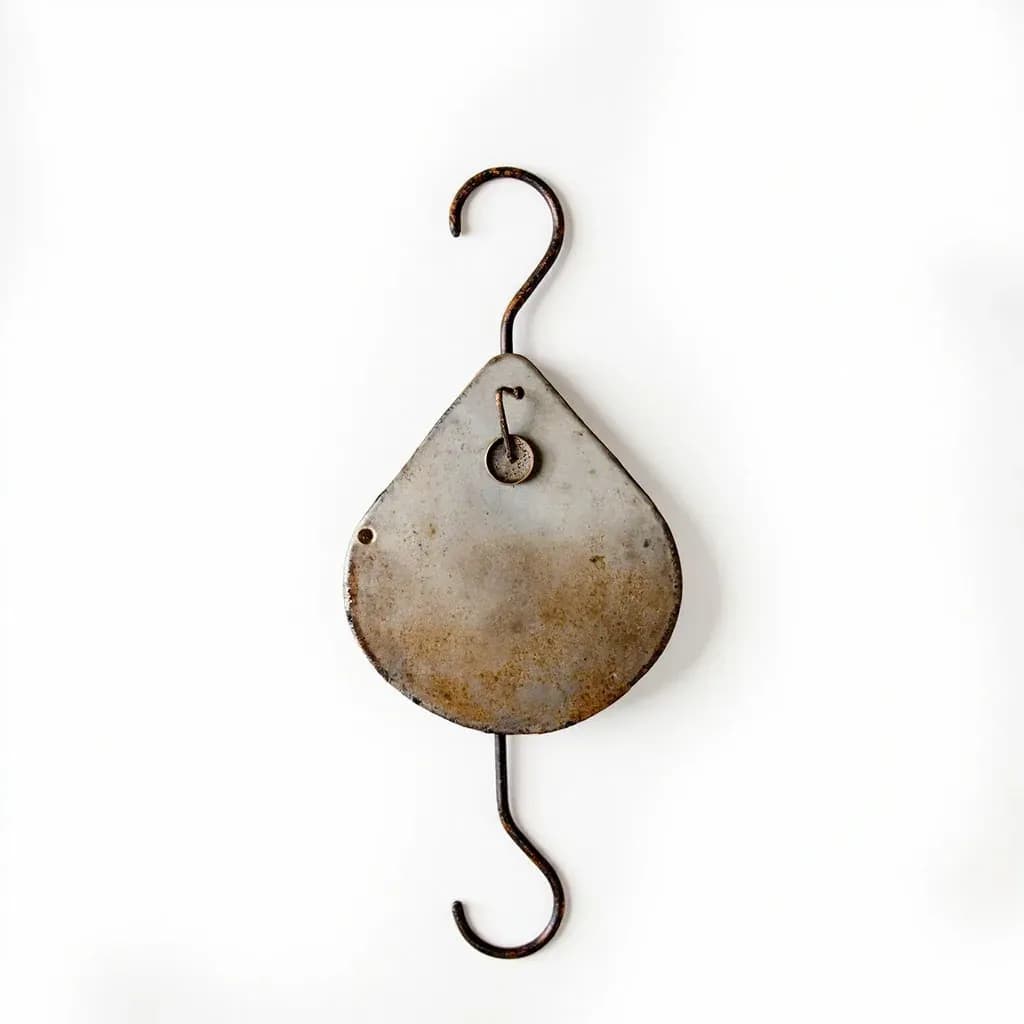
Hanging Scale
A suspended spring or digital scale for weighing produce, meat, and bulk goods.
A hanging scale is a weighing device suspended from a hook, with goods hung from below on a pan or hook and the weight read from a dial or digital display. Cooks and market vendors use it to quickly weigh produce, whole fish, hanging cuts of meat, and sacks of bulk ingredients. Because it doesn't need a flat surface, it suits weighing bulky or awkward items.
A hanging scale is the workhorse of markets, butcher shops, and farm stands — a weighing instrument built around a top hook rather than a flat platform, so it hangs from a beam, rail, or bracket and supports the load below. The vertical form factor matters more than it sounds: it lets you weigh a dripping whole fish, a swinging half-carcass, a sack of grain, or a CSA box without ever needing a level surface, a stable counter, or a way to set the item down. Internally it uses the same weighing technology as a countertop kitchen scale — a spring mechanism in analog models, a load cell in digital ones — but packaged for mess, bulk, and motion.
A hanging scale earns its place wherever weight is unavoidable but counter space, cleanliness, or the shape of the object is a problem. Spring-and-dial models remain common at farm shops, tea markets, and outdoor stalls because they need no power and tolerate rough handling; digital versions dominate in modern butcher shops and CSAs where per-kilogram pricing has to be exact. For most home kitchens a flat digital scale is more convenient, but a hanging scale is the right answer the moment the item is awkward, heavy, or wet — a whole chicken before roasting, a foraged haul of mushrooms, or a wheel of cheese at a stall.
Hanging loads swing, and the readout creeps up to the true weight only as motion damps out; analog springs also drift with age, drops, and overload, so a quick check with a known weight — 1 L of water is 1 kg at standard density — every few months is wise. None of this is a flaw; it is the cost of weighing things that would never sit still on a platform scale.
Alternatives
Types & varieties
Classic dial-faced model with a coiled spring and pointer; inexpensive, needs no batteries, but accuracy drifts with use and overload.
Electronic load cell with LCD readout; faster and more precise, usually with tare and unit-switch; runs on AAA or button-cell batteries.
Traditional steelyard design where a fixed weight slides along a graduated beam; very durable, no power needed, common at farm stands and tea markets.
Small digital scale in a hard case; popular with small producers, mushroom foragers, and market gardeners weighing under 5 kg.
Heavy-duty stainless steel body with high capacity (often 50 kg or more) and a sturdy meat hook; built for carcasses and primal cuts.
Mid-capacity model often paired with a wire fruit basket or weighing pan for vegetables, cheese, and dry goods.
Marine-grade stainless construction with a sealed dial or digital head to resist water and salt.
Reading and Calibrating a Hanging Scale
A hanging scale behaves differently from a platform scale because the load is free to swing. The pointer or digital number will not settle at the true weight until oscillation damps out, which on a heavy carcass can take several seconds. The single most useful habit is to wait for stillness — and never to read while still holding the hook in your hand, because your arm's micro-tremors add to the swing and push the reading high.
Recalibration matters more than most cooks realize. A spring scale that was accurate on the day you bought it can be off by several percent after a year of regular use, a hard drop, or a single overload event. The simplest field check is a 1 L bottle of water (1 kg at standard density), or a bag of sugar or flour whose weight you can verify on a trusted scale. For digital models, follow the manufacturer's zero procedure with no load on the hook; for analog dials, turn the zero-adjust screw at the face until the pointer sits on zero with the empty pan attached.
- Wait for the load to stop swinging before reading — the number creeps up to the true weight as motion damps out.
- Zero or tare the scale with the empty pan, hook, or sling attached; the container is heavier than people expect at small weights.
- Verify accuracy periodically with a known weight such as 1 L of water (1 kg), a 500 g bag of sugar, or a certified calibration mass.
- Hang from a fixed, rigid point — a beam, rail, or dedicated bracket — never from your hand, which introduces sway and inflates the reading.
- For analog models, treat the zero-adjust screw as a routine tool, not a once-only setup.
Common uses
Tips & pitfalls
- Do not exceed the stated capacity — overloading permanently stretches the spring in analog models and can damage the load cell in digital ones.
- For sticky or wet goods, weigh in a bag or pan and tare it out rather than letting residue build up on the hook.
- In a butcher or fish context, choose stainless steel — it tolerates wash-downs and resists corrosion from blood and brine.
- For items sold by reference weight (for example, 'price per 100 g'), use the scale's tare function repeatedly to add items without resetting.
- Store spring scales hanging, not lying in a drawer, to keep the spring in its natural rest position and slow fatigue.
Good to know
- Also called
- Suspended scale, hanging balance, produce scale, butcher's scale
- Mechanism
- Top suspension hook with a bottom hook, pan, or sling; internal spring (analog) or load cell (digital)
- Typical capacities
- Pocket models 1–5 kg (2–11 lb); kitchen/market models 10–25 kg (22–55 lb); heavy-duty butcher models 50–100 kg (110–220 lb)
- Common units
- Kilograms, pounds, ounces; some dual-scale models and metric-only versions
- Readout types
- Analog dial, spring-and-needle, sliding-counterweight balance, or digital LCD
- Body materials
- Stainless steel, chromed steel, aluminum, or ABS plastic housing
- Typical accuracy
- Consumer spring scales ±1–2%; digital hanging scales typically ±0.1–0.5%
- Power (digital)
- Battery-powered, usually AAA or button cell
- Origin
- Spring scale invented by Richard Salter c. 1770; hanging balance descends from the steelyard used in ancient Egypt, Rome, and China
- Typical price range
- Basic pocket models under $20; commercial stainless digital models $40–$200
- Care
- Wipe with a damp cloth; never soak a spring mechanism; recalibrate periodically and remove batteries from digital models in long-term storage
Also called
Digital Platform Scale · Hanging Spring Scale · Produce Scale
Related

Peeler
Swift blade for stripping skin off fruit and vegetables

Grater
Sharp-toothed surface for shredding cheese and vegetables

Microplane
Ultra-fine rasp for citrus zest, garlic, and hard cheese

Mixing Bowl
All-purpose bowl for combining, whisking, and tossing

Whisk
Looped wires that beat air into eggs, cream, and sauces

Spatula
Flat blade for flipping, lifting, and scraping

Slotted Spoon
Pierced spoon that lifts solids and drains the liquid behind

Wooden Spoon
Gentle, heat-friendly spoon for stirring anything