Prep Tools
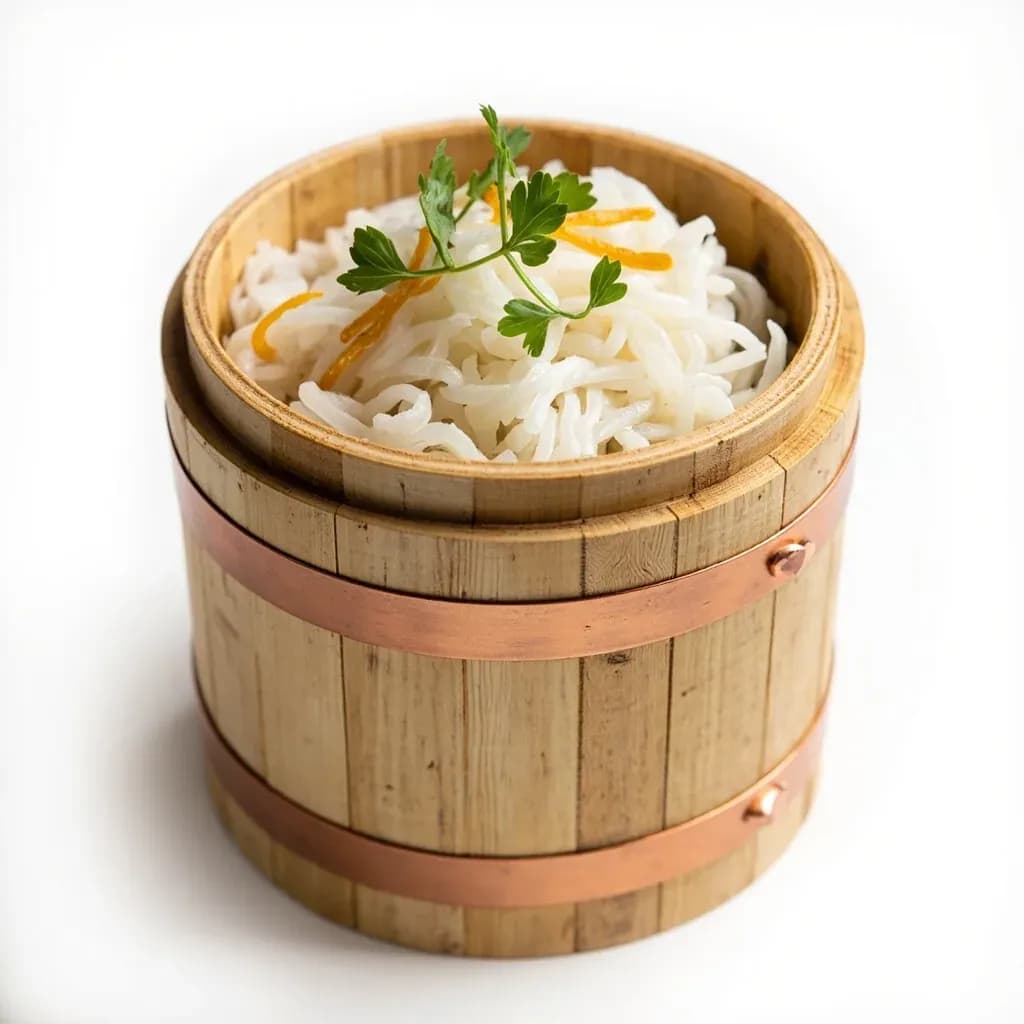
Hangiri Sushi Rice Tub
A wide, flat-bottomed wooden tub used to cool and season cooked rice for sushi.
A hangiri is a shallow, wide-rimmed cypress (hinoki) tub bound with copper hoops, used to mix and cool freshly cooked rice with seasoned vinegar. The large surface area and absorbent wood draw off excess moisture and steam, giving sushi rice its glossy, separate grains. Sushi rice is cut and folded in the tub with a paddle while being fanned.
A hangiri is a wide, shallow wooden tub — traditionally coopered from hinoki (Japanese cypress) — whose geometry and material are both deliberate answers to the problem of preparing rice for sushi. Cooked short-grain rice comes off the pot at 80–85 °C with steam still rising from every grain; if that rice is piled in a deep bowl it continues to cook in its own residual heat, the grains collapse into paste, and the surface turns gummy. The hangiri solves this by spreading the rice into a thin, even layer across a broad flat bottom, exposing it to air so steam and surface moisture escape quickly. The shallow depth (roughly 10–15 cm) and sloped sides also let the cook work the rice with a flat paddle without burying it, which matters once vinegar is introduced.
The wood does work that metal or plastic cannot. Hinoki is mildly hygroscopic: it draws a small amount of surface water out of the outermost grains, which is what gives properly seasoned sushi rice its characteristic sheen and the ability to hold its shape grain-by-grain rather than collapsing into a starchy mass. At the same time, wood insulates the rice from a rapid temperature drop, so the grains cool through the critical 60–50 °C zone evenly instead of shocking on the outside and staying hot in the center. Modern plastic or stainless sushi-oke are functional substitutes, but they neither wick moisture nor buffer temperature, so the finished rice tends to read slightly wetter and clumpier.
In serious sushi shops the hangiri is treated as an heirloom, paired permanently with a wooden shamoji (rice paddle), and never touched with soap. A new tub is seasoned with vinegar before first use, and over years develops a light patina that cooks prize rather than scrub away. The same tool is also read as 'handai' (飯台) in Kansai — the form, function, and care are identical.
Alternatives
Types & varieties
Premium choice; pale, aromatic Japanese cypress; favored in top sushi restaurants for moisture-wicking and subtle fragrance.
More affordable and widely available; slightly coarser grain, still functional, somewhat more absorbent than hinoki.
Reinforced with a copper or brass band at the rim; traditional in many Kyoto- and Tokyo-style shops.
Sealed interior for easier cleaning, but the lacquer reduces the wood's moisture-absorption benefit.
30–36 cm versions sized for 1–3 go of rice; popular for domestic use.
45–60 cm models used at edomae counters to handle 5–10 kg of rice at a time.
Why wood, and why this shape
Every element of the hangiri is a response to how cooked rice behaves in the first minutes after the pot. A flat, wide bottom spreads rice in a layer 2–3 grains thick, so steam vents upward instead of staying trapped in a hot core. Sloped rather than vertical sides let the cook reach the bottom with a flat paddle without digging. The wood itself moderates both moisture and temperature: hinoki pulls a thin film of water off the outer grains (which is why properly hungiri-finished rice looks glossy rather than wet) and insulates against the kind of fast surface chill that a metal bowl would cause. Plastic tubs perform the spreading function but do nothing about moisture or chill; stainless steel actively cools the rice too fast and can over-dry the surface.
- Flat bottom spreads rice into a 2–3 grain layer for fast steam venting.
- Hinoki wicks surface moisture without drying the grain's interior.
- Wood insulates, preventing the rapid surface chill that ruins texture.
- Sloped sides give the paddle clearance to cut and fold without crushing.
Seasoning, care, and longevity
A new hangiri has a faint raw-wood smell that will transfer to rice on first use, so it is seasoned by wiping the interior with a cloth dampened with rice vinegar and letting it dry. From then on, the tub is treated more like a cutting board than a mixing bowl: rinse quickly under cool water, wipe with a clean cloth, and stand it on its side in shade to air dry. Soap, soaking, and dishwashers are forbidden because they swell the coopered staves, lift the glue joints, and split the copper band. A light patina of use is desirable; an occasional rub with fine salt on a dry cloth refreshes the wood and lifts residual odors. Store the tub in a cool, ventilated spot, rotated occasionally so no single side dries faster than the rest.
- Season new tubs with a rice-vinegar wipe before first use.
- Rinse, wipe, and stand on its side to dry — never soak or dishwasher.
- Refresh occasionally with a dry salt rub; avoid soap.
- Store in shade, ventilated, rotated; lift by the band, not the staves.
Common uses
Tips & pitfalls
- Season a new hangiri by wiping it with a cloth dampened with rice vinegar; this tightens the grain and neutralizes raw-wood taste before first use.
- Never soak a hangiri in water — prolonged wetting swells the staves, warps the bottom, and splits the copper band along the rim.
- Use only a wooden shamoji; metal paddles scratch the interior and can react with vinegar, leaving an off-flavor in the rice.
- When folding vinegar into hot rice, work with a slicing and cutting motion rather than stirring — pressing or mashing crushes the grains and produces gluey, broken shari.
- Avoid dish soap entirely; if the tub smells sour, wipe with diluted rice vinegar, then air dry. Soap residue is hard to rinse from wood and taints the next batch.
- Direct sunlight, a hot radiator, or a heating vent will crack the staves; store the tub in a cool, shaded, ventilated spot, ideally resting on a wooden shelf.
- A light patina of use is a sign of a well-cared-for tub — resist the urge to scrub it back to new.
- Lift by the copper band, not by gripping the staves; the band reinforces the rim, but the joints can loosen if stressed.
Good to know
- Japanese name
- Hangiri (飯切り) in Tokyo; Handai (飯台) in Kansai
- Material
- Traditionally hinoki (Japanese cypress); also sugi (cedar); sometimes bound with copper or brass
- Shape
- Round, flat-bottomed, shallow, with gently sloped sides
- Typical diameters
- 30–60 cm (12–24 in); professional sushi-ya use 45–60 cm
- Typical depth
- 10–15 cm (4–6 in)
- Companion tool
- Shamoji (flat wooden rice paddle)
- Weight (60 cm, empty)
- 2.5–4 kg depending on wood and banding
- Care
- Wipe only — no soaking, no dishwasher, no soap
Also called
Sushi Rice Tub · Handai
Related

Peeler
Swift blade for stripping skin off fruit and vegetables

Grater
Sharp-toothed surface for shredding cheese and vegetables

Microplane
Ultra-fine rasp for citrus zest, garlic, and hard cheese

Mixing Bowl
All-purpose bowl for combining, whisking, and tossing

Whisk
Looped wires that beat air into eggs, cream, and sauces

Spatula
Flat blade for flipping, lifting, and scraping

Slotted Spoon
Pierced spoon that lifts solids and drains the liquid behind

Wooden Spoon
Gentle, heat-friendly spoon for stirring anything