Prep Tools
Honey Refractometer
An optical gauge that reads honey's moisture content to confirm it is ripe.
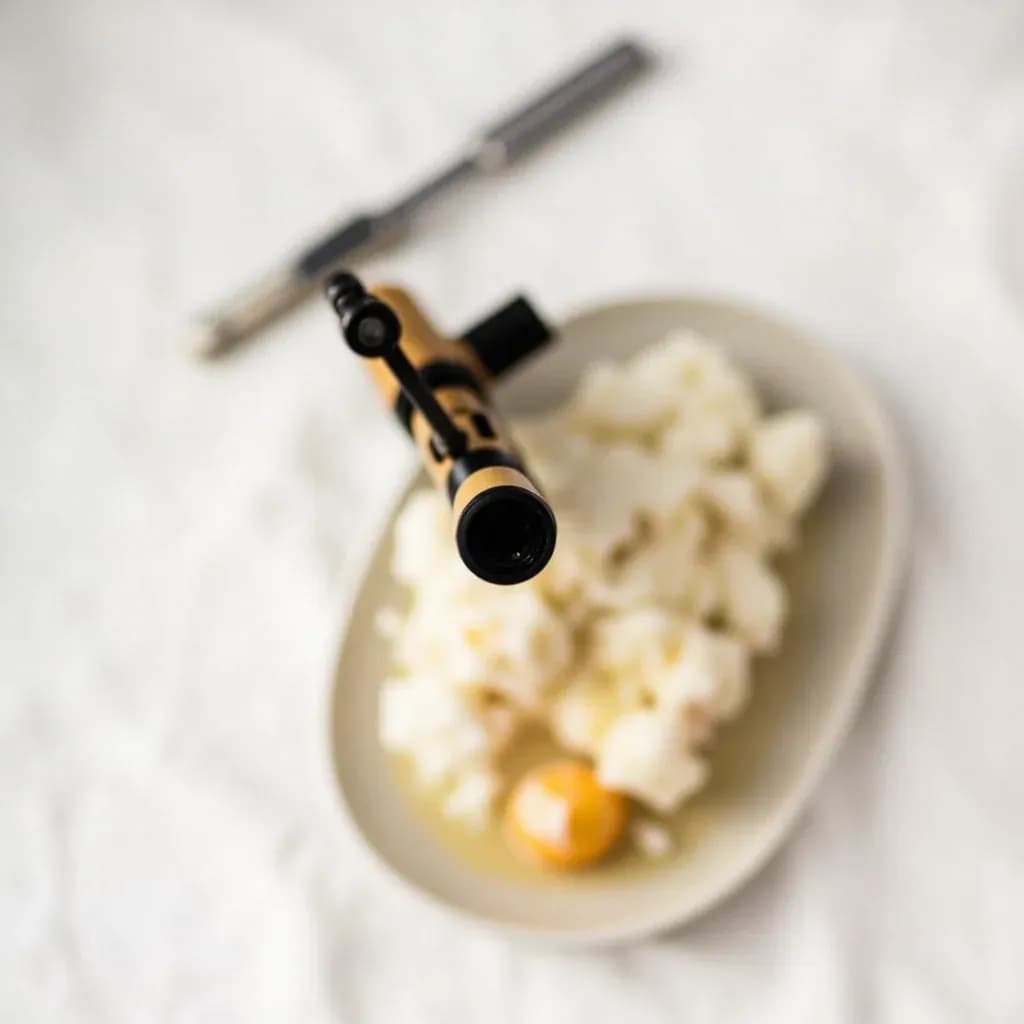
A honey refractometer measures how light bends through a drop of honey to determine its water content, typically on a Brix or honey-specific scale. Beekeepers use it before harvest and bottling to confirm honey is below about 18 to 20 percent moisture so it will not ferment. A quick drop on the prism gives an instant reading through the eyepiece.
A honey refractometer is a specialized optical instrument that reads the water content of honey by measuring how much light bends as it passes through a thin film of the sample. Where a kitchen or general-purpose Brix refractometer is calibrated for the relatively dilute sugar solutions of fruit juice and jam, a honey refractometer is rescaled to read in percent moisture across roughly 12–27% water content, with most units also showing Brix (about 58–92 °Bx) on a secondary scale. Two or three drops of honey on the prism are enough to produce a sharp boundary line in the eyepiece, and that single number tells the user whether the honey is ripe, stable, and legally marketable.
The practical importance of that reading is hard to overstate. Honey above about 18% moisture carries a real risk of fermenting in the jar, and most regulatory standards — Codex Alimentarius, the EU honey directive, and USDA grading — cap table honey at 20%, with premium table grades sitting below 18.5%. A refractometer is the fastest, most reliable way to check that threshold: far more precise than a hydrometer, far faster than laboratory analysis, and affordable enough for any serious beekeeper, mead maker, or honey packer.
In a cooking context the tool earns its place at the bench of anyone who buys honey in bulk, blends varietals, makes mead or honey glazes, or needs to diagnose a batch that seems to be going off. It also matters at the source: beekeepers use it to decide when a frame of capped honey is ready to leave the hive, traditionally waiting until roughly three-quarters of the cells are capped before sampling the rest.
Alternatives
Types & varieties
Handheld unit with eyepiece, daylight illumination, and optional ATC; the workhorse of small-scale beekeepers.
Electronic sensor with LCD readout, automatic temperature compensation, and higher repeatability; battery-powered.
Built-in compensation for samples read between roughly 10–30 °C, removing the need for temperature correction tables.
Displays both % moisture and Brix (typically 58–92 °Bx), useful for reading honey and general sugar solutions on one instrument.
Pocket-sized digital model with a small sample well; favored for fast field checks at the apiary.
The 18% line and why it matters
The number on the scale is small, but the consequences are large. Honey is a supersaturated sugar solution that is microbiologically stable precisely because there is not enough free water for yeast cells to multiply. Cross that line — generally somewhere between 17.5 and 18.5% moisture, depending on the honey's sugar profile — and the dormant osmophilic yeasts present in nearly every honey can begin to ferment. The result is the sour, fizzy, often foamy honey that has gone wrong in the back of a cupboard.
- Below 17.5%: very stable; ideal for long storage and for blending drier varietals into a wetter batch.
- 17.5–18.5%: the safe commercial band; almost all regulatory definitions of table honey sit here.
- 18.5–20.0%: legal in many jurisdictions for industrial or baking honey, but fermentation risk rises with temperature and time.
- Above 20.0%: outside most standards; treat as a fermentation risk unless the honey is being actively dehydrated.
- Crystallized and creamed honey: refract only after gentle liquefaction, since crystals scatter light and produce an unreadable boundary line.
Field technique at the hive
A refractometer is most useful in the hands of a beekeeper deciding which frames to pull, and a few habits make the difference between a reliable reading and a misleading one. Edge frames and uncapped cells almost always read wetter than the center of a fully capped super, so the right sample is a smear of capped honey drawn from several frames spread across the box.
- Sample from capped cells only, ideally three to five frames spread across the super.
- Take the reading in the shade, not in direct sun, which heats the prism and the sample unevenly.
- If the hive is hot, let the sample sit on the prism for about 30 seconds to equilibrate before reading.
- Average three readings per super; a single wet frame can drag a whole batch above the threshold.
- Do not test honey that has been sitting on a hot truck or in a sun-warmed extractor — return it to room temperature first.
Common uses
Tips & pitfalls
- Calibrate with a few drops of distilled or deionized water at 20 °C before each session; the scale should read 0% moisture (or 0.0 °Bx on the Brix scale).
- Bring the honey sample to room temperature (around 20 °C) before reading — temperature is the single largest source of error on analog units.
- Sample from multiple frames across the super and average the readings; edge frames and uncapped cells almost always run wetter than the center.
- Press the cover plate gently so the sample spreads as a thin, even film with no air bubbles; trapped air throws off the boundary line.
- Clean the prism with a soft microfiber cloth and distilled water only, and wipe gently to avoid scratching the glass.
- Do not test creamed or crystallized honey directly — liquefy the sample gently in a warm water bath first, then cool it back to 20 °C before reading.
- Rinse and dry the instrument thoroughly after each use and store it in its case to prevent prism fogging or corrosion.
- Avoid using a general-purpose Brix refractometer for honey: its scale is calibrated for sucrose solutions and reads inaccurately above about 19% moisture.
Good to know
- Measurement principle
- Reads the refractive index of honey through a glass prism; the boundary line on the internal scale is translated into percent moisture, and often Brix on a secondary scale.
- Moisture scale range
- Approximately 12–27% water content, with the key quality threshold at 18.0–18.5%.
- Calibration temperature
- Standardized at 20 °C (68 °F); ATC models compensate automatically between roughly 10–30 °C.
- Sample volume
- 2–3 drops of liquid honey (about 0.1–0.2 mL) on the prism.
- Regulatory threshold
- Most international standards cap honey at 20% moisture; premium table honey runs below 18.5%.
- Resolution
- Typically 0.1% increments on the moisture scale.
- Light source
- Ambient daylight on analog models; internal LED on digital units.
Also called
honey refractometer · moisture refractometer
Related

Peeler
Swift blade for stripping skin off fruit and vegetables

Grater
Sharp-toothed surface for shredding cheese and vegetables

Microplane
Ultra-fine rasp for citrus zest, garlic, and hard cheese

Mixing Bowl
All-purpose bowl for combining, whisking, and tossing

Whisk
Looped wires that beat air into eggs, cream, and sauces

Spatula
Flat blade for flipping, lifting, and scraping

Slotted Spoon
Pierced spoon that lifts solids and drains the liquid behind

Wooden Spoon
Gentle, heat-friendly spoon for stirring anything