Prep Tools
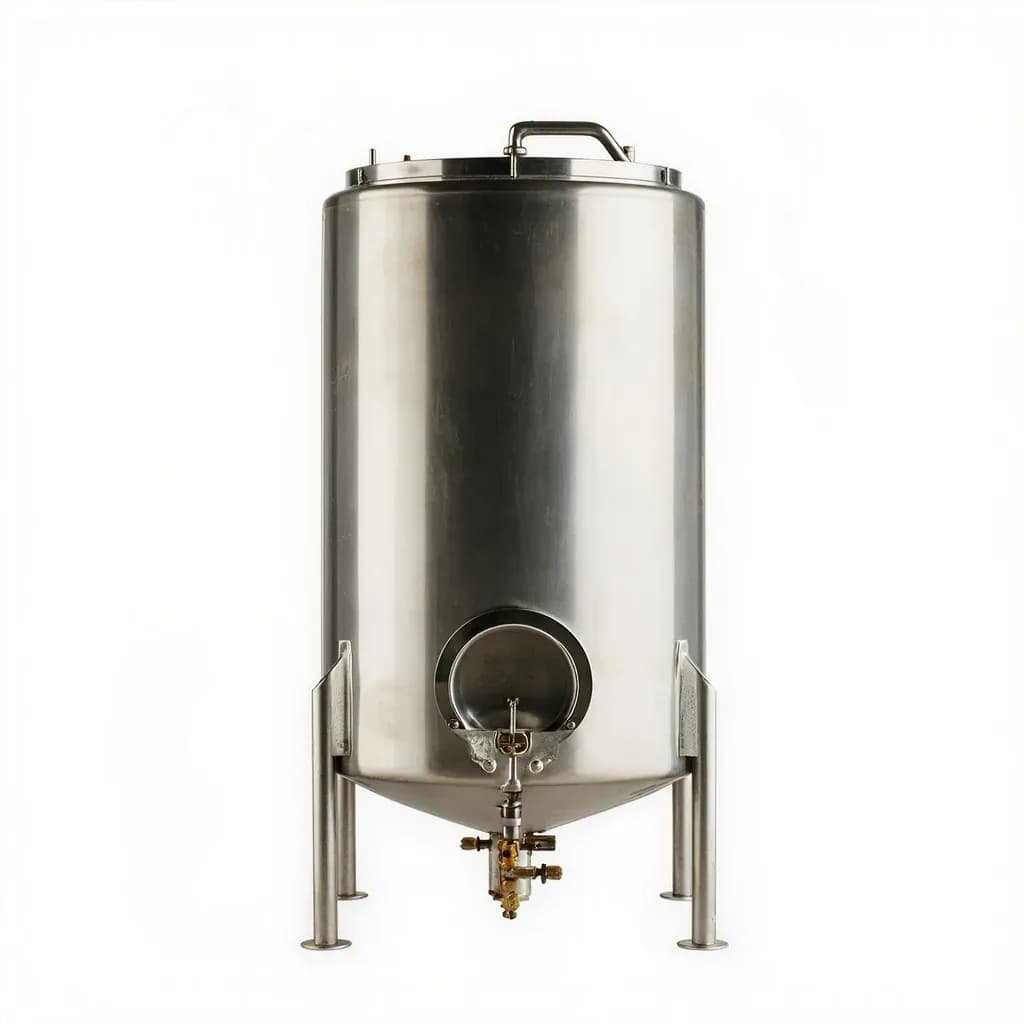
Honey Settling Tank
A tall tank that lets air bubbles and wax rise out of freshly extracted honey before bottling.
A honey settling tank is a food-grade stainless container with a bottom gate valve where extracted honey rests for a day or two. During settling, fine wax bits and air bubbles float to the top while clean honey is drawn off from below. Beekeepers use it between extraction and jarring to produce clear, bubble-free honey.
A honey settling tank is the quiet workhorse of the honey house — a tall, narrow vessel that sits in the processing line between the extractor and the bottling tank (or, in small operations, the jar itself). Its job is purely gravitational: hold freshly extracted honey still and warm for long enough that air bubbles, fine wax flecks, propolis bits, and the occasional bee part that survived extraction can float to the top on their own. The beekeeper then skims the resulting scum and draws clear honey from a bottom-mounted gate.
The physics are simple but unforgiving. Honey is dense (about 1.42 kg/L) and viscous, while wax and air are not, so given enough vertical distance and time debris migrates upward on its own. That is why settling tanks are built tall and narrow rather than short and wide — more height means more time for the lightest particles to rise out of the column. Viscosity is the limiting factor: at cool room temperature honey is so thick that bubbles barely budge, which is why most operations hold the tank at 25–35 °C (77–95 °F) to speed the work. A typical strained batch clears in 12–48 hours; freshly extracted, foamy honey from new comb may need 3–5 days.
The beekeeper's tool rarely appears in a working kitchen, but the principle does. Small-scale extractors substitute food-grade plastic buckets with gates, or simply a tall stockpot left in a warm (not hot) place overnight. The lesson for anyone storing or repackaging honey is the same: a brief, gentle warm rest improves clarity and texture, while rough handling re-introduces exactly the air the settling tank was built to remove.
Alternatives
Types & varieties
Lightweight, inexpensive, common for hobbyists; opaque white plastic blocks light that can darken honey over time.
Durable and sanitary, preferred by commercial packers; often jacketed or designed to sit inside a warming cabinet.
Sloped bottom funnels every last drop toward the honey gate, reducing waste of the cleanest honey at the very bottom.
Simpler and cheaper; works fine when paired with a baffle or when the operator is willing to tip the tank at the end.
Built-in band or coil heater (or a glycol jacket) holds honey at a steady warm temperature to shorten settling time and keep the gate flowing freely.
Removable fine-mesh basket at the top so straining and settling happen in one vessel, useful for small operations without a separate strainer.
Adjacent piece of equipment that catches drips and pump-off from the bottling line; sometimes used interchangeably with a settling tank for small operations.
Sizing and Material
Choose a tank with roughly 10–20% more capacity than the largest single extractor load you plan to pour in at one time, and never fill it past the 90% line — headspace is where the foam and wax cap will live while it rises. Material matters less for the honey itself than for the operator: stainless is the workhorse of any operation that handles more than a few hundred pounds a year because it tolerates hot-water sanitizing and decades of use, while food-grade polypropylene is the right answer for hobbyists who want something light enough to lift off a single-frame harvest. Heated or jacketed tanks are worth the investment when the honey house sits in a cool climate or when the operator is running varietals that benefit from a steady, controlled temperature during clarification.
Working the Honey Gate
The gate is where a clean batch is won or lost. A few habits separate clear, professional honey from cloudy jars:
- Open the gate slowly and let it run for a few seconds into a scrap jar before you commit to the filling jar; the first draw is often the cloudiest.
- Stop drawing well before the tank is empty — the last 5–10% at the top sits under the wax cap and is better returned to a coarse strainer for re-processing.
- If the gate slows to a drip, the honey is cooling; close it, warm the tank back to about 30 °C, and resume rather than forcing flow by cranking the valve.
- Re-seal the tank immediately if you pause mid-bottle; an open gate is an open invitation for dust, drips, and insects to undo the clarity you just built.
Common uses
Tips & pitfalls
- Fill only to about 90% capacity; leave headspace for the foam and wax cap that will rise to the top.
- Warm the tank (or the room) before pouring in honey — cold honey settles very slowly because of high viscosity.
- Skim or ladle off the wax-and-air scum that forms on top before you start drawing from the bottom gate.
- Draw from the bottom; reserve the last 5–10% of honey at the top to return to a coarse strainer rather than bottle it clear.
- Cover the tank. Honey is hygroscopic and absorbs moisture from the air, and surface contamination from dust or insects ruins the clarity you just settled for.
- Avoid galvanized or non-food-grade metal; acids in honey react with zinc and off-flavor the batch.
- Do not stir or pump the honey once settling has started — vibration re-suspends the very particles you are trying to remove.
- Sanitize with hot water only; strong chlorine or scented detergents linger in honey and pass straight through to the consumer.
- Let freshly extracted, very foamy honey stand longer (3+ days) or warm it gently so trapped air can escape before bottling.
- For varietals (clover, orange blossom, tupelo, and the like), use a dedicated tank so flavors do not cross-contaminate between batches.
Good to know
- Material
- Food-grade stainless steel in commercial operations; food-grade polypropylene plastic for hobbyist scale.
- Typical shape
- Tall, narrow cylinder, often with a slightly conical bottom leading to a honey gate; height-to-width ratio is intentionally greater than 1 so debris has more vertical distance to rise.
- Typical capacities
- Hobbyist 5–25 L (1.3–7 gal); sideline 50–200 L (13–50 gal); commercial 200–1500 L (50–400 gal).
- Outlet
- Bottom-mounted honey gate (also called a honey valve or bottling valve), usually a nylon or stainless ball valve with a restrictor to slow flow.
- Cover
- Sealed or loose-fitting lid to keep out dust, insects, and airborne moisture, since honey is hygroscopic and readily absorbs water from the air.
- Recommended settling temperature
- Roughly 25–35 °C (77–95 °F). Warmer honey is less viscous, so bubbles and wax rise faster.
- Typical settling time
- 12–48 hours for lightly strained honey; up to 3–5 days for unwaxed, freshly extracted honey with high air content.
- Position in workflow
- Comes after extraction and (optionally) coarse straining, before bottling.
Also called
settling tank · honey ripener · bottling tank
Related

Peeler
Swift blade for stripping skin off fruit and vegetables

Grater
Sharp-toothed surface for shredding cheese and vegetables

Microplane
Ultra-fine rasp for citrus zest, garlic, and hard cheese

Mixing Bowl
All-purpose bowl for combining, whisking, and tossing

Whisk
Looped wires that beat air into eggs, cream, and sauces

Spatula
Flat blade for flipping, lifting, and scraping

Slotted Spoon
Pierced spoon that lifts solids and drains the liquid behind

Wooden Spoon
Gentle, heat-friendly spoon for stirring anything