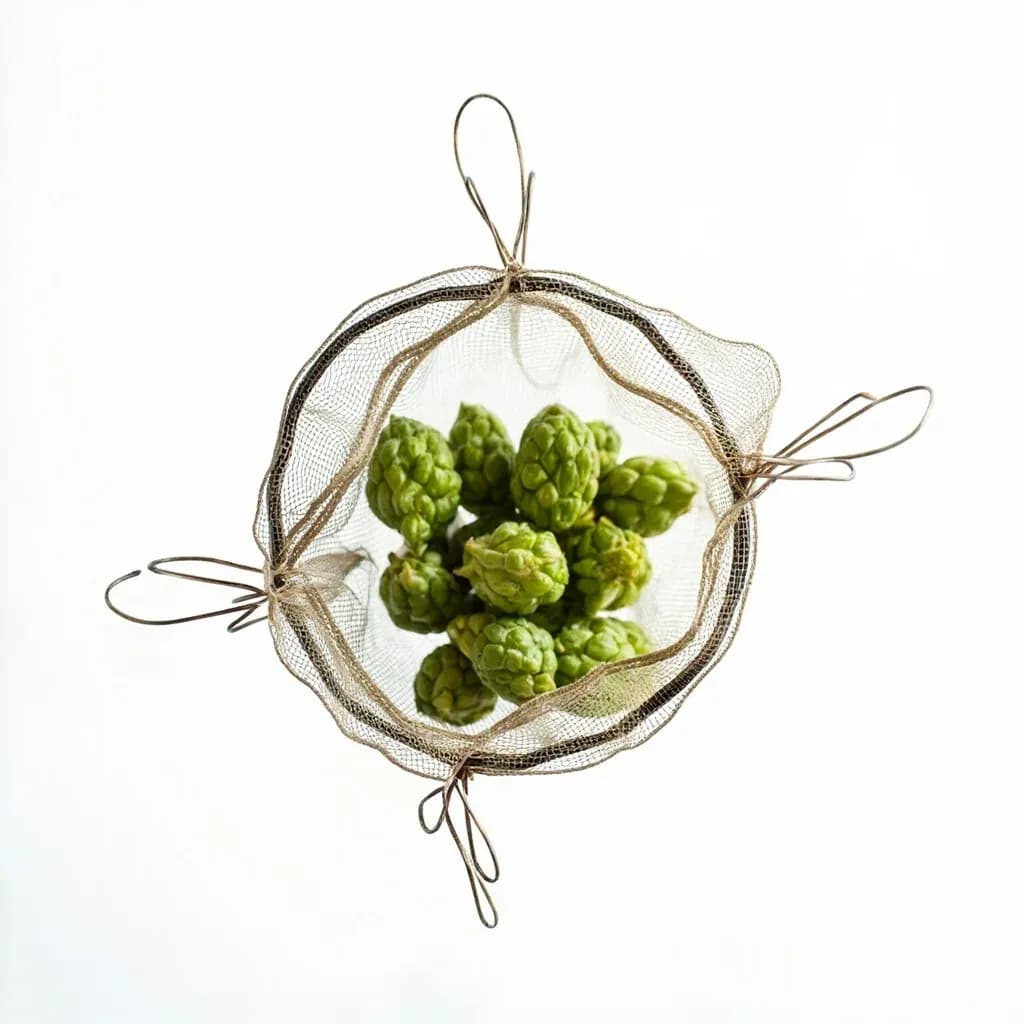
Prep Tools
Hop Spider / Hop Bag
A mesh container that holds hops in the boil or fermenter so the brew stays clear of plant matter.
A hop spider is a mesh tube or filter that suspends hops in a brew kettle so their bitterness and aroma steep into the wort while the spent matter stays contained. A hop bag does the same job as a simple mesh sack, also used for dry-hopping in the fermenter. Both keep the finished beer clearer and make cleanup faster than loose hops.
A hop spider or hop bag is a permeable container — either a rigid stainless-steel mesh cylinder or a fine fabric sack — used to hold hops (and often other flavorings) inside boiling wort or a fermenter. By confining the plant material, the brewer can lift it cleanly out of the kettle at flameout, keep hop debris from clogging plate chillers or transfer lines, and pull a clearer, less vegetal beer into the fermenter. The trade-off is convenience versus maximum hop utilization: bagged hops make slightly less intimate contact with the wort, so bitterness targets can run a few IBUs lower than a comparable loose-hop charge, which matters when chasing a precise IPA.
In practice the tool earns its keep at two moments — the late-boil aroma additions and the cold-side dry hop — where loose hop debris is the main source of kettle mess, trub carryover, and clogged dip tubes. A spider also accepts non-hop ingredients (spices, citrus peel, coffee, oak chips, fruit) with the same easy-removal benefit. The same mesh cylinders double outside brewing as spice cages for stocks, court-bouillons, mulled wine, and tea infusions, which is why many cooks who don't brew keep one in a drawer anyway.
Alternatives
Types & varieties
Cylindrical mesh basket with a hook that suspends from the kettle rim; reusable, durable, easy to clean, and the modern homebrewing standard.
Tube of mesh closed at one end and pulled shut with a food-safe cord; cheaper and more flexible than a framed spider, and packs flat.
Fine-woven reusable bag; the homebrewing workhorse — good wort contact with effective debris trapping.
Traditional coarse-woven cotton sack; cheap and accessible, but sheds lint and is harder to fully sanitize.
Reusable bag with sewn-in weight/volume markers so you can dose hops without a scale.
Integrated into some electric all-in-one brewing systems; fixed in the kettle wall and out of the way of the malt pipe.
Coarser-weave bag fitted with stainless washers or a chain so it sinks and stays submerged during dry hopping.
Bagging vs. loose hops: the utilization trade-off
The single most important thing to know about a hop spider is that it is not perfectly transparent to the wort. The mesh holds back the hop solids, so alpha acids and aroma oils must extract through a barrier that limits surface contact and reduces circulation with the bulk wort. Pellets in particular tend to form a wet, sticky mass that channels wort around itself instead of through itself, compounding the effect. Experienced brewers report utilization losses of roughly 5–10% compared with loose hopping, which translates to slightly lower IBUs and sometimes a touch less late-hop aroma intensity. The practical responses are simple: dose a small early bittering charge loose and bag only the late additions, or build an extra 10% of hops into bagged additions to hit the same target.
- Pellets compact more than leaf hops and benefit from a coarser mesh or a wider basket.
- Loose bittering hops extract fastest; bag only what you intend to remove.
- Agitate the spider once or twice during a long boil to break up stagnant pockets.
- For whirlpool/hop-stand additions, drop the spider after flameout and rest 15–30 minutes for aroma pickup.
Beyond the boil: dry hopping and secondary flavorings
The same container is just as useful on the cold side. A weighted dry-hop sock keeps pellets submerged below the CO₂ blanket so they don't foul the airlock and oxidize the beer, and it lets you pull the spent hops in one motion before transfer — no floating debris at the racking tube, no green krausen ring in the fermenter. The mesh also tames aggressive secondary additions that would otherwise turn to mush: citrus peel, coffee grounds, oak chips, vanilla beans, fruit purées, and whole spices for a holiday ale. Anything you want to steep and then remove cleanly belongs in a bag.
Uses outside brewing
A rigid stainless spider has a quiet second life as a kitchen spice cage. It infuses mulled wine, cider, and hot toddy mixes without leaving broken peel and clove husks floating in the cup, and it drops cleanly into a stockpot for court-bouillon, pho-style broths, or a pickling brine where you want whole spices present for the simmer but absent at service. Tea drinkers use small versions for loose-leaf infusions, and a fine mesh bag works as a reusable bouquet garni holder for any long simmer.
Common uses
Tips & pitfalls
- Wet a fabric bag before adding hops — a dry bag wicks moisture out of the wort and slows flow into the mesh.
- Do not overpack the spider: leave room for hops to expand and wort to circulate, or alpha-acid extraction will suffer and you will leave bitterness on the table.
- Hang the spider fully submerged but not sitting on the kettle floor, where direct contact with the heating element can scorch hops and create harsh bitterness bumps.
- Agitate or stir the spider a couple of times during a long boil — stagnant pockets underutilize the hops and leave a green core at knockout.
- Rinse the spider or bag immediately after use: alpha acids and hop resins polymerize as they cool and will permanently stain or clog the mesh if left to dry.
- Sanitize fabric bags with a no-rinse sanitizer or by boiling 5 minutes before each use; never reuse a bag that smells musty or sour.
- Replace fabric bags every handful of brews once the mesh stretches, develops holes, or refuses to shed water — a torn bag drops hop debris straight back into the kettle.
- For dry hopping, weigh the bag down with food-grade stainless washers or a length of chain; floating bags ride up to the airlock and can pull oxygen into the headspace.
Good to know
- Also called
- Hop bag, hop filter, hop basket, hop sock
- Primary materials
- Woven stainless-steel mesh (rigid spider) or food-grade nylon, muslin, or polyester (bag)
- Typical mesh size
- Roughly 200–400 micron for rigid spiders; bag weave ranges from coarse (whole leaf) to fine (pellets)
- Working environment
- Boiling wort (100 °C / 212 °F); also used cold in fermenters and kegs for dry hopping
- Compatible hop forms
- Pellets, whole leaf, and hop plugs
- Common sizes
- Sized for 5-gallon (19 L) and 10-gallon (38 L) homebrew kettles; commercial versions scale up
- Cleaning
- Rinse immediately after use; stainless versions are dishwasher-safe; fabric bags can be boiled or machine-washed unscented
- Storage
- Hang dry; store dry in a sealed bag to prevent mildew on fabric versions
Also called
Hop Cannon · Dry-Hop Doser · Hop Bag · Hop Filter
Related

Peeler
Swift blade for stripping skin off fruit and vegetables

Grater
Sharp-toothed surface for shredding cheese and vegetables

Microplane
Ultra-fine rasp for citrus zest, garlic, and hard cheese

Mixing Bowl
All-purpose bowl for combining, whisking, and tossing

Whisk
Looped wires that beat air into eggs, cream, and sauces

Spatula
Flat blade for flipping, lifting, and scraping

Slotted Spoon
Pierced spoon that lifts solids and drains the liquid behind

Wooden Spoon
Gentle, heat-friendly spoon for stirring anything