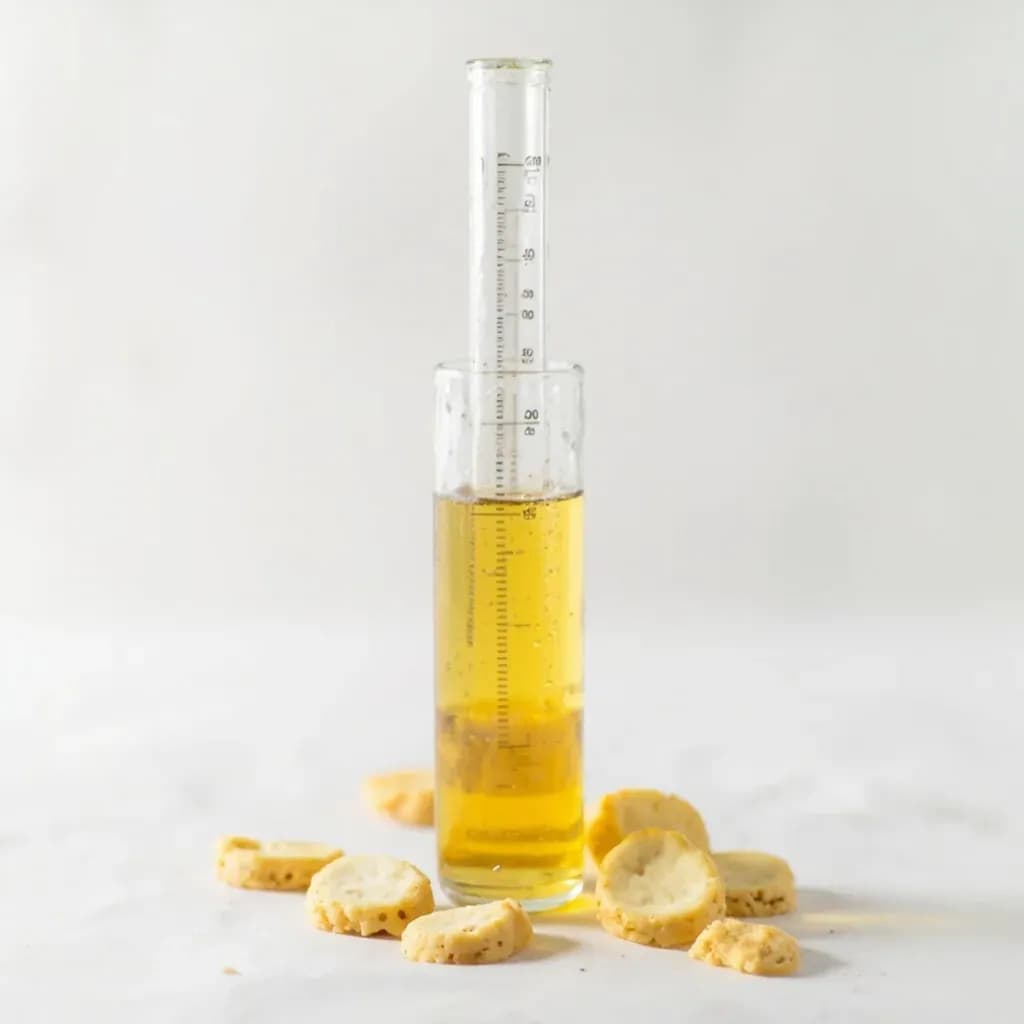
Prep Tools
Hydrometer
A floating glass instrument that measures a liquid's density to track sugar or alcohol.
A hydrometer is a sealed, weighted glass float that sinks to a depth determined by the density of the liquid it floats in, read off a calibrated stem. Brewers, winemakers, and distillers use it to measure sugar content (specific gravity) before fermentation and again after to calculate alcohol; confectioners use it for syrup density. The reading should be taken at the liquid's reference temperature for accuracy.
A hydrometer is a slender, hand-blown glass tube with a weighted bulb at the bottom and a paper scale inside, designed to float in a sample of liquid and indicate that liquid's density relative to pure water. It works on Archimedes' principle: the denser the liquid, the higher the instrument rides; the lighter it is, the deeper it sinks. In the kitchen it is the traditional instrument for tracking the sugar content of wort, must, and syrup, and for following the slow metabolic drama of fermentation from start to finish.
In practice the hydrometer lives almost entirely in the brewing and winemaking world, where it answers questions no other common kitchen tool can: how much sugar is dissolved in this liquid, how much of that sugar has been converted to alcohol, and whether fermentation has actually finished. A few pastry cooks and confectioners still keep a Brix or Baumé instrument for large batches of sugar syrup, where it functions as a slow but trustworthy alternative to a refractometer.
Its great strength is mechanical simplicity — no batteries, no electronics, just glass and gravity. Its corresponding weakness is that it must float in a tall column of relatively cool liquid, it is sensitive to temperature, and it rewards patient technique. A reading taken carelessly can be off by several gravity points, which translates directly into miscalculated alcohol or misjudged sweetness.
Alternatives
Types & varieties
The standard homebrewer's instrument, reading roughly 0.990–1.120 in wort and beer
Calibrated in °Brix (percent sucrose by weight); the workhorse scale in winemaking and cidermaking
A dedicated sugar-concentration instrument used in brewing and in sugar-syrup work
Reads in degrees Plato, the brewing industry's equivalent to Brix and the commercial-brewery standard
Used after fermentation or distillation to estimate alcohol by volume; will not give a meaningful reading in unfermented wort
Glass hydrometer with a built-in thermometer and a printed correction chart for accurate temperature-adjusted readings
Combines SG, Brix, and potential alcohol on a single scale; the all-in-one choice for homebrewers
An older scale still found in some winemaking and confectionery work, where °Baumé approximates sugar density
Taking a clean reading
A hydrometer reading is only as good as the technique behind it. Small errors in temperature, bubbles, or eye position can shift the result by several gravity points, and several points of error is the difference between a strong pale ale and a session beer. Treat the reading as a deliberate procedure rather than a glance.
- Sanitize the test jar and the hydrometer first; contamination of an active fermentor with wild bacteria or old yeast is a real risk.
- Pour wort or must gently down the side of the jar to minimize splashing and air incorporation.
- Spin the hydrometer between your fingers once or twice after dropping it in to dislodge clinging bubbles, which falsely lift the reading.
- Lower your head until your eye is level with the liquid surface and read at the bottom of the meniscus.
- Note the sample temperature and apply the printed correction table if it differs from the hydrometer's calibration temperature.
- Discard the sample rather than pouring it back into the fermentor; the few seconds in an open jar can introduce contaminants and oxidation.
Temperature and accuracy
Temperature is the single most common source of error with a glass hydrometer. A sample drawn from a 75°F fermentor and read on a 60°F-calibrated instrument will appear denser than it really is, because warm liquid expands and floats the hydrometer higher. The printed correction table that ships with most instruments takes roughly 0.001 SG off the reading for every 10°F above calibration, though the exact figure varies. A thermo-hydrometer with a built-in thermometer makes this correction easier to apply correctly.
- Cool the sample to the hydrometer's calibration temperature for the most accurate reading, or chill the jar in a water bath.
- If cooling is impractical, record the temperature alongside the gravity and look up the correction rather than guessing.
- A clean, properly read glass hydrometer in clean hands is realistically precise to about ±0.002 SG — adequate for home work and most pro brewing.
Common uses
Tips & pitfalls
- Spin the hydrometer gently in the sample jar to dislodge clinging air bubbles, which falsely raise the reading.
- Read at the bottom of the meniscus with your eye level with the liquid surface — viewing from above or below skews the result.
- Bring the sample to the hydrometer's calibration temperature (usually 60°F/15.6°C or 68°F/20°C) or apply the printed correction table.
- Use a test jar at least an inch taller than the hydrometer so the instrument floats freely without touching the bottom.
- Never use an alcoholmeter in unfermented wort — dissolved sugar throws the reading off badly; use an SG, Brix, or Plato instrument instead.
- Rinse with cool, not hot, water; thermal shock can crack the thin glass and ruin the calibration permanently.
- Discard any hydrometer with chips, cracks, or a cloudy interior — the calibration can no longer be trusted.
- Record gravity alongside temperature every reading; the pair tells you the true value and tracks fermentation progress honestly.
Good to know
- Primary function
- Measures the density (specific gravity) of a liquid relative to water
- Operating principle
- Archimedes' principle — the depth to which the weighted glass floats indicates the liquid's density
- Calibration temperature
- Most are calibrated at 60°F (15.6°C) or 68°F (20°C); readings shift with temperature and must be corrected
- Typical scale
- Specific gravity (SG), where water reads 1.000; unfermented wort typically falls between 1.040 and 1.100+
- Reading point
- Bottom of the meniscus, with the eye level with the liquid surface
- Material
- Hand-blown glass with a weighted bulb (mercury or steel shot) and a printed paper scale inside
- Size and vessel
- About 6–8 in (15–20 cm) tall; needs a test jar at least an inch taller so the hydrometer floats freely
- Care
- Rinse with cool water, air dry upright, and store in its protective tube to preserve the calibration
Also called
Saccharometer · Specific Gravity Meter · Brewing Hydrometer
Related

Peeler
Swift blade for stripping skin off fruit and vegetables

Grater
Sharp-toothed surface for shredding cheese and vegetables

Microplane
Ultra-fine rasp for citrus zest, garlic, and hard cheese

Mixing Bowl
All-purpose bowl for combining, whisking, and tossing

Whisk
Looped wires that beat air into eggs, cream, and sauces

Spatula
Flat blade for flipping, lifting, and scraping

Slotted Spoon
Pierced spoon that lifts solids and drains the liquid behind

Wooden Spoon
Gentle, heat-friendly spoon for stirring anything