Prep Tools
Ice Bath Tub
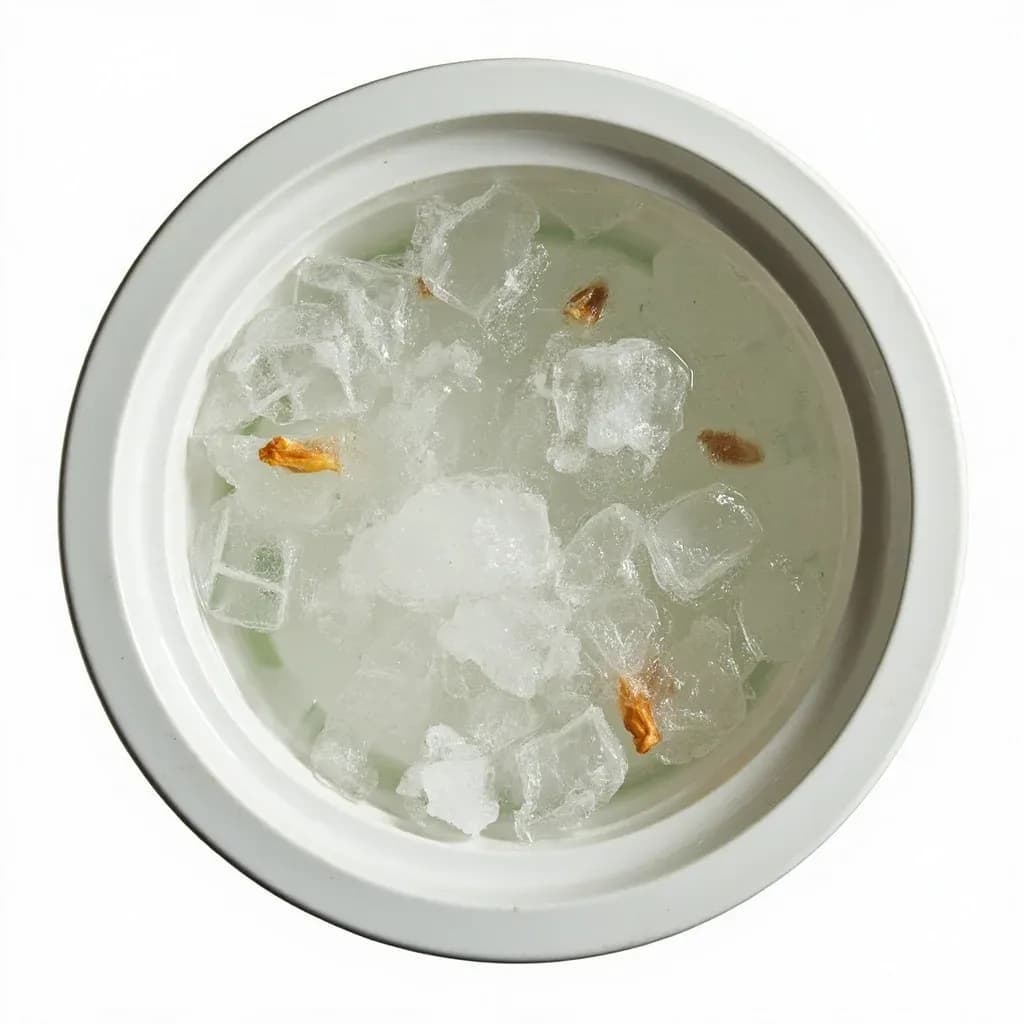
A tub of ice and water for shocking cooked food and rapidly chilling pans or bowls.
An ice bath tub is a basin filled with ice and water used to stop cooking instantly and cool food fast. Cooks plunge blanched vegetables, eggs, or poached items into it to lock in color and texture, and rest hot pans or bowls in it to chill custards and stocks quickly. The mix of ice and water transfers heat far faster than ice alone.
An ice bath tub is a leakproof container filled with a slurry of ice and cold water, used to drop the temperature of hot food, hot liquids, or warm equipment far faster than a refrigerator or freezer ever could. The principle behind it is the same one that makes a swimming pool feel colder than the air at the same temperature: water transfers heat roughly twenty-five times faster than air, so an object submerged in an ice bath gives up its heat in minutes rather than hours. In a working kitchen the setup is humble — a black polypropylene bus tub parked under the prep table, refreshed throughout service — but it is responsible for some of the most visible quality moves in cooking, from bright green blanched vegetables to glossy custards that don't weep to stocks that taste clean rather than flat.
Salt is the bath's secret weapon. Adding about a tablespoon of plain table salt per quart of ice water depresses the freezing point of the bath, typically pulling it into the high 20s°F / around -2°C — a meaningful drop below the freezing point of pure water. That extra chill matters when you are racing to cool a gallon of stock through the food-safety danger zone, or when you need to stop carryover cooking on a delicate custard before the eggs finish tightening off the heat. The trade-off is straightforward: skip the salt for vegetable shocks meant to be eaten without further seasoning, and reach for it whenever speed matters more than precision.
For food-safety-driven cooling, the ice bath exists to help meet the FDA Food Code's two-stage rule: move hot food from 135°F to 70°F (57°C to 21°C) within two hours, then from 70°F to 41°F (21°C to 5°C) within four more. A twenty-minute bath accomplishes what two hours in a refrigerator cannot, which is why the bath is treated as essential equipment in any kitchen that cools large volumes of soup, stock, braise, or sauce. At home, a 9 × 13 baking dish nested inside a roasting pan, or a large mixing bowl set in the sink, reproduces the same effect with tools you already own.
Alternatives
Types & varieties
Just ice and cold water; holds roughly 32°F / 0°C. Sufficient for shocking vegetables and gentle cooling tasks.
Ice water plus table salt (or kosher salt); drops the bath well below freezing. Used when speed matters — stocks, custards, large volumes.
Vodka or rubbing alcohol added to the ice lowers the temperature further; rarely used in kitchens, mainly lab and ice-cream contexts.
The classic restaurant setup: a black or white polypropylene bus tub under a prep station, reused all service.
Full- or half-size stainless insert set inside a larger hotel pan or sink; great for blanched vegetables or sheet-pan chilling.
Food-grade plastic containers that nest easily in a sink; opaque versions help keep light-sensitive items cool.
A pre-chilled salted bath used to stop carryover cooking on sous-vide bags, often followed by a brief rest on the counter to let the surface dry before skin-crisping.
Setting up an effective bath
The most common failure is using too little ice. A productive bath is closer to a slurry than a bucket with cubes floating in it — roughly a 1:1 ice-to-water ratio by volume, with enough headroom that the food can sit fully submerged without crowding. The container should be wider than it is deep when possible, because the food touches cold water on more surface area at once.
- Pre-chill the container with cold water before adding ice; a warm tub melts the first batch of ice before the bath is even ready.
- Add salt last and stir until dissolved to get the full sub-freezing effect; undissolved salt sitting on the ice is doing very little work.
- Use a spider or slotted spoon to lift blanched vegetables out of their cooking water and into the bath — pouring the cooking water in dilutes the bath and adds heat.
- Refresh the bath as soon as ice has visibly melted past halfway; a warm bath is barely cooling at all.
- Stir the food (or the bath) every minute or so when cooling liquids; still water forms an insulating boundary layer around the food.
Cooling large volumes safely
The ice bath is the first half of the FDA-recommended two-stage cooling method for hot foods destined for the refrigerator. Stage one uses the bath to drop the temperature from 135°F to 70°F (57°C to 21°C) within two hours, taking the food out of the bacterial-growth danger zone. Stage two finishes the job in a refrigerator, bringing the food from 70°F to 41°F (21°C to 5°C) within four more hours.
- Split large pots of stock or braising liquid into smaller, shallower vessels — a shallow hotel pan can lose heat three or four times faster than a deep stockpot of the same volume.
- Stir frequently while the pot sits in the bath; heat escapes fastest from the surface and from the walls in contact with the cold water.
- Label and date anything that moves from the bath back into a working container; cold items dropped into a warm bath are a common cross-contamination risk.
- Drain and sanitize bus tubs between uses; the bath stays cold enough to discourage pathogens, but the tub surface does not.
Common uses
Tips & pitfalls
- Weigh the bath with more ice than you think you need — most home cooks underestimate; aim for an ice slurry, not ice cubes floating in water.
- Add salt only when you need the extra few degrees of drop and the food tolerates it; for delicate custards or blanched vegetables meant to be served unsalted, skip it.
- Don't seal lids on submerged containers — pressure changes and water infiltration can cause issues; use weighted plates or leave lids ajar.
- Avoid putting piping-hot Pyrex or other borosilicate or annealed glass straight into ice water; let it temper at room temperature for 5–10 minutes first.
- For chocolate tempering, seed with chopped chocolate in the bath rather than adding cold water or ice directly to the chocolate itself.
Good to know
- Purpose
- Rapidly lowers the temperature of cooked food, hot liquids, or warm equipment to halt cooking, set textures, lock in color, or speed chilling for storage.
- Composition
- A leakproof container filled with a mixture of ice and cold water; salt is commonly added to drop the temperature below 32°F / 0°C.
- Heat-transfer principle
- Water conducts heat roughly 25 times faster than air, which is why a water bath chills food far more quickly than a refrigerator or freezer.
- Salted-bath temperature
- Adding about 1 tablespoon (≈15 g) of plain table salt per quart (≈1 L) of ice water pulls the bath into the high 20s°F / around -2°C; larger amounts of salt drive it lower (toward roughly 20°F / -6°C at saturation); rock or kosher salt works but dissolves more slowly.
- Ice-to-water ratio
- A productive bath is mostly ice with just enough water to make good contact — a roughly 1:1 ice-to-water ratio by volume is a common working target.
- Common containers
- Restaurant bus tubs (polypropylene, ~15 × 20 × 5 in / 38 × 51 × 13 cm), full- or half-size stainless hotel pans, Cambro translucent containers, and large stainless mixing bowls.
- Material caution
- Hot glass should not be plunged into an ice bath — thermal shock can shatter it; let glass cool briefly at room temperature first.
- Capacity cue
- Bath should be large enough to fully submerge the item with room for water to circulate; overcrowding melts the ice and stalls cooling.
- Food-safety link
- Two-stage cooling (ice bath, then refrigerator) is the FDA Food Code recommended method to move hot foods through the 135°F→70°F / 57°C→21°C danger zone and on to 41°F / 5°C within 6 hours total.
Also called
ice bath · ice water bath · shocking bath
Related

Peeler
Swift blade for stripping skin off fruit and vegetables

Grater
Sharp-toothed surface for shredding cheese and vegetables

Microplane
Ultra-fine rasp for citrus zest, garlic, and hard cheese

Mixing Bowl
All-purpose bowl for combining, whisking, and tossing

Whisk
Looped wires that beat air into eggs, cream, and sauces

Spatula
Flat blade for flipping, lifting, and scraping

Slotted Spoon
Pierced spoon that lifts solids and drains the liquid behind

Wooden Spoon
Gentle, heat-friendly spoon for stirring anything