Prep Tools
Topping Ingredient Pans
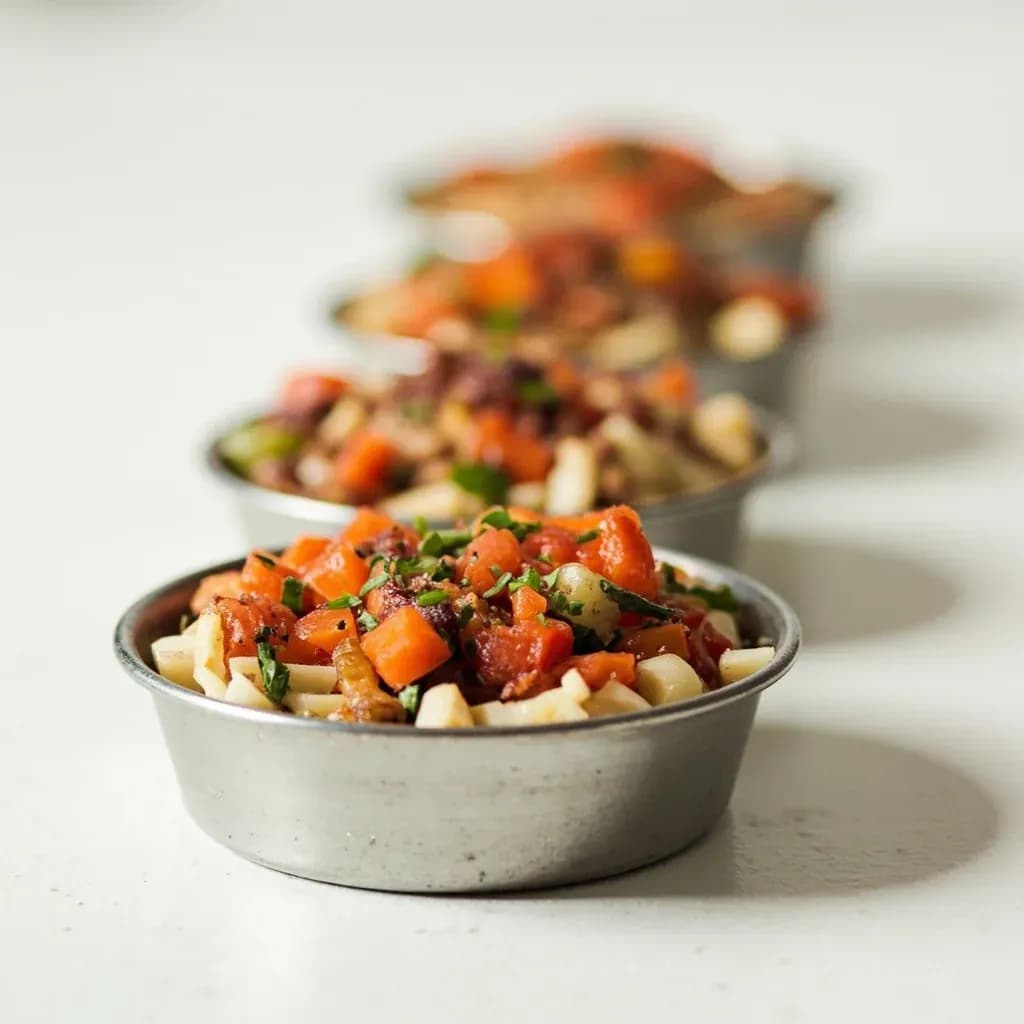
Shallow inset pans that hold prepped toppings and garnishes at the assembly line.
Topping ingredient pans are small, often stainless-steel inset containers arranged in a rail or cold table to hold sliced, chopped or measured ingredients ready for assembly. They keep pizza toppings, taco fillings, salad bar items or condiments organized and within easy reach. Standardized sizes drop into prep stations and refrigerated wells for service.
Topping ingredient pans — also called garnish pans, inset pans, or simply ingredient pans — are the shallow, modular containers that sit in the cutouts of a prep table, refrigerated cold well, or ice-cooled station to keep ready-to-grab toppings, garnishes, and prepped mise en place within arm's reach during service. They share the same gastronorm (GN) and U.S. hotel-pan sizing grid used for steam-table pans, so a 1/6 GN topping pan drops cleanly into a matching cutout in a salad bar, sandwich line, or pizza station, and a smaller pan can be made to fit a larger cutout with a stainless adapter bar.
The category is built around modular, line-side holding: each pan is a discrete, removable cell that can be swapped, refilled, or rotated to a walk-in for turnover without disturbing the rest of the station. Clear polycarbonate is the visual standard because line cooks and expediters can read the contents at a glance; stainless versions carry over to hot-holding steam tables and walk-in shelving. A 65 mm (2.5") depth is the workhorse for fast-grab items, while 100–150 mm pans are reserved for bulk storage behind the line.
A common point of confusion: "topping pan" refers to the insert itself, while "cold pan" is sometimes used for the ice-cooled recessed well that the topping pan sits in. When sourcing parts, confirm whether you need the insert, the well, or both.
Alternatives
Types & varieties
Workhorse for hot or cold service; opaque, so contents must be labelled.
Industry standard for cold topping stations; staff see contents without lifting; Cambro Camwear is the long-standing reference.
Drains brine or ice melt away from pickles, olives, marinated onions, and rinsed produce.
Used in colour-coded systems to separate allergens, raw proteins, vegetables, or stations.
Hooks over a rail above the prep surface; common on pizza, sandwich, and sub lines.
Notch in the rim so a serving utensil rests inside the pan with the handle hanging over the edge, out of the food.
Sits inside the pan and lifts product above standing brine, ice melt, or juice.
Stainless bar that lets a smaller pan (e.g., 1/6) sit flush inside a larger cutout (e.g., 1/3 or 1/2).
Counter cutout with a deep outer pan that holds ice beneath the topping pan to hold 0–4 °C (33–40 °F).
Polycarbonate or stainless cover that seals the pan between rushes to slow oxidation and protect from contamination.
Setting up a topping station
A well-designed topping station is read top-to-bottom by an expediter: highest-turnover, fastest-grab items in the 65 mm pans closest to the dominant hand; bulkier, slower-moving, or wet items in deeper or perforated pans; allergens and raw proteins isolated by colour and position. The order of pans should mirror the order of assembly — cheese and sauce near the start of the build, fresh herbs and delicate greens at the end — so a cook's hand travels in one direction down the line. Ice-cooled wells or refrigerated prep tables are worth the real estate: a pan of cilantro or sliced chiles will hold its colour and aroma roughly twice as long at 2 °C as it will at 8 °C.
- Place highest-turnover items in 65 mm pans within easy reach of the dominant hand.
- Mirror the assembly order — first ingredients on one end, finishing garnishes on the other.
- Reserve perforated or false-bottom pans for pickles, marinated onions, olives, and any item that sits in its own brine.
- Use a stainless adapter bar when mixing 1/6 and 1/3 pans in the same cutout so smaller pans sit flush.
Material choice: polycarbonate vs. stainless
Polycarbonate is the visual default for cold topping stations because it is light, shatter-resistant, and lets the line see what is running low without lifting it. It is not rated for hot holding, and it scratches — once the walls are visibly scored, retire the pan because micro-grooves harbour biofilms and resist sanitiser. Stainless is heavier, opaque, and indifferent to temperature, which makes it the right call anywhere a pan moves between a cold well, a steam table, a flat-top, and a walk-in shelf, or where heavy scoops will bang around inside it.
- Polycarbonate: cold service only; replace once deeply scratched.
- Stainless: works cold, ambient, and hot; must be labelled by eye.
- Choose reinforced or rolled rims on stainless — thin stamped rims bend after a season of sliding in and out of wells.
- High-density polyethylene and ABS pans exist for back-of-house storage where cost outweighs appearance.
Common uses
Tips & pitfalls
- Fill to roughly two-thirds to three-quarters so tongs or a scoop can enter without spillage or product flying out.
- Use a slotted spoon and a perforated or false-bottom pan for wet items — pickles, marinated onions, giardiniera — so the product sits above the brine.
- Match pan depth to the well depth: a 150 mm pan dropped into a 100 mm well will not seat flush, and a 65 mm pan in a 150 mm well wobbles and tips.
- Assign one dedicated utensil per pan and store it in the pan between uses; never swap tongs between raw bacon and lettuce.
- Run FIFO: refill from the back, push older product forward, and use a plastic bench scraper to clear pan walls without scratching polycarbonate.
- Drain melt-water from ice-cooled cold pans at least once per service; standing melt-water leaches flavour from produce and dilutes dressings.
- Colour-code for allergens — purple or blue is commonly reserved for tree nuts, gluten, or dairy — and keep those pans physically separate on the line.
- Retire polycarbonate pans that are deeply scored or cracked; micro-grooves harbour biofilms and resist sanitising, even in the dish pit.
- Label each pan with a wipeable card showing item name, prep time, and use-by date — even experienced staff read labels in a rush.
- Cover pans between rushes with a flat lid, plastic wrap, or a roll-top cover to slow oxidation of cut produce and herbs.
Good to know
- Category
- Commercial prep/holding equipment, designed to sit in a cutout in a prep table or cold well
- Also called
- Ingredient pans, inset pans, garnish pans, topping pans, cold pans
- Sizing system
- Gastronorm (GN) / U.S. hotel pan (1/1, 1/2, 1/3, 1/4, 1/6, 1/9)
- Sizing standard
- European EN 631 for GN sizes; U.S. hotel-pan dimensions match GN within a few millimetres
- Most common size at topping stations
- 1/6 GN (≈176 × 162 mm / 6.9" × 6.4")
- Common depths
- 65 mm (2.5"), 100 mm (4"), 150 mm (6")
- Approx. capacity (1/6 GN, 100 mm deep)
- ≈ 2.4 L
- Primary materials
- Stainless steel, clear polycarbonate, high-density polyethylene, ABS
- Notable brands
- Cambro, Vollrath, Carlisle, Update International, American Metalcraft, Winco, Polar Ware
- Common certifications
- NSF/ANSI 2 (food equipment); many polycarbonate pans are dishwasher-safe and NSF-listed
- Polycarbonate temperature range
- ≈ −40 °C to 99 °C / −40 °F to 210 °F; not for hot holding
- Stainless temperature range
- Suitable for cold wells, ambient, and steam-table hot holding
- Compatible fixtures
- Refrigerated prep tables, ice-cooled cold pans, drop-in cold wells, salad bars, steam tables; adapter bars mix sizes in one cutout
Also called
topping pans · ingredient pans · condiment inset pans · prep pans
Related

Peeler
Swift blade for stripping skin off fruit and vegetables

Grater
Sharp-toothed surface for shredding cheese and vegetables

Microplane
Ultra-fine rasp for citrus zest, garlic, and hard cheese

Mixing Bowl
All-purpose bowl for combining, whisking, and tossing

Whisk
Looped wires that beat air into eggs, cream, and sauces

Spatula
Flat blade for flipping, lifting, and scraping

Slotted Spoon
Pierced spoon that lifts solids and drains the liquid behind

Wooden Spoon
Gentle, heat-friendly spoon for stirring anything