Prep Tools
iSi Cream Whipper (Siphon)
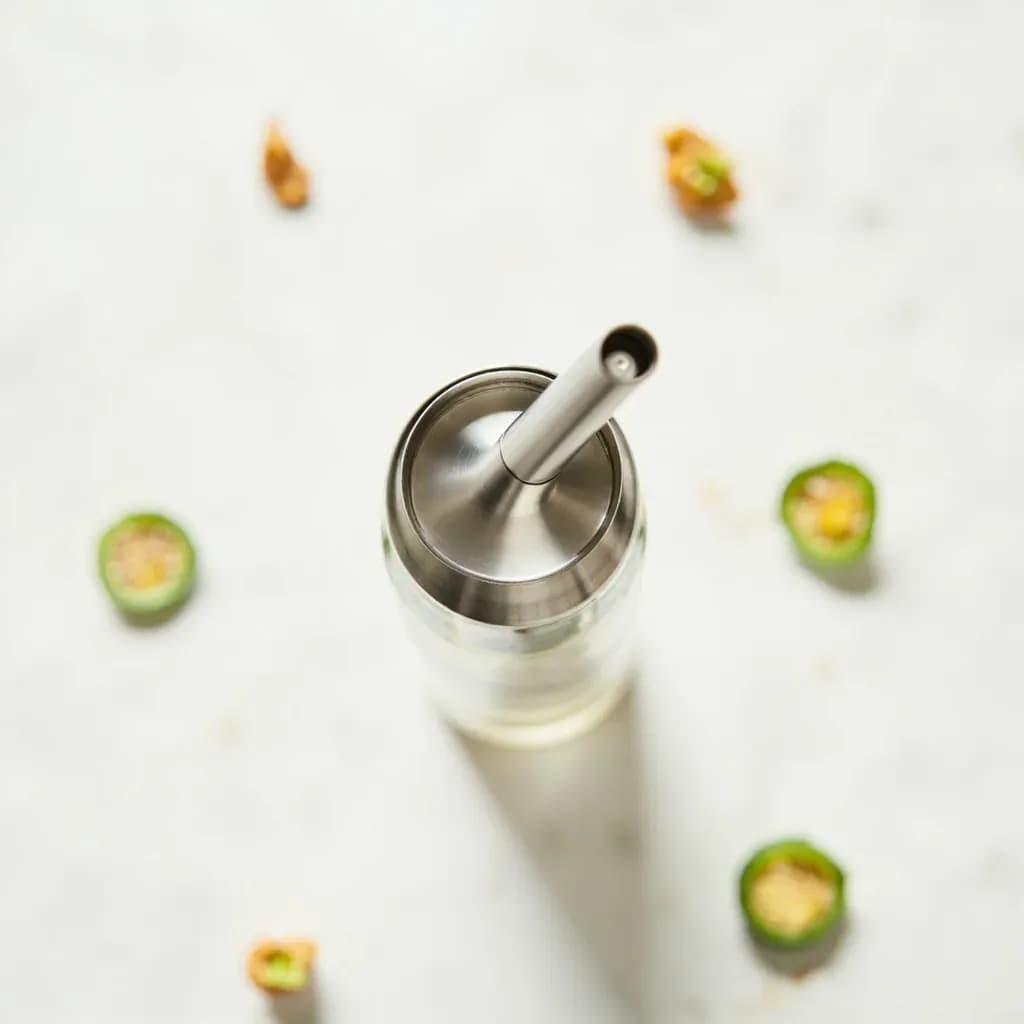
A charged canister that whips cream, foams, and espumas using nitrous oxide gas under pressure.
An iSi cream whipper is a pressurized canister charged with nitrous oxide cartridges that dissolve gas into a liquid. Releasing the lever dispenses whipped cream or, in modern cooking, light foams and espumas from purees, custards, and infused liquids. It also speeds rapid infusions and aerated batters, making it a staple of both pastry and avant-garde kitchens.
The iSi Whipper is a sealed pressure vessel that uses a small nitrous-oxide cartridge to aerate and dispense liquids through a nozzle. Drop in a charger, screw on the head, and shake; the N2O dissolves into the liquid, and when you release the valve the sudden pressure drop pulls that gas back out as a cloud of microbubbles, leaving cream whipped, sauces foamed, and purées transformed into light espumas. Unlike a soda siphon, which uses carbon dioxide to carbonate water, the iSi relies on N2O's affinity for fats — it is far more soluble in lipids than in water — which is exactly why it stabilizes dairy and oil-based mixtures so reliably.
Beyond simple whipped cream, the tool is a workhorse of modernist plating: it can foam a consommé, aerate a warm vinaigrette or sabayon into a lighter, more pourable sauce, or push a flavored cream through an injector tip to fill a profiterole in one motion. It also works as a rapid infusion chamber — herbs, citrus zest, and spices macerate in minutes under pressure rather than hours in a jar. Treated as a precision instrument rather than a novelty, it is one of the few pieces of restaurant equipment that genuinely changes what a home cook can put on a plate.
The discipline that makes it work is unglamorous: everything must be cold for dairy, the canister must never be overfilled, and the head, gasket, nozzle, and pickup tube need to be cleaned and dried after every use. Get those habits right and the whipper becomes as dependable as a stand mixer; ignore them and it leaks, clogs, or fails to charge.
Alternatives
Types & varieties
0.5 L stainless steel; the standard workhorse in home and pro kitchens
0.5 L with insulated body; better hot/cold retention than the standard model
1 L professional size with double-wall insulation; preferred for hot espumas and high-volume service
0.25 L entry-level, often with a plastic head; fine for occasional whipped cream
0.25 L in stainless; aimed at plated dessert and savory garnishes
Ridged nozzle for classic whipped-cream swirls and piped garnishes
Smooth, narrow opening for clean plating lines and thin foams
Long, narrow nozzle for injecting fillings into pastries, choux, or layered cocktails
The Physics of N2O in the Siphon
A charged whipper is essentially a small pressure vessel in equilibrium. While the valve is closed, the N2O dissolves into the liquid until the headspace gas and the dissolved gas reach the same partial pressure. The moment you open the valve, headspace pressure collapses, the dissolved gas comes out of solution as a fine foam, and the now-pressurized liquid is pushed up the pickup tube and out the nozzle. This is why three details matter so much: the liquid must be cold (cold holds more dissolved gas), the chamber must be shaken (shaking forces gas into solution faster than diffusion alone), and there must be enough headspace inside the canister for the gas to live and expand.
Hot vs. Cold Applications
The same tool handles both, but the prep differs. Cold uses — whipped cream, cocktail foams, chilled purées — want everything (canister, liquid, even the head if possible) refrigerated for at least an hour. Hot uses — warm espumas, sabayon-style foams, aerated beurre blanc — want the liquid cooked and strained, then poured into a canister that has been warmed under the hot tap to avoid thermal shock to the gasket. Many cooks run two whippers on the line, one reserved for cold service and one for hot, simply because the temperature swing shortens seal life.
Maintenance and Troubleshooting
Almost every whipper problem traces to one of three causes: residual fat clogging the valve, a tired gasket, or an overfilled canister. After every use, unscrew the head, eject any remaining gas (point the head away from you), and hand-wash the head, gasket, nozzle, and pickup tube in warm soapy water; the body and metal head can go in the dishwasher. A persistent hiss when the siphon is inverted and not dispensing is the tell that the silicone gasket has flattened and needs replacing — an inexpensive part that fixes most persistent leaks. If a foam comes out thin and liquid, the cause is almost always under-shaking or a warm canister, not a broken tool.
Common uses
Tips & pitfalls
- Chill the canister, head, and liquid thoroughly before charging; warm liquid is the single most common cause of thin, weeping foam.
- Never fill past the etched max line — headspace is what lets the gas expand and aerate the liquid.
- Use one 8 g charger per 0.5 L of liquid; a second charger gives a denser, almost butter-like texture for piping.
- Shake the charged siphon vigorously for 5–8 seconds before the first dispense; under-shaking is the most common home-cook mistake.
- Strain every purée through a fine chinois before charging — whole spices, seeds, and coffee grounds clog the valve instantly.
- Always vent remaining gas before unscrewing the head, and point the head away from your face and skin when doing so.
- Replace the silicone gasket annually, or at the first sign of a hiss when the siphon is held upright and not dispensing.
- If a foam collapses on the plate, stabilize the base liquid with 0.3–0.5% soy lecithin or 0.1–0.2% xanthan gum before charging.
- Liss, Mosa, Chef'n Whipper, EuroNoir, and most generic N2O chargers share the iSi thread and work interchangeably.
Good to know
- Manufacturer
- iSi GmbH, Vienna, Austria; founded 1967
- Gas
- Nitrous oxide (N2O) only — fat-soluble, not a carbonating gas
- Standard charger
- 8 g N2O cartridge, one per ~0.5 L of liquid
- Sizes
- 0.25 L (Easy/Creative), 0.5 L (Gourmet Whip, most common), 1 L (Thermo Whip, pro)
- Body
- Stainless steel on Gourmet and Thermo lines; anodized aluminum or plastic on entry models
- Working pressure
- ~4–6 bar (60–90 psi) when fully charged
- Fill rule
- Never above the etched max line — headspace is required for gas to expand
- Notable history
- Brought into mainstream cuisine by Ferran Adrià's espuma technique at elBulli in the 1990s
Also called
Whipping Siphon · Whipping Siphon (iSi) · cream charger siphon · espuma gun
Related

Peeler
Swift blade for stripping skin off fruit and vegetables

Grater
Sharp-toothed surface for shredding cheese and vegetables

Microplane
Ultra-fine rasp for citrus zest, garlic, and hard cheese

Mixing Bowl
All-purpose bowl for combining, whisking, and tossing

Whisk
Looped wires that beat air into eggs, cream, and sauces

Spatula
Flat blade for flipping, lifting, and scraping

Slotted Spoon
Pierced spoon that lifts solids and drains the liquid behind

Wooden Spoon
Gentle, heat-friendly spoon for stirring anything