Prep Tools
Jaccard Blade Tenderizer
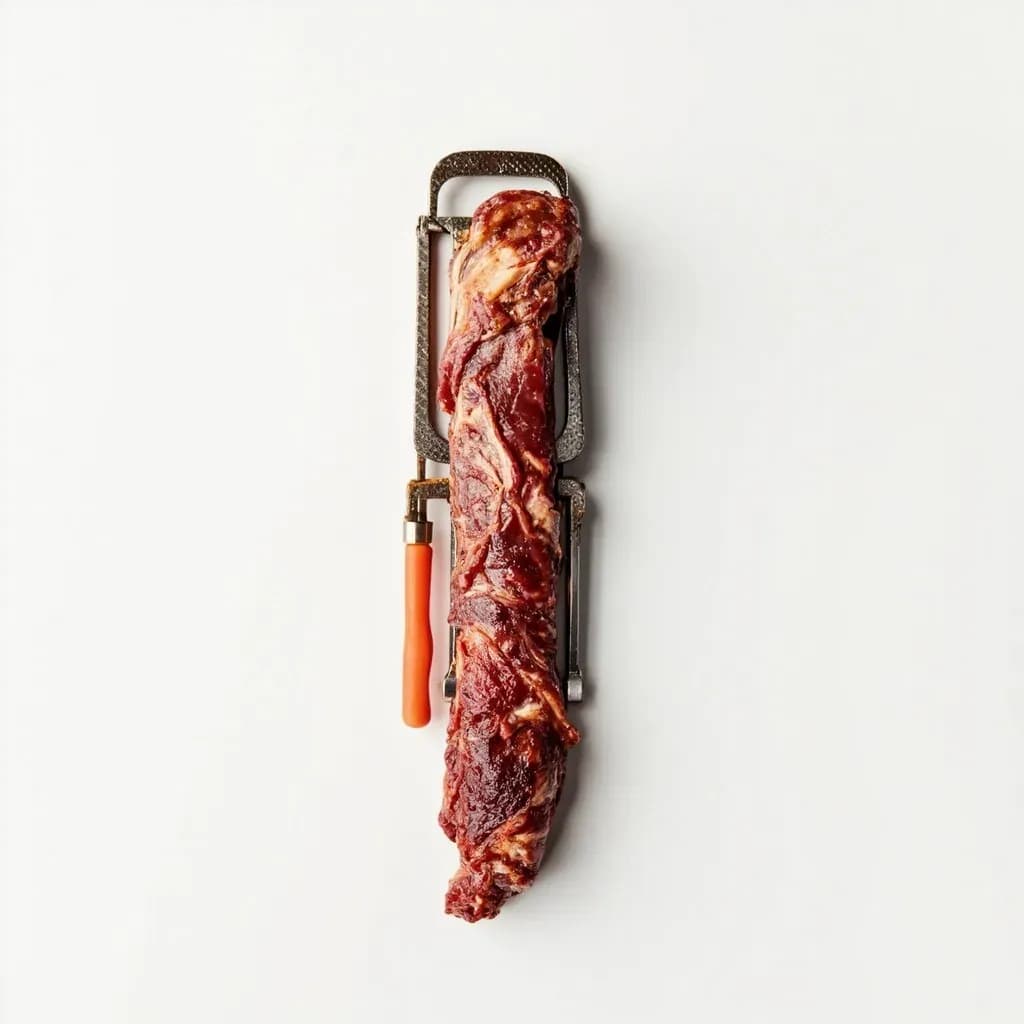
A handheld block of fine blades that pierces meat to sever fibers and speed marinade penetration.
A Jaccard tenderizer is a handheld tool with rows of thin, sharp blades that, when pressed into meat, sever connective tissue and muscle fibers without flattening the cut. This shortens the fibers so the meat cooks more tenderly and lets marinades soak in faster and deeper. It works on steaks and roasts where a mallet would mash the meat.
The Jaccard blade tenderizer is a handheld tool built around a rectangular block of 45 (or more) small stainless-steel blades that, when pressed into a piece of meat, pierce and sever muscle fibers in hundreds of clean cuts at once. It is the dominant brand in the category of fine-blade mechanical tenderizers and has been the go-to tool in butcher shops, restaurant kitchens, and serious home pantries since its mid-1960s patent. Where a traditional mallet-style tenderizer crushes and flattens, the Jaccard slices — opening the meat's structure without compressing it, which is why it has become the preferred tool for high-heat cooking where surface texture and a hard sear matter.
The real value of the tool is two-fold: it physically shortens tough muscle fibers, and the array of tiny channels it leaves behind acts as a conduit for salt, marinade, dry rub, and smoke. That makes it especially useful on lean, tight-grained meats — flank, skirt, hanger, round, chuck, venison, bison — that would otherwise turn chewy or dry. A few practiced presses turn a London broil that would need an overnight soak into one that picks up flavor in 30 minutes, and turn a cube steak you might have skipped past into something worth a hot pan and good butter.
The technique has earned a verb in professional kitchens: to jaccard a steak or roast is to run the tool across its surface once or twice, flip the meat, and proceed. Difficulty is low; the only real skill is restraint, and the only real discipline is sanitation, because a forest of small blades traps bacteria in ways a flat knife does not.
Alternatives
Types & varieties
The flagship model and the one most cooks picture when they hear 'Jaccard.' Red or black plastic body with a rectangular blade head; the standard for steak work.
Larger blade head covering more surface per press; well suited to big roasts, whole briskets, and pork shoulders.
Smaller handheld versions sized for portion cuts, chicken breasts, and pork chops.
Heavier-duty commercial version with a reinforced housing and a denser blade pattern for high-volume kitchens.
Different blade lengths on each face, giving variable penetration in a single tool.
Jaccard vs. the mallet-style tenderizer
The two tools solve overlapping problems but produce very different results, and most well-equipped kitchens keep both on hand. A textured mallet tenderizes by crushing and is excellent for cutlets, schnitzel, and cube steak where a thin, even profile is the goal. The Jaccard is the better choice when you want tenderization without flattening — for steaks, roasts, and whole muscles destined for the grill, smoker, or hot pan. The blade pattern also opens the meat to absorb flavor far more efficiently than pounding does.
- A mallet flattens and bruises fibers; the Jaccard slices them cleanly.
- A mallet is best for thin, pounded cutlets and cube steak.
- The Jaccard is best for steaks, roasts, and grill- or smoker-ready cuts where thickness and sear matter.
- Marinade and dry-rub absorption is dramatically faster after jaccarding.
- Tenderized meat holds more liquid during cooking, so perceived serving weight per raw pound is slightly higher.
Common uses
Tips & pitfalls
- Work on a plastic or wood cutting board, never glass or stone — the blades will chip and dull on hard surfaces.
- Partially freeze the meat (20–30 minutes) before tenderizing; firmer flesh gives cleaner, more defined channels and less tearing.
- Press straight down and lift cleanly; don't rock or twist the tool or you'll shred the meat into mush.
- Don't over-tenderize — two or three passes across a steak is usually enough; more turns the protein into paste.
- Tenderize before marinating, not after, so the channels stay open to receive liquid.
- Clean between batches and especially between species — the blade array harbors bacteria in ways a flat knife does not.
- Use a stiff brush and hot soapy water under running water to clear fibers from between the blades; many pros finish with a brief bleach-water bath.
- Replace the tool when blades bend, hook, or stop cutting cleanly — dull blades compress rather than slice, and overwork the meat.
- Pat the meat dry after tenderizing if you want a hard sear; surface moisture released from the channels can prevent browning.
- Avoid using on delicate fish — the blades are designed for red meat and poultry; for fish, use a fork or score lightly with a knife.
Good to know
- Tool type
- Handheld mechanical meat tenderizer
- Manufacturer
- Jaccard Corporation, North Kansas City, Missouri
- Invented
- Mid-1960s; patented as a handheld multi-blade tenderizer
- Standard blade count
- 45 small stainless-steel blades in the classic model
- Blade material
- Stainless steel
- Mechanism
- Hand-pressed or spring-loaded block that pierces and severs muscle fibers
- Blade penetration
- Roughly 1/4 to 1/2 inch, depending on model
- Cleaning
- Hand-wash recommended; blades trap fibers and need brushing. Most current models are top-rack dishwasher safe; some have removable blade cartridges.
Also called
Blade Tenderizer · Needle Tenderizer · Meat Tenderizer
Related

Peeler
Swift blade for stripping skin off fruit and vegetables

Grater
Sharp-toothed surface for shredding cheese and vegetables

Microplane
Ultra-fine rasp for citrus zest, garlic, and hard cheese

Mixing Bowl
All-purpose bowl for combining, whisking, and tossing

Whisk
Looped wires that beat air into eggs, cream, and sauces

Spatula
Flat blade for flipping, lifting, and scraping

Slotted Spoon
Pierced spoon that lifts solids and drains the liquid behind

Wooden Spoon
Gentle, heat-friendly spoon for stirring anything