Prep Tools
Jar Lid Sealer
A hand tool that crimps or seams metal lids onto jars for an airtight preserving seal.
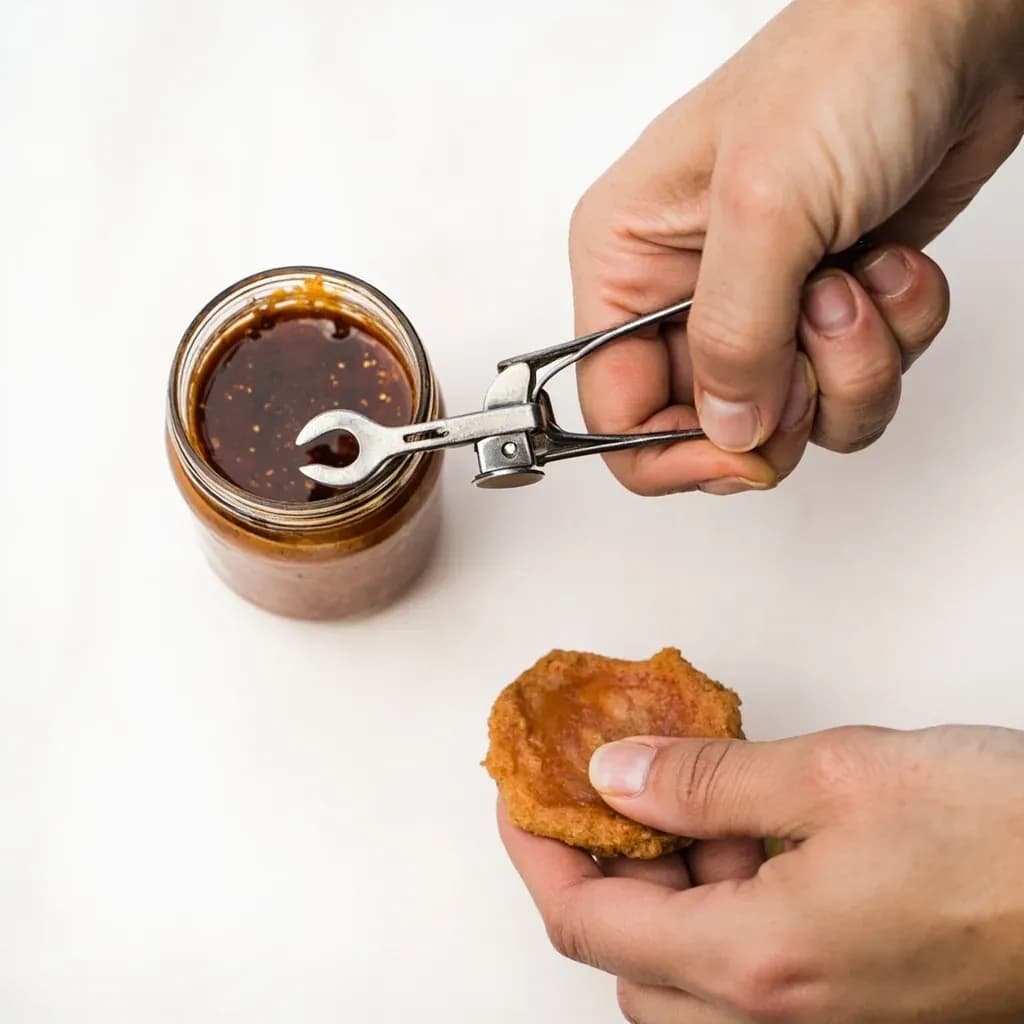
A jar lid sealer crimps a metal cap or seams a two-piece lid tightly onto a jar to create the airtight seal needed for safe home preserving. It is used after filling jars with jam, pickles or canned goods, often before pressure or water-bath processing. The crimping version (zatvarachka) is common across the Balkans for sealing reusable bottle caps.
A jar lid sealer is a hand tool built for one job in the home-canning workflow: handling a hot, sterilized flat lid without contaminating the sealing compound underneath. The standard version is a slim 7-to-8-inch plastic wand tipped with a strong magnet — pick the lid cleanly out of simmering water, hold it by the metal disc, and set it down centered on the jar mouth so the screw band can be applied. A wet, oily, or fingerprinted lid is one of the most common reasons beginners get seal failures, and the magnet wand solves that problem in a single motion.
Despite the name, a jar lid sealer does not crimp or seam the lid to the jar. In the standard two-piece Mason system — flat lid plus separate screw band — the seal is vacuum-driven, not mechanical: as the contents cool after water-bath or pressure processing, the air inside contracts and pulls the lid's softened sealing compound tight against the rim, often with an audible "ping" as the vacuum completes. The tool is a hygiene and accuracy aid; cooks who need true metal-on-metal seaming for tin cans or specialty one-piece lids work with a can seamer instead.
Within its lane, the magnetic wand is one of those accessories that earns its drawer space the first time a stray fingerprint would have cost a jar of preserves.
Alternatives
Types & varieties
The standard jar lid sealer: a plastic stick tipped with a magnet for lifting flat lids from hot water and centering them on jars.
Same magnet head plus a small wire or plastic loop on the opposite end for fishing hot screw bands from the canner water.
Accessory that screws onto countertop vacuum sealers (such as FoodSaver jar sealers) to evacuate air from Mason jars fitted with a special wide-mouth lid.
Purpose-built tool for plastic reusable canning lids (Tattler, Ball Plastic) that helps seat the rubber gasket and snug the band without over-torquing.
How the Mason Jar Seal Actually Forms
The two-piece lid system can mislead cooks into thinking a mechanical crimp is happening, but nothing is being deformed. A factory-new flat lid carries a pinkish ring of food-grade plastisol (a soft rubber-like compound) bonded to its underside. During processing, that compound softens slightly in the heat and the steam inside the jar drives air up and out. As the jar cools on the counter, the trapped steam condenses, the headspace contracts, and atmospheric pressure pushes down on the lid from outside. The button in the center of a Ball or Kerr lid flexes down with a characteristic "ping" when the vacuum takes hold, and the plastisol is now pressed uniformly against the glass rim.
Two practical consequences flow from this. First, the screw band exists only to hold the lid in place during processing — air and liquid must be able to escape past it — which is why the band should be tightened only "fingertip tight": apply the band with your fingertips and stop at the first feel of resistance. Torque it down with a full grip and you trap the very air that needs to vent, producing a buckle or a seal failure. Second, the band can and should be removed once the jar has cooled and the vacuum is confirmed; the lid alone is holding the seal, and a band left on for long storage will eventually rust to the threads, hide a failed seal, and make the jar nearly impossible to open.
Common uses
Tips & pitfalls
- Simmer lids in water at a bare bubble, not a rolling boil — a hard boil can damage the sealing compound and dent the lids on the pot bottom.
- Never touch the flat underside of a lid with bare fingers; skin oils interrupt the seal and the lid must then be set aside for non-canning use.
- Tighten the screw band only 'fingertip tight' — until you feel resistance. Over-tightening traps air and is a leading cause of buckled lids and seal failures.
- Let jars cool undisturbed for 12–24 hours before checking the seal; the vacuum forms as the contents cool, and moving them too soon can break it.
- Remove screw bands before long-term storage; bands left on can rust onto the threads, mask a seal failure, and become impossible to unscrew later.
- Test the magnet's grip before buying — weak magnets drop lids back into the water and defeat the tool's purpose. Neodymium tips are noticeably stronger than older ceramic ones.
- Use a new flat lid for every canning cycle; bands and reusable plastic lids (Tattler, Ball Plastic) may be reused according to the maker's instructions, but flat sealing lids are single-use.
- Work over a folded kitchen towel or the canning rack so a dropped lid does not chip its edge or pick up grit before it goes on the jar.
Good to know
- Tool type
- Hand-held prep tool for home canning
- Construction
- Plastic handle with a strong magnet (neodymium or ceramic) at the working end
- Length
- Usually 7–8 inches (18–20 cm)
- Compatibility
- Two-piece Mason jar lids (flat lid + screw band), regular and wide mouth
- Heat tolerance
- Handle stays cool; magnet end is briefly dipped in simmering water with the lids
- Care
- Wipe clean; most models are top-rack dishwasher safe
- How the seal forms
- As contents cool, contracting air creates a vacuum that pulls the warmed sealing compound against the jar rim
- Common brands
- Norpro, Ball, RSVP International, New Metro, plus many houseware makers
Also called
Jar Lid Crimper · Zatvarachka · Pressure Canning Lid Sealer · Jar Lid Seamer · Can Seamer
Related

Peeler
Swift blade for stripping skin off fruit and vegetables

Grater
Sharp-toothed surface for shredding cheese and vegetables

Microplane
Ultra-fine rasp for citrus zest, garlic, and hard cheese

Mixing Bowl
All-purpose bowl for combining, whisking, and tossing

Whisk
Looped wires that beat air into eggs, cream, and sauces

Spatula
Flat blade for flipping, lifting, and scraping

Slotted Spoon
Pierced spoon that lifts solids and drains the liquid behind

Wooden Spoon
Gentle, heat-friendly spoon for stirring anything