Prep Tools
Jelly Bag
A fine mesh or muslin bag that slowly strains cooked fruit to yield clear, sediment-free juice for jelly.
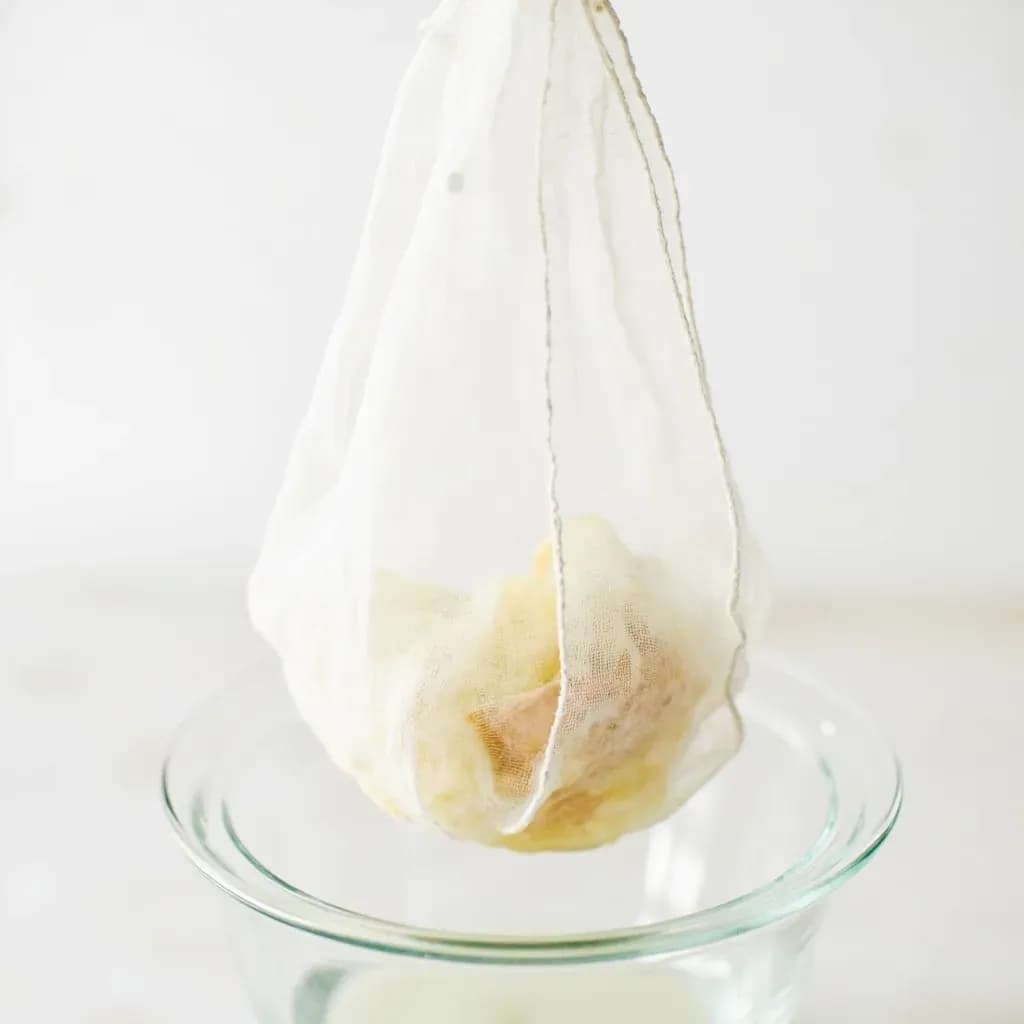
A jelly bag is a tall, narrow bag of muslin or fine nylon mesh hung over a bowl so cooked fruit pulp can drip through under gravity. It is essential for making crystal-clear jellies and clarified stocks because squeezing is avoided to keep the liquid bright. Foragers and home preservers use it for wild-fruit juices, and the same bag works for straining nut milks or yogurt.
A jelly bag is a conical fabric bag — traditionally cotton flannel, more often nylon mesh today — designed to suspend cooked fruit pulp in mid-air so the juice can drip out under gravity alone. Unlike cheesecloth draped over a colander, a proper bag holds the pulp away from its own liquid, which is the entire point: letting juice fall cleanly through the weave leaves behind the pectin-rich sediment, fruit skins, and seeds that would otherwise cloud the finished preserve. The result is a sparkling, jewel-like jelly rather than a soft, opaque jam.
The bag's role is part of a larger logic in preserving. Clear jellies depend on juice that is both pectin-strong and sediment-free, and the slow, patient method the bag enables is the surest route to that clarity: a four- to twelve-hour cold drip, often running overnight. Cooks who try to hurry by squeezing the pulp force fine particles through the fabric and undo the very clarity they are after, which is why a well-made bag — with a rigid hoop or stand that keeps the cone open and a catching vessel deep enough to hold the steady drip — is the tool that makes the difference between a cloudy spread and one that holds a trembling, translucent set in the jar.
Alternatives
Types & varieties
The classic conical bag; tight weave produces the clearest juice; needs pre-soaking and gentle handling.
Drips faster, cleans easily, and tolerates machine washing; juice is slightly less pristine than flannel.
Heavier, sturdier cotton alternative often used by home preservers as a DIY substitute.
Bag paired with a wooden or wire frame that suspends it over a bowl, freeing both hands during the long drip.
Has a rigid ring at the top to hold the bag open and four corner loops for hanging from a hook or cupboard knob.
Why gravity, not pressure
The jelly bag exists to do one job that other straining tools handle poorly: extract clear juice from cooked fruit pulp without disturbing the sediment trapped inside the fruit cells. When you press, squeeze, or twist a filled bag, you crush those cells and push fine particles of flesh and pectin through the weave. The juice that drips under pressure looks abundant in the bowl but carries the suspended solids that turn a would-be-clear jelly cloudy and slightly softer in set. Letting the bag hang untouched lets only the free-flowing, water-thin juice escape, while the heavier pulp stays behind. That patience is what gives a properly made apple, quince, or grape jelly its characteristic transparency and clean, snappy set.
Bag versus cheesecloth
A jelly bag is essentially a structured, repeatable version of what many cooks try to do with cheesecloth. Cheesecloth draped over a colander lets the pulp sit in its own liquid, which leaches sediment back into the juice and slows draining. A sewn conical bag suspends the pulp above the catch vessel, so the juice leaves cleanly without pooling. In a pinch, two layers of damp cheesecloth gathered into a bundle and hung from a wooden spoon across a deep pot is a workable substitute — but the weave is rarely as tight as purpose-made flannel, and the result is usually a touch cloudier.
- Draped cheesecloth: pulp sits in pooled juice, slower drip, cloudier result.
- Hung jelly bag: pulp suspended, cleaner drip, clearer jelly.
- DIY version: double-layer cheesecloth tied and hung from a spoon over a deep pot.
Caring for a flannel bag
Cotton flannel bags reward a little attention and last for many seasons. The enemies are residual fruit sugars, which sour and attract mildew, and fabric softener, which coats fibers and slows the drip. Rinse the bag in cold water as soon as the drip finishes, before the sugars dry onto the cloth, then wash in hot soapy water or on a gentle machine cycle. Skip the softener and tumble dryer. Air-dry completely — hung in the sun if possible — and store in a dry cupboard. If the bag starts to drip sluggishly, a simmer in a pot of plain water for ten minutes strips out any residue and restores flow.
Common uses
Tips & pitfalls
- Never squeeze, twist, or press the bag if clarity matters; pressing forces sediment through the weave and clouds the jelly.
- Pre-wet the bag with hot water and wring it out before adding pulp, so the juice drips freely and the bag does not absorb flavor from the first batch.
- Hang the bag over a deep bowl or pot overnight rather than resting it in a colander, where pulp would sit in pooled juice and turn cloudy.
- If the drip slows or stalls, gently lift and swirl the bag and rehang it rather than scraping the inside, which disturbs sediment.
- Save the dripped solids — they are excellent folded into muffins, stirred into yogurt, or dried into fruit leather.
- For the clearest possible jelly, line the inside of the bag with a single layer of damp cheesecloth to catch the finest sediment.
- Allow at least twice the expected volume in the catching vessel, since the bag will drip steadily for many hours.
- Wash flannel bags without fabric softener, which coats the fibers and slows the drip; air-dry fully to prevent mildew.
Good to know
- Also called
- Jelly strainer bag, jelly cloth, fruit straining bag
- Traditional material
- Cotton flannel or unbleached muslin
- Modern material
- Nylon mesh or polyester
- Typical capacity
- Roughly 1 to 2 quarts of fruit pulp per batch
- Drain time
- Usually 4 to 12 hours, often left overnight
- Dripped vs pressed yield
- Dripping gives clear juice and slightly less volume; pressing yields more liquid but cloudy jelly
- Cleaning
- Rinse cold, then hot soapy wash or machine wash; boil occasionally to sterilize
- Storage
- Must be bone-dry before storing to prevent mildew; can be frozen
Also called
mesh straining bag · muslin straining bag · jelly strainer bag
Related

Peeler
Swift blade for stripping skin off fruit and vegetables

Grater
Sharp-toothed surface for shredding cheese and vegetables

Microplane
Ultra-fine rasp for citrus zest, garlic, and hard cheese

Mixing Bowl
All-purpose bowl for combining, whisking, and tossing

Whisk
Looped wires that beat air into eggs, cream, and sauces

Spatula
Flat blade for flipping, lifting, and scraping

Slotted Spoon
Pierced spoon that lifts solids and drains the liquid behind

Wooden Spoon
Gentle, heat-friendly spoon for stirring anything