Prep Tools
Jelly Bag Stand
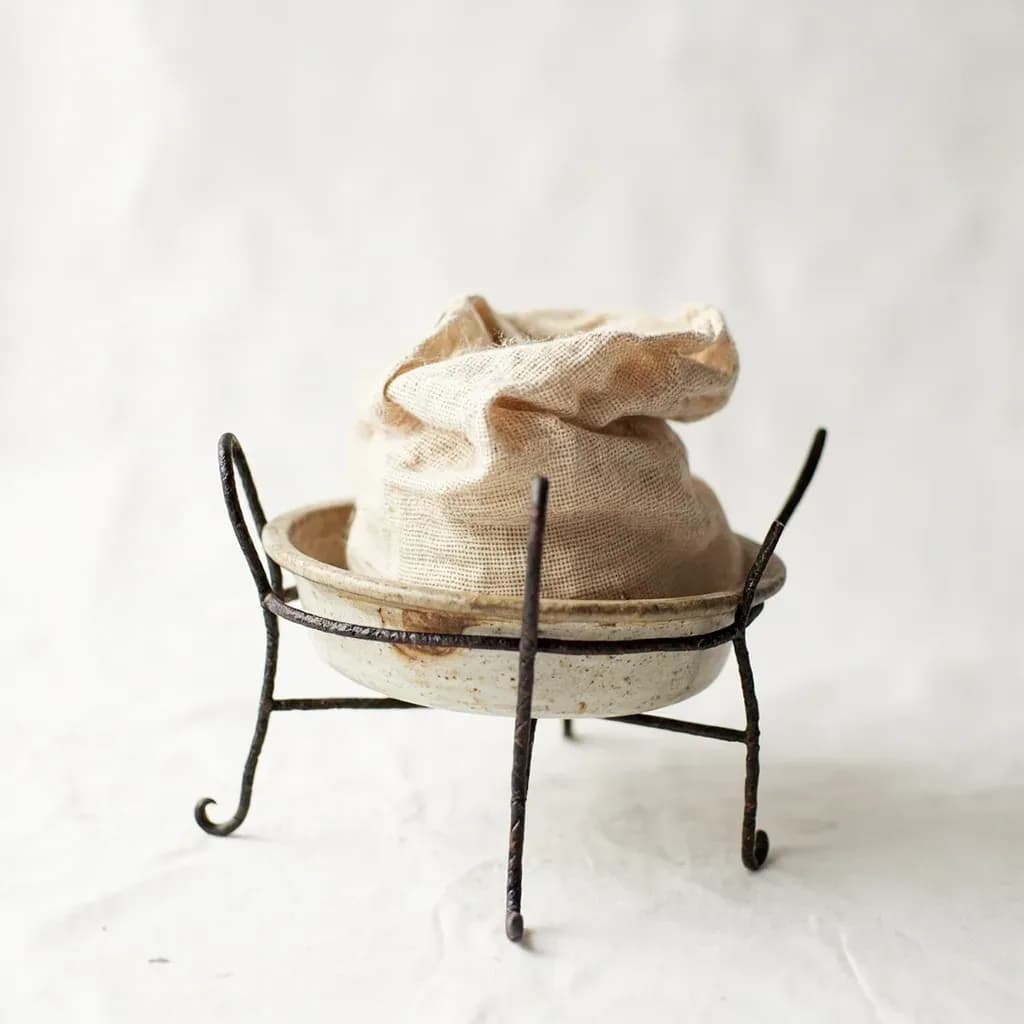
A frame that suspends a cloth jelly bag so cooked fruit drips into a bowl for clear jelly.
A jelly bag stand is a metal frame, often four-legged, that holds a fine cloth bag open above a collecting bowl. Cooked fruit pulp is poured in and left to drip slowly, yielding clear, sediment-free juice for jellies and clarified stocks. The unattended slow drip, rather than squeezing, is what keeps the strained liquid bright and clear.
A jelly bag stand is a small frame, typically 30–45 cm (12–18 in) tall, designed to hold the mouth of a cloth jelly bag open while the bag hangs free above a catching bowl. The stand creates the airspace that clear jelly requires: if the bag touches the bowl, the bowl rim, or the work surface, juice runs back up the outside of the cloth and carries fine pulp with it, clouding the finished set. Most designs are a four-legged wooden frame with a ring or crossed top rails, though modern versions are made of chrome or stainless steel and some fold flat for storage.
What looks like a single-purpose Victorian gadget is, in practice, a general-purpose gravity strainer. The same setup that drips cooked apple pulp for crab-apple jelly will, with a finer cloth, clarify consommé, drain yogurt overnight, or filter sloe gin before bottling. Its real service is that it works unattended — most fruit jellies need 8 to 12 hours to drip clean, so the cook can set it up after supper and wake to a clear, brilliant juice ready for sugar and a boil.
The stand only does its job when the bag is prepared correctly: pre-soaked, lightly wrung, and tied so the pulp sits in a loose cone with room to drain. Once gravity is in charge, the cook's role is mostly to leave it alone — no prodding, no squeezing, no peeking under the cloth.
Alternatives
Types & varieties
Traditional beech or maple frame with crossed top rails or a circular ring; the bag is tied at the top and draped through the ring or over the rails
Sturdier than wood, often with a single ring and three or four splayed legs; favored in modern kitchens and usually dishwasher-safe
Hinged legs or telescoping ring that fold flat for storage; common in contemporary British-made designs
A horizontal bar mounted between two uprights; the jelly bag is hung by its drawstring loop from the bar, leaving the bag sides free to billow
Why the airspace matters
The whole point of the stand is to keep the dripping bag away from everything — the bowl rim, the bowl sides, and the work surface. The first juice that runs off a jelly bag is cloudy, and any of that cloudy liquid that touches the outside of the cloth and runs back up will be drawn back through the weave on the next pass, clouding the clear drip that follows. A wide, deep bowl positioned so the bag hangs at least a hand's breadth above the bottom and well clear of the rim keeps the system one-way. Slower is also better: in a cool kitchen, or with a chilled receiving bowl, the juice thickens just enough in the cloth to filter more efficiently, which is why experienced preservers set up their stands overnight rather than rushing the drip.
Beyond jelly
Anything that benefits from a long, gentle, hands-off strain can use the same setup. A fine-mesh nut-milk bag or a doubled layer of muslin suspended in a stand will clarify stocks, drain yogurt, or filter infusions with the same clarity. The stand is really a small piece of kitchen infrastructure — the kind of object that lives in a cupboard for years and earns its keep the one weekend a year you make crab-apple jelly, then surprises you in October when you need a clear consommé or a brilliant bottle of sloe gin.
Common uses
Tips & pitfalls
- Never squeeze or press the pulp in the bag — squeezing forces fine solids through the weave and clouds the jelly; let gravity do the work overnight
- Pre-soak the jelly bag in very hot water and wring it out before use; this tightens the weave, prevents absorption of juice, and stops pulp sticking to the cloth
- Position the stand over a wide, deep bowl so the bag hangs clear of the sides and the bowl rim; trapped drips running back up the outside of the bag cloud the result
- Chill the receiving bowl or set the whole stand over a tray of ice if the kitchen is warm — slower dripping in a cool environment gives the clearest jelly
- Reserve the first cloudy drip in a separate jug; once the run clears, swap to the main collection bowl
- If the jelly bag is suspended by a drawstring loop, hook it on a peg rather than tying it to a fixed bar, so you can lower the bag as it empties and gets lighter
- Wooden stands should never be immersed in water; wipe with a damp cloth and dry upright to prevent the joints from loosening
- Boil or launder the bag after every use without fabric softener, which would coat the fibers and slow the drip
- For very seedy or acidic fruit (red currant, blackberry, raspberry), line the bag with a single extra layer of fine muslin to keep seeds and skins from migrating through
Good to know
- Primary function
- Holds a cloth jelly bag open and suspended above a bowl so fruit juice drips through under gravity
- Origin
- Appeared in 19th-century kitchens when home jelly- and preserve-making peaked in Britain and the United States; Victorian-era cookery manuals illustrate dedicated jelly stands
- Typical height
- 30–45 cm (12–18 in), tall enough to clear a deep preserving bowl
- Bag opening diameter
- 20–25 cm (8–10 in) is standard for a round stand ring
- Common materials
- Beech or maple wood (traditional); chrome-plated steel, stainless steel, or wrought iron (modern); sometimes enamel-coated metal
- Related tool
- Jelly bag — a conical flannel, muslin, or fine-weave nylon bag, traditionally with a drawstring or gathered top
- Capacity
- Designed to hold a bag containing 2–4 kg (4½–9 lb) of cooked fruit pulp
- Drip time
- Allows unattended overnight dripping (8–12 hours), the standard method for clear jelly
- Cleaning & storage
- Bag is rinsed, boiled, and air-dried; wooden stands are wiped but never soaked; metal stands are usually dishwasher-safe; collapsible models fold flat for storage
Also called
jelly bag stand · jelly strainer stand · straining stand
Related

Peeler
Swift blade for stripping skin off fruit and vegetables

Grater
Sharp-toothed surface for shredding cheese and vegetables

Microplane
Ultra-fine rasp for citrus zest, garlic, and hard cheese

Mixing Bowl
All-purpose bowl for combining, whisking, and tossing

Whisk
Looped wires that beat air into eggs, cream, and sauces

Spatula
Flat blade for flipping, lifting, and scraping

Slotted Spoon
Pierced spoon that lifts solids and drains the liquid behind

Wooden Spoon
Gentle, heat-friendly spoon for stirring anything