Prep Tools
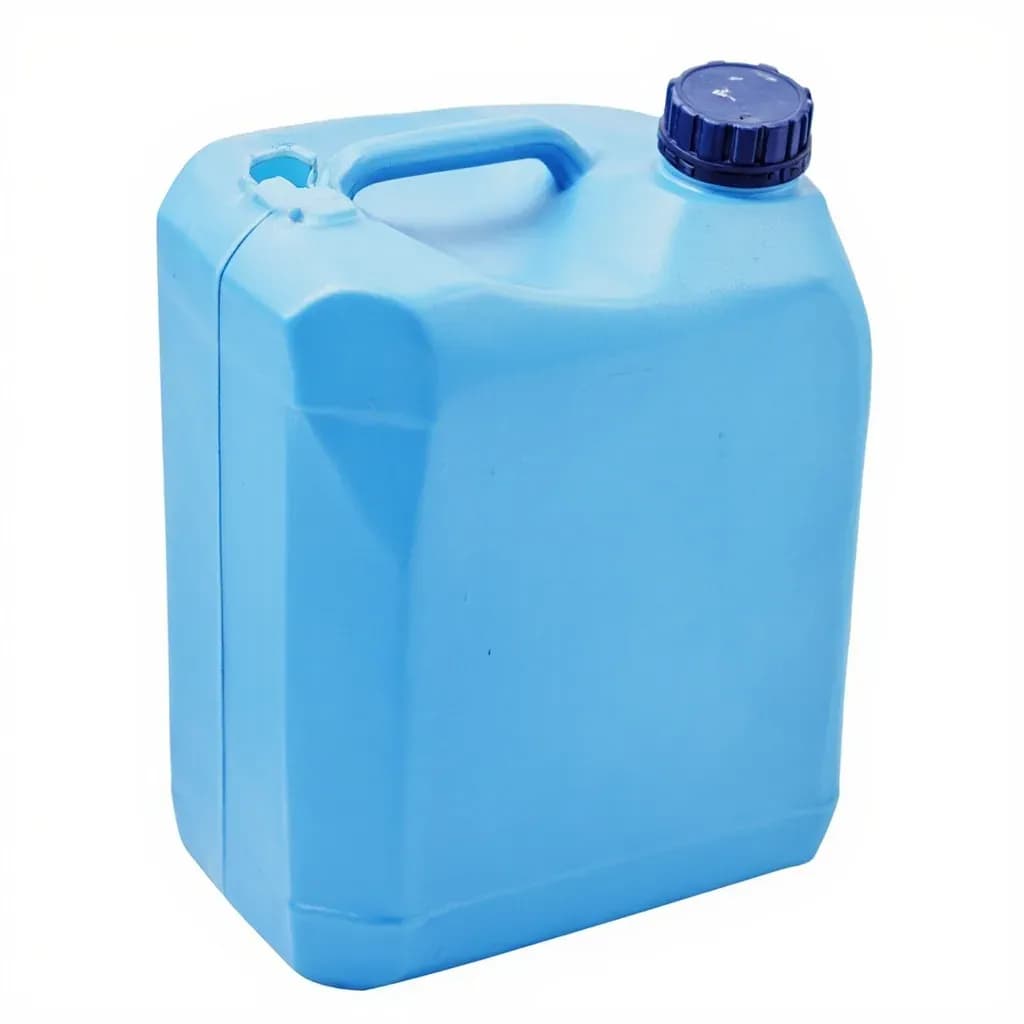
Water Jerrycan
A rugged handled container for storing and transporting cooking water or oil.
A jerrycan is a sturdy rectangular container with a screw cap and carry handle used to store and haul water, and sometimes oil, where running water is limited. In many kitchens it holds the day's cooking and washing water, its flat sides letting several stack neatly in storage. Food-grade plastic versions are essential to keep stored water safe to drink and cook with.
The water jerrycan is a robust, portable container with a tri-ribbed body, three handles and a vented screw cap, designed to hold roughly 20 litres of liquid securely during transport and storage. Originally developed in 1930s Germany for military fuel and water, the design was widely adopted after the Second World War and is now produced in food-grade steel, stainless steel and high-density polyethylene (HDPE) for both civilian and commercial kitchens. For a cook, its value lies in safely moving or storing large volumes of water, oil, brine, stock or fermentables where a regular pot or bottle would be impractical or unsafe.
In practice, the jerrycan is a storage and logistics tool rather than a cooking implement. The vented cap is its cleverest feature: a small secondary screw lets air into the can as you pour, eliminating the glug-glug pulsing that slows flow from a sealed container and reduces splashing. That same vent, when closed, makes the can leak-proof enough to survive being rolled, stacked or strapped to a vehicle. Whether you run an off-grid kitchen, a catering operation, a market stall or simply want a serious emergency water reserve, a food-grade jerrycan is one of the most reliable vessels you can own.
One caution shapes every other decision: fuel-spec and food-spec cans are not interchangeable. Hydrocarbon residue is difficult to remove and toxic, so only cans explicitly marked food-grade should ever touch water, oil or anything else that ends up in a human body.
Alternatives
Types & varieties
Original pressed-steel military can with enamel interior; extremely durable but heavy and vulnerable to rust if the coating is breached.
Modern, lightweight, rust-proof and the standard for potable water and many food liquids.
Soft PVC or TPU with screw cap; folds flat for packing, ideal for camping and emergency kits but less rigid for long-term storage.
Premium food-service option for bulk oil or dairy; expensive but fully sanitary, inert and easy to sterilise.
Larger opening for easy filling, cleaning and dispensing viscous liquids such as cooking oil, brine or syrup.
Designed to lock together on pallets for commercial kitchens, warehouses and catering storage.
Fuel cans carry a phenolic interior coating that is not food-safe; always check for explicit food-grade marking before culinary use.
Choosing the right jerrycan for kitchen use
The iconic 20-litre size is worth respecting, but it is not always the most practical for a domestic kitchen. A full steel 20-litre can weighs around 24 kg, which is awkward to lift onto a counter and impossible to store under a standard sink. For most home cooks, a 10-litre food-grade HDPE can offers a better balance: it fits under counters, is light enough to lift comfortably when full, and pours briskly when the vent is open.
- Pick HDPE for water, brine and most fermentations — light, rust-proof and cheap to replace.
- Pick stainless steel for bulk cooking oil, dairy or anything that needs hot washing; it tolerates higher temperatures and is fully inert.
- Pick wide-mouth cans for viscous liquids (oil, syrup, honey-brine) so you can fill, clean and dispense without funnel gymnastics.
- Pick a collapsible vinyl can only for short trips and emergency kits; the soft walls are hard to clean thoroughly and do not stack well.
Jerrycan as a fermenter
Serious homebrewers often reach for a food-grade jerrycan for primary or secondary fermentation, especially when the batch is too large for a glass carboy. The opaque HDPE blocks light (good for beer and kombucha) and the screw cap accepts a standard rubber stopper and airlock. The trade-off is that HDPE is slightly oxygen-permeable, so very long aging of beer or wine is better done in glass. Always sanitise the interior thoroughly and confirm the can has never held anything non-food.
Care, cleaning and replacement
Steel and HDPE cans want different care. Steel needs a watch on the interior enamel — once that coating chips, rust follows and the can must be retired from food service. HDPE wants shade and gentle cleaning; abrasive scourers scour the surface and create hiding places for biofilm. Both benefit from being fully drained and air-dried with the cap off between uses.
- Inspect steel cans annually for chipped enamel; retire the can if you see rust or flaking.
- Wash HDPE cans with warm (not hot) water and a mild food-safe detergent; rinse and air-dry cap-off.
- Store empty cans with caps loose so residual moisture can escape and odours do not linger.
- Recycle worn HDPE cans through code-2 streams; steel cans are scrap-metal grade once retired from food use.
Common uses
Tips & pitfalls
- Never repurpose a former fuel can for food: hydrocarbon residues are toxic and notoriously hard to remove. Only use cans marked food-grade for anything edible.
- Sanitise a new jerrycan with a dilute food-safe solution (about 1 tsp unscented bleach per gallon of water), shake to coat, then rinse thoroughly before first use.
- Store water-filled cans out of direct sunlight. UV promotes algae growth in water and degrades HDPE over time, shortening the can's life.
- Replace the cap gasket at the first sign of weeping. Spare gaskets are cheap, and a slow leak ruins labels, floors and goodwill.
- Open the small vent screw on the cap only when pouring; keep it closed during transport so the spout stays sealed.
- Date-stamp contents with a permanent marker on a strip of label tape. HDPE accepts china marker, pencil or paint pen far better than ballpoint.
- Keep HDPE cans away from open flames, hot plates and dishwashers running above roughly 80 °C — the plastic will warp and may leach.
- For long-term water storage, dose with about 4 ppm food-grade bleach and rotate the stock annually so it stays potable and fresh-tasting.
Good to know
- Name origin
- Anglicised from wartime slang 'Jerry' (for German) + 'can'; the design is attributed to the Wehrmacht in the 1930s.
- Standard capacity
- 20 litres (≈ 5.28 US gal / 4.4 imperial gal); 5, 10, 15 and 25 L sizes are also common.
- Typical materials
- Cold-rolled steel with internal enamel or zinc coating, HDPE plastic, occasionally aluminium or stainless steel.
- Food-grade plastic
- HDPE (recycling code 2) is the standard food-grade plastic; only cans marked food-grade are safe for potable water, oil or fermentables.
- Weight (empty, 20 L)
- Roughly 4–4.5 kg for steel, about 1–1.5 kg for HDPE.
- Pouring method
- A small vent screw on the cap is opened to admit air and allow smooth, splash-free pouring; closed for transport to seal the spout.
- Military standard
- Codified as a NATO fuel-and-water container under STANAG 2141 / MIL-DTL-3711.
- Typical lifespan
- Steel cans last decades if the interior coating holds; HDPE cans last 5–15 years depending on UV exposure.
Also called
Water/Oil Jerrycan · Jerry Can (Water Storage) · Water Storage Drum · Jerry Can
Related

Peeler
Swift blade for stripping skin off fruit and vegetables

Grater
Sharp-toothed surface for shredding cheese and vegetables

Microplane
Ultra-fine rasp for citrus zest, garlic, and hard cheese

Mixing Bowl
All-purpose bowl for combining, whisking, and tossing

Whisk
Looped wires that beat air into eggs, cream, and sauces

Spatula
Flat blade for flipping, lifting, and scraping

Slotted Spoon
Pierced spoon that lifts solids and drains the liquid behind

Wooden Spoon
Gentle, heat-friendly spoon for stirring anything