Prep Tools
Julienne Grater
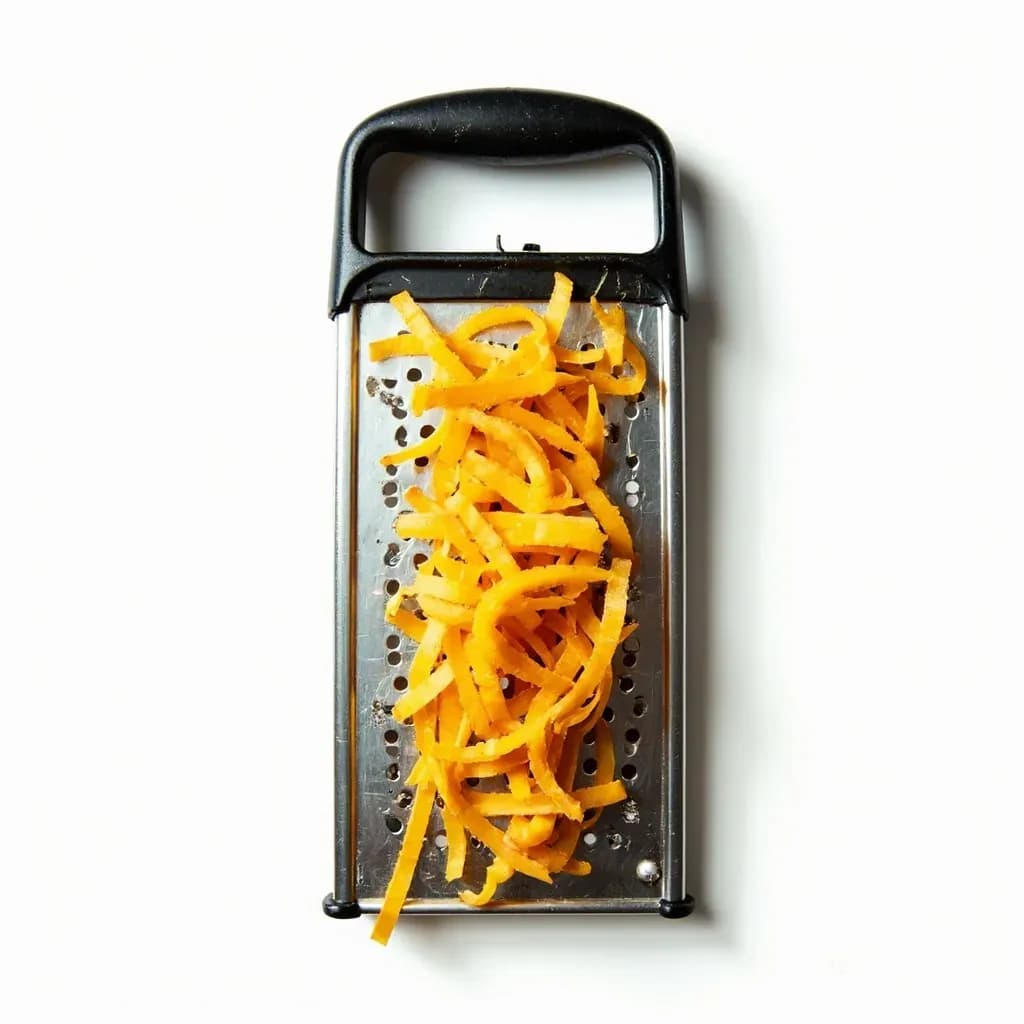
A grater with toothed blades that shred vegetables into thin matchstick strips.
A julienne grater is a handheld grater fitted with sharp toothed blades that cut firm vegetables into fine, uniform matchstick strips as they are drawn across it. It is used for carrots, papaya, potatoes, daikon, and similar produce in salads, slaws, and dishes like Korean carrot salad and rösti. Faster than knife-julienning, it gives consistent strands for even cooking and presentation.
The julienne grater is a tool purpose-built for producing thin, uniform matchstick strips — the cut cooks know as julienne, or in Japanese cooking as sengiri ("thousand cuts"). Unlike a rasp-style grater, which reduces food to fine, fluffy shreds, a julienne grater uses rows of small raised teeth — essentially many miniature chisels — set into a flat or slightly curved metal surface. The vegetable slides across these teeth, which shear it cleanly into short strips of consistent cross-section, typically 1–3 mm thick.
The tool is most strongly associated with Japanese home and professional kitchens, where it shows up at nearly every stage of vegetable prep: shredded daikon served alongside grilled fish, carrot for kinpira, cucumber threads in sunomono, and the fine vegetable garnishes that finish bowls of ramen or donburi. It fills a real gap between the microplane (too fine, too fluffy) and a mandoline's julienne blade (longer, very straight, but rigid in its angle and harder on delicate produce).
It's worth distinguishing a julienne grater from its frequent lookalikes. A julienne peeler produces long, curling strips that work beautifully in raw salads but tend to be uneven and softer in texture. A mandoline julienne attachment pushes food through parallel blades for ruler-straight strips but won't tackle small pieces or curved shapes easily. The julienne grater sits comfortably in the middle: short, uniform matchsticks, quick to produce, and forgiving across a range of firm produce.
Alternatives
Types & varieties
Flat metal plate with rows of small raised teeth; the classic 'sengiri' style, often held over a bowl or slid across a cutting board
The narrow slot on a standard box grater with raised, looped blades; produces slightly thicker, rougher matchsticks
Handheld tool with several parallel blades that cut uniform strips as the user presses the food across; includes 'sengiri-kiki'-style cutters
Box-shaped grater with a turning handle; food feeds against julienne blades, useful for larger volumes and less hand strain
Ceramic-bladed version (notably Kyocera); holds its edge well and will not rust, but is more brittle than steel
Larger flat version designed to sit on a board or counter; aimed at higher-volume prep
Choosing the right style
The flat Japanese-style grater is the standard for delicate work — daikon garnish, carrot for sunomono, cucumber threads — because the cook controls the angle, pressure, and direction of each stroke. A rotary or crank julienne grater earns its place when you're feeding a crowd or doing high-volume prep; it minimizes hand fatigue and produces consistent strips, though they're often slightly thicker than hand-cut ones. The multi-blade Japanese slicer gives the most uniform cuts but only works on firm, regularly shaped vegetables — tapered carrots, knuckles of ginger, and small or curved pieces will jam or crush. A box-grater julienne slot is a perfectly serviceable budget option, though the strips tend to be coarser and the narrow slot is notoriously fiddly to clean. Ceramic versions hold an edge well and won't rust, but treat them gently — a hard knock against another tool can chip a tooth.
Handling the shreds
- Rinse cut matchsticks in cold water and drain — this firms up the cell walls and gives them the crisp, almost translucent look you see in restaurant garnishes.
- For salads and condiments, salt the shreds lightly and let them sit 10–15 minutes, then squeeze out excess moisture before dressing.
- Layer shreds between paper towels if prepping ahead; they'll hold their texture for an hour or two in the refrigerator.
Common uses
Tips & pitfalls
- Use light, even pressure — the raised teeth do the work; pressing too hard crushes the food and clogs the surface
- Cut a flat face on the food first so it rides steadily across the teeth and doesn't tip into the gaps
- Keep fingertips tucked and use a food guard or holder when working with small pieces — the teeth are sharp
- Move the food in a single smooth stroke across the teeth, lifting it away between passes rather than sawing back and forth
- Choose firm, fresh produce — soft, watery, or overripe vegetables mash instead of cutting cleanly and gum up the surface
- On Japanese flat-style graters, grating across the grain of the vegetable (perpendicular to the fibers) gives cleaner, less torn strips
- Rinse and dry the grater immediately after use to prevent rust and preserve sharpness, especially on stainless steel
- Avoid prying stuck food out with metal — use a soft brush, plastic scraper, or bamboo skewer to clear the teeth without bending them
Good to know
- Origin
- Japan; a long-standing tool in both home and professional kitchens
- Cut produced
- Thin matchstick strips, typically 1–3 mm in cross-section (a 'julienne' or 'sengiri' cut)
- Mechanism
- Rows of small raised teeth (effectively tiny chisels) shear the food as it slides across the surface
- Blade material
- Stainless steel (most common); ceramic versions also exist
- Body/handle
- Wood, bamboo, stainless steel, or plastic frame depending on style
- Orientation
- Flat or slightly curved surface; food is slid across by hand, or held against the teeth on a board
- Compared to
- Distinct from a microplane (fine, fluffy shreds), a julienne peeler (long curly strips), and a mandoline julienne blade (uniform strips from a fixed-angle push)
- Best suited to
- Firm vegetables and root vegetables — daikon, carrot, cucumber, zucchini, kohlrabi, radish
Also called
Julienne Peeler · Vegetable Shredder · Korean Carrot Grater · Papaya Shredder · Rösti Grater
Related

Peeler
Swift blade for stripping skin off fruit and vegetables

Grater
Sharp-toothed surface for shredding cheese and vegetables

Microplane
Ultra-fine rasp for citrus zest, garlic, and hard cheese

Mixing Bowl
All-purpose bowl for combining, whisking, and tossing

Whisk
Looped wires that beat air into eggs, cream, and sauces

Spatula
Flat blade for flipping, lifting, and scraping

Slotted Spoon
Pierced spoon that lifts solids and drains the liquid behind

Wooden Spoon
Gentle, heat-friendly spoon for stirring anything