Prep Tools
Kisra Batter Spreader (Gargaiba)
A flat Sudanese tool used to swipe thin kisra sorghum batter across a hot griddle into a crepe.
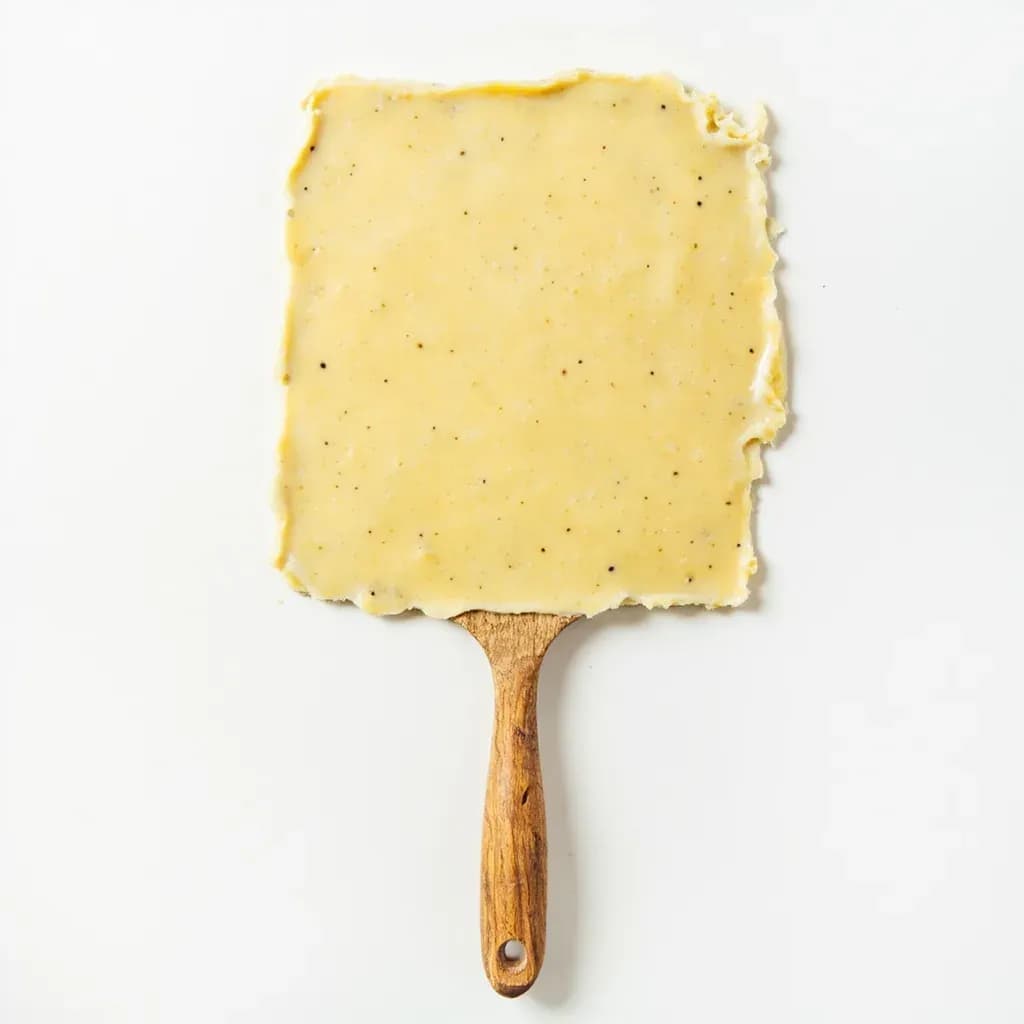
A kisra batter spreader, or gargaiba, is a flat-edged wooden or palm-rib tool used to draw a thin layer of fermented sorghum batter across a hot plate to make Sudanese kisra flatbread. One smooth swipe spreads the batter into a paper-thin sheet that cooks in seconds. It is a traditional implement central to making this everyday bread.
The gargaiba is the small, flat paddle that Sudanese and South Sudanese cooks use to swipe fermented sorghum or millet batter across a hot griddle, laying it down in a single whisper-thin film. The tool looks almost crude — often a palm-sized fragment of dried calabash gourd or a shaped sliver of wood — but its working edge is the secret behind a proper kisra, the lacy, sour flatbread that anchors meals from Khartoum to Juba. Unlike a French crepe spreader, the gargaiba is held nearly parallel to the cooking surface and dragged rather than pushed; the batter clings to the tool itself and is deposited in the trailing wake, which is why the classic kisra emerges paper-thin and often translucent at the edges.
The defining physical feature is the leading edge: it is thinned, slightly flexible, and almost paper-like, so it skims the griddle rather than digging into it. A new clay doqa is seasoned to a mottled, well-oiled finish precisely so that this edge can glide across the surface and leave an even film of batter without tearing or sticking. The gargaiba is not used to scoop or pour — it is used to paint with batter, dipping into the bowl each pass so that what clings to the tool becomes the next crepe.
Kisra is so central to Sudanese eating — typically stacked on a tray called a sinia alongside stews like mulah, bamia, or fasolia — that the gargaiba has remained essentially unchanged for generations. Modern silicone and plastic versions exist, but most home cooks in Sudan still reach for a piece of smoothed calabash or hardwood, judging its readiness by feel rather than spec.
Alternatives
Types & varieties
A piece of broken, dried bottle gourd smoothed to a thin edge; lightweight, slightly textured, considered the most authentic by Sudanese home cooks.
Carved from a flat hardwood offcut; durable, and easy to re-knife or re-sand when the working edge dulls.
A flexible, food-safe silicone paddle sold abroad; easy to clean, but it lays down a slightly thicker kisra than a traditional gourd edge.
Not traditional; some cooks overseas substitute a flat metal crepe spreader or rozell-style tool, but the hard edge can score a clay doqa and cause sticking on later crepes.
Anatomy of a Gargaiba
Despite its humble appearance, the gargaiba has a deliberate shape that rewards attention. Most pieces are roughly rectangular or paddle-like, somewhere between a playing card and a small dustpan in size, with one long edge thinned to a flexible, almost paper-like lip. That lip is what skims the griddle; the rest of the body acts as a hand-friendly reservoir that holds just enough batter to lay down a full circle in one sweep. A blunt or chipped edge tears the batter into ridges; a properly thinned one leaves an even, lacy film with the characteristic mottled pattern of a true kisra.
- Working edge: thinned, slightly flexible, and rounded so it skims rather than scrapes.
- Body: flat and broad enough to carry a thin coat of batter across the griddle in one pass.
- Grip: held between thumb and fingers near the trailing edge, almost flat against the surface, with the wrist doing the turning.
Working With a Clay Doqa
The doqa — a heavy, unglazed clay griddle — and the gargaiba are a matched pair. A new doqa must be seasoned before its first kisra: wiped with a thin film of oil and heated slowly so the clay pores fill and the surface darkens to a mottled grey-brown. That seasoned finish is what lets the gargaiba glide. Trying to make kisra on an unseasoned surface, or substituting a metal spreader, defeats the system — the tool and the cooking surface evolve together.
- Season a new doqa with oil and gentle heat before the first kisra.
- Keep the surface smooth — score marks from metal tools will snag future batters.
- Wipe the griddle between batches with a lightly oiled cloth, not water, to preserve the seasoning.
Batter Consistency and Fermentation
Kisra batter is fermented sorghum flour (sometimes blended with millet) whisked with water to the texture of thin pancake batter or single cream, then left at room temperature for 12–24 hours — occasionally up to 48 for a sharper tang. That fermentation is doing two jobs: it predigests the starches so the crepe cooks in seconds, and it gives kisra its characteristic gentle sourness. A properly fermented batter will flow off the gargaiba in a continuous sheet; if it clumps or drags, the flour needs more water or more time.
- Aim for the viscosity of single cream or thin pancake batter.
- Ferment 12–24 hours at room temperature; longer for a tangier flavor.
- Whisk in a little water before spreading if the batter thickens overnight.
Common uses
Tips & pitfalls
- Hold the gargaiba almost flat against the griddle, tilted only slightly toward you — pushing edge-down will dig into the surface and tear the batter.
- Dip the tool into the batter just before each pass; the film clinging to the gargaiba is what becomes the crepe, so do not ladle batter onto the hot surface first.
- Move in one confident circular sweep from the center outward — pausing or reversing leaves thick ridges and uneven spots.
- Keep a bowl of water and a cloth at hand to wipe the gargaiba when batter begins to build up and drag across the griddle.
- Reshape or sand the working edge of a wooden gargaiba when it loses its thin profile; a blunt edge will tear rather than spread.
- Never use a metal spreader on a clay doqa — it scores the seasoned surface and causes future kisra to stick badly.
- If your first crepes tear, the batter is almost certainly too thick; thin it with a splash of water and try again.
- Warm the gargaiba briefly over the griddle before the first pass so the batter flows rather than seizing on contact.
Good to know
- Also called
- Gargaiba, gurgai, or maraq in Sudan; "kisra spreader" or "kisra stick" in English
- Origin
- Sudan and South Sudan
- Primary use
- Spreading fermented sorghum or millet batter into paper-thin kisra crepes
- Traditional material
- A smooth fragment of dried calabash (bottle gourd, Lagenaria) or shaped hardwood
- Modern materials
- Hardwood, food-grade silicone, plastic
- Typical size
- Roughly 10–18 cm (4–7 in) wide, palm-sized
- Shape
- Flat, paddle-like, with one edge thinned and slightly rounded so it can skim the griddle surface without digging in
- Paired equipment
- Sudanese clay griddle (doqa) or metal saj/tawa
- Typical kisra diameter
- 30–60 cm (12–24 in), depending on the size of the griddle
- Batter fermentation time
- 12–24 hours at room temperature, sometimes up to 48 hours for a tangier flavor
- Difficulty
- Moderate; the swipe-and-lift motion takes a few tries to master
Also called
Gargaiba · Kisra Spreader
Related

Peeler
Swift blade for stripping skin off fruit and vegetables

Grater
Sharp-toothed surface for shredding cheese and vegetables

Microplane
Ultra-fine rasp for citrus zest, garlic, and hard cheese

Mixing Bowl
All-purpose bowl for combining, whisking, and tossing

Whisk
Looped wires that beat air into eggs, cream, and sauces

Spatula
Flat blade for flipping, lifting, and scraping

Slotted Spoon
Pierced spoon that lifts solids and drains the liquid behind

Wooden Spoon
Gentle, heat-friendly spoon for stirring anything