Prep Tools
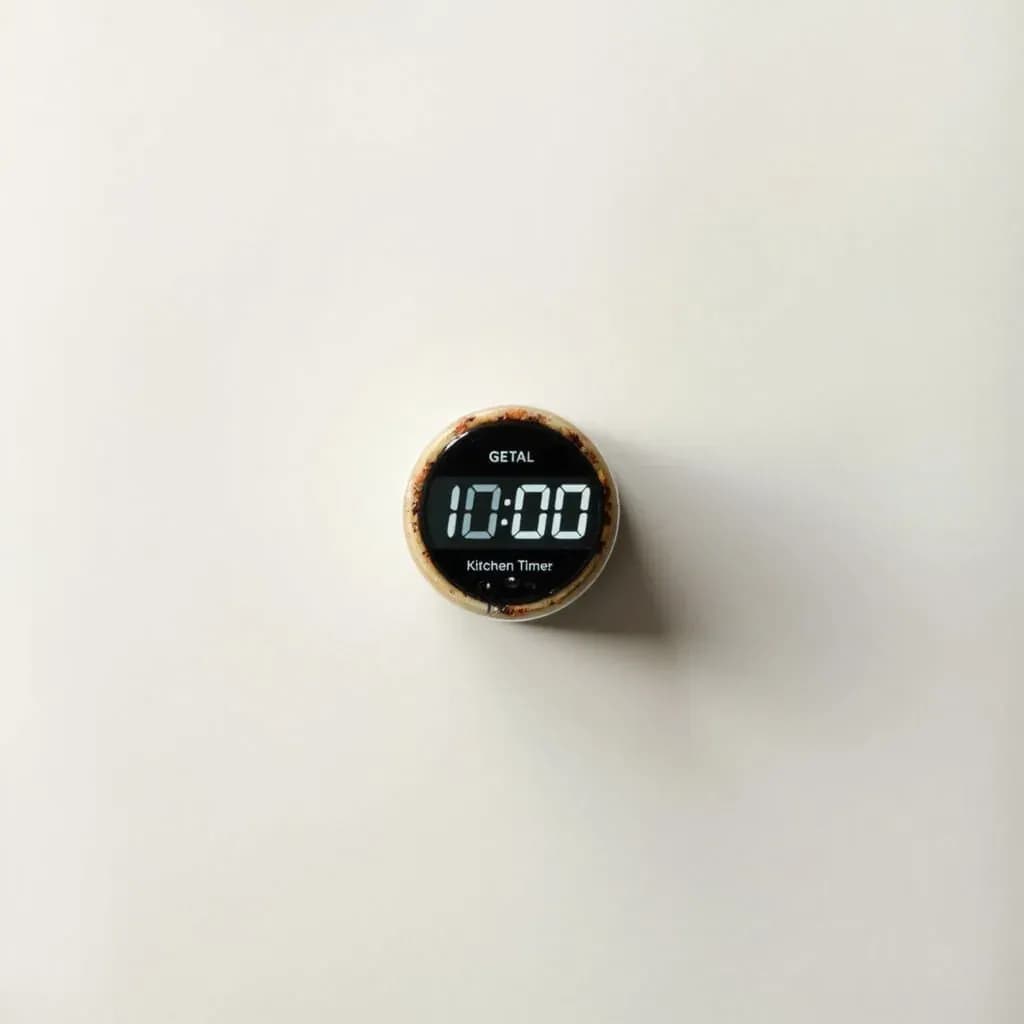
Kitchen Timer
A countdown timer that alerts when a cooking interval has finished.
A kitchen timer counts down a set interval and sounds an alarm so cooks do not over- or under-cook a dish. It is used for everything from boiling eggs and steeping tea to proofing dough and timing roasts. Digital, mechanical dial, and multi-channel models all serve to free the cook's attention for other tasks.
A kitchen timer is the single most under-appreciated tool in the home kitchen. Most cooking failures — gummy rice, overcooked fish, a fallen soufflé, bitter tea, candy that won't set — are timing failures, and a timer is the cheapest insurance against them. It counts down a set interval and signals, audibly and/or visually, when the time has elapsed, freeing the cook to focus on other tasks rather than a wall clock.
Two families dominate. The wind-up mechanical timer, with its top-mounted bell, runs on a coiled steel spring and needs no power, but its accuracy drifts as the spring unwinds, and most cap at 60 minutes. The digital quartz timer runs on a small battery, reads to 99 minutes 59 seconds on an LCD or LED, and is accurate to within a second; most will also count up after zero, which makes them useful for resting meat or proofing dough where you watch for a sign, not a deadline. Digital models range from a clip-on magnetic unit for the range hood to multi-channel timers that track two to four countdowns at once.
A good timer is loud enough to hear over a hood fan, visible from across the room, and placed somewhere your hands won't knock it. Beyond a single beeper, modern cooks also reach for smart-speaker timers (voice-activated, hands-free), hourglasses (silent, no batteries, fixed intervals), and even vibrating wearables for quiet kitchens. The right tool depends on the task, the noise level, and how many things are going at once.
Alternatives
Types & varieties
Spring-driven, top-mounted bell, usually 1–60 minutes. Iconic American style (West Bend, Taylor). Needs no batteries; accuracy drifts as the spring unwinds.
Quartz/electronic, LCD or LED display, often counts up after reaching zero. Common max 99:59. The most kitchen-friendly all-rounder.
Has a magnet on the back to stick to ovens, range hoods, or refrigerators. Popular in both pro and home kitchens for visibility and easy retrieval.
Tracks 2–4 separate countdowns simultaneously with distinct alerts. Useful when braises, sides, and resting all finish at different times.
Integrated into the oven control panel; only reliable while the oven is on, so it's not a substitute for a general-purpose kitchen timer.
Free, always available, can run multiple countdowns; vulnerable to grease, water, and silenced notifications.
Voice-activated (Alexa, Google Assistant, Siri). Hands-free starting; requires network and a powered speaker.
Pre-electronic alternative, traditionally 1, 3, or 5 minutes. Silent, no batteries, decorative — but limited to fixed intervals.
Small digital or mechanical timer capped at short intervals (often 20–60 minutes) for prep tasks or quick steeps.
Pocket or wrist-worn unit that vibrates instead of beeping; useful in quiet environments, for hearing-sensitive cooks, or in open-plan homes.
Mechanical vs. digital: how they actually behave
The two families are not interchangeable. A mechanical timer is essentially a small clock escapement: a wound spring drives a gear train that rotates a dial, and a bell trips when the dial returns to zero. There is no calibration step in the strict sense, but winding fully past the target and then back to it tensions the spring properly. Accuracy is best in the first 20 minutes or so and degrades as the spring relaxes, which is fine for an hour-long braise but matters for candy or pastry.
- Mechanical: no battery, no count-up mode, drifts slightly, limited to about 60 minutes, and the bell is unmistakable in a quiet kitchen but easy to miss under a hood fan.
- Digital: accurate to about a second, counts up after zero, often louder and more piercing, and available in single- or multi-channel formats.
- If you cook by feel — searing, sautéing, adjusting to taste — a digital timer you can glance at is more useful than one that just beeps. If you bake by recipe and want a one-touch 30-minute reminder, the mechanical timer still earns its place.
The multi-event problem
Most meals are not one countdown. A Sunday roast might track a 90-minute braise, a 12-minute rest, a side of green beans for 4 minutes, and a quick reduction that should come off the heat when everything else does. A single-channel timer forces you to mentally juggle the offset, and that's where cooks lose track. A two- or three-channel timer — or two separate digital units labeled with sticky notes — turns the juggling into a glance.
- Count back from the moment you want to serve, not forward from when you start. Set the longest cook first, then schedule shorter items to finish at the same moment.
- Use a sticky note on each running timer: "eggs – 7 min," "rest – 10 min," "beans – 4 min." The label outlives the beeper.
- For long cooks, set an intermediate check-in timer (e.g., 45 minutes into a 2-hour braise) for basting or rotation, and a final timer for the finish.
What a timer can't do
A timer measures elapsed time, not doneness. It cannot tell that a steak has hit 130°F, that bread has proofed enough to dome over the rim, or that a custard has set to the right wobble. Pair the timer with a thermometer, a finger test, or a visual cue — the timer is a reminder to check, not a substitute for the check. The exception is process timing: steeping tea, boiling eggs, blanching, and candy stages, where the interval itself is the definition of done.
Common uses
Tips & pitfalls
- Set the timer before you start the task, not after — once your hands are full it's easy to forget, and a beep 30 seconds later than needed is worse than none at all.
- For baking, always set a timer; home oven temperatures can swing 25°F (15°C) or more from the dial setting, and a minute of carryover can take a cake from done to dry.
- Wind a mechanical timer fully past your target, then back to it — this properly tensions the spring and noticeably improves accuracy.
- Place the timer where you can both see and hear it; in a noisy kitchen, choose a digital model with a loud (≥85 dB) alert or a vibrating backup.
- Digital timers can fail silently with a dead battery; test the display with a short count every few months and keep a spare cell on hand.
- Don't trust memory for anything safety- or texture-critical: egg doneness, candy stages, resting time, and proofing all deserve a timer.
- For very short intervals (under a minute), an hourglass or a phone stopwatch is often more accurate and easier to start cleanly than a mechanical timer.
- Keep the timer away from direct stovetop heat and steam; both shorten battery life and warp plastic housings, and a magnetic timer stuck to a hot oven hood is a bad idea.
Good to know
- Function
- Counts down a set interval and signals (audible and/or visual) when time elapses, so the cook doesn't have to watch a clock.
- Drive type
- Two main families: spring-driven mechanical (wound by hand, no power source) and quartz/electronic digital (battery-powered).
- Typical capacity
- Mechanical timers commonly max out at 60 minutes; digital timers commonly reach 99 minutes 59 seconds (99:59).
- Accuracy
- Digital quartz timers are typically within ±1 second; mechanical timers run within roughly ±1–2% of the set interval and slow as the spring unwinds.
- Alert type
- Mechanical models ring a metal bell or beep; digital models beep, buzz, or flash; vibrating models exist for quiet environments.
- Common power source
- AAA, AA, or button-cell batteries for digital models; mechanical units need none.
- Origin of "egg timer"
- Originally a small sandglass calibrated to about 3 minutes — the time for a soft-boiled egg; the name later transferred to short-interval mechanical timers.
- Historical note
- The classic wind-up mechanical kitchen timer with a top-mounted bell was popularized in the U.S. in the 1920s–1930s, with West Bend and Taylor among the early American makers.
Also called
kitchen timer · egg timer · cooking timer
Related

Peeler
Swift blade for stripping skin off fruit and vegetables

Grater
Sharp-toothed surface for shredding cheese and vegetables

Microplane
Ultra-fine rasp for citrus zest, garlic, and hard cheese

Mixing Bowl
All-purpose bowl for combining, whisking, and tossing

Whisk
Looped wires that beat air into eggs, cream, and sauces

Spatula
Flat blade for flipping, lifting, and scraping

Slotted Spoon
Pierced spoon that lifts solids and drains the liquid behind

Wooden Spoon
Gentle, heat-friendly spoon for stirring anything