Prep Tools
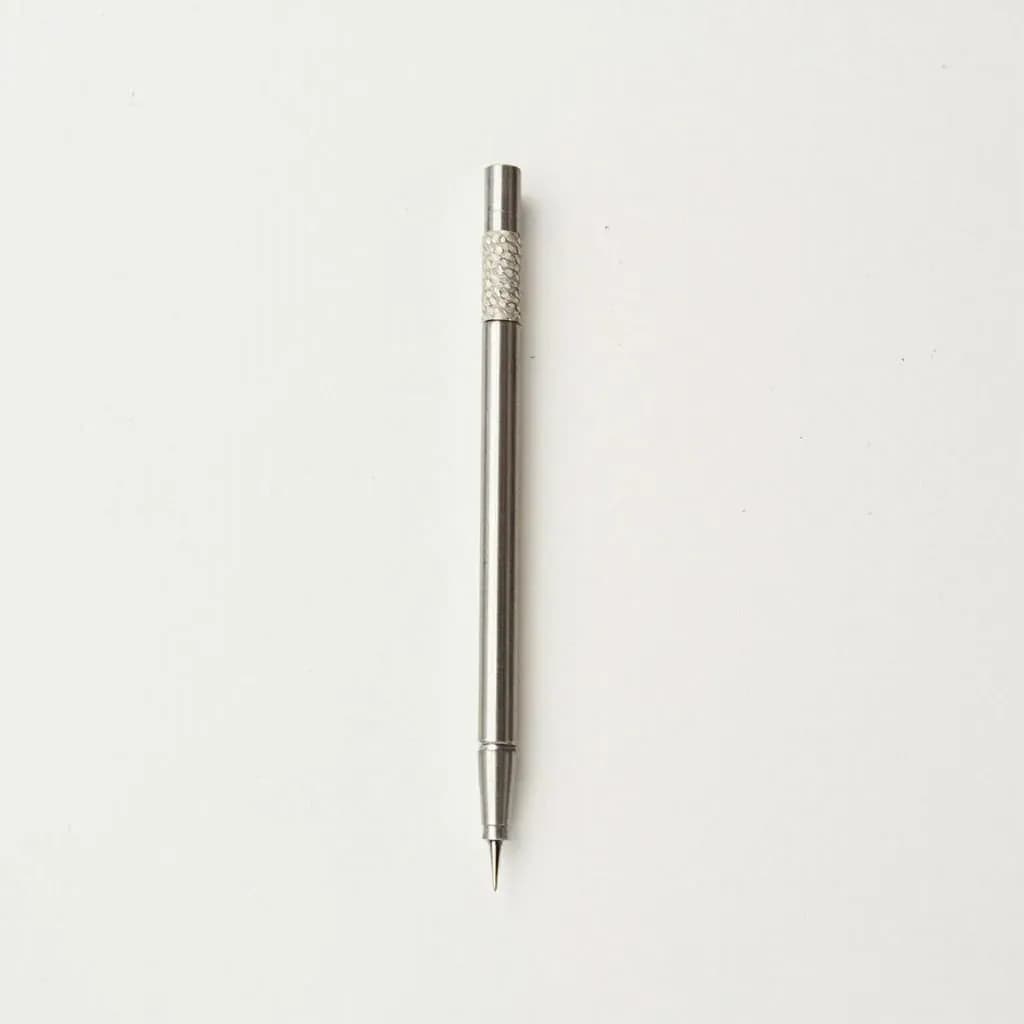
Latte Art Pen
A fine-tipped pen for drawing detailed designs in coffee foam, milk, and sauces.
A latte art pen is a slender stylus with a fine metal tip used to etch and drag detailed patterns into the crema or milk foam of espresso drinks. Baristas use it for precise touches like dragging chocolate, swirling foam, or adding fine lines that a free-pour cannot achieve. The same tool decorates plated desserts and sauce drizzles.
A latte art pen is a precision dispensing tool that lays down a controlled, hair-thin stream of liquid onto a food surface — most often the microfoam of an espresso drink, but also sauces, chocolate, or food coloring on plated desserts. It looks like a thick marker or a small syringe: a fine nozzle (roughly 0.5–1.5 mm across) feeds from a small refillable reservoir, either driven by a manual plunger or a tiny battery-powered pump. The point is not to pour patterns the way a pitcher does, but to draw them — to add lettering, faces, geometric linework, or fine details on top of a base shape that the barista has already poured.
The tool matters because it extends the visual vocabulary of coffee and plating beyond what free-pour alone can deliver. A skilled barista pours a clean rosetta or tulip from the pitcher; the pen lets them add a face inside that rosetta, etch a shop's logo, or sign a customer's name on the foam. In pastry and savory kitchens it serves the same role — a fine-line cousin of the squeeze bottle used for plating. It is a finishing implement, not a substitute for the foundational pour, and professionals use it to add detail to an already-glossy surface rather than to draw entire compositions from scratch.
How it behaves depends almost entirely on the liquid inside and the surface beneath it. Glossy, freshly poured microfoam and lightly thickened chocolate hold a crisp line because their surface tension is high enough to resist spreading; thin, watery liquids bleed outward and feather the moment they land. The pen rewards a steady hand and an understanding of viscosity — push too hard and the line puddles; hold too far away and the stream breaks into droplets before it reaches the foam.
Alternatives
Types & varieties
A small motor pushes liquid from an internal reservoir at consistent pressure, producing smooth lines with minimal hand fatigue. Best for high-volume café service and complex, repeatable designs. The Barista Hustle 'Etch' pen is a well-known commercial example.
Plunger-driven for direct control over flow rate. Affordable, easy to disassemble and clean, but requires a steadier hand for even lines.
A soft bottle fitted with a precision nozzle, more common in plating than in coffee. Less precise than dedicated pens but versatile across sauces of varying thickness.
Single-use or refillable pen loaded with food-grade colored ink for writing on cappuccinos, cookies, and plates. Convenient but limited to thinner media.
Preparing the pen and the surface
The pen performs only as well as the liquid inside it and the surface waiting beneath it. A few fundamentals separate a crisp line from a feathered mess.
- Match viscosity to surface: lightly thickened chocolate and glossy microfoam hold fine lines; thin liquids bleed and spread within seconds.
- Pre-fill the reservoir and let the pen stand upright for a moment so trapped air bubbles rise to the top and the flow stays even.
- When tinting sauces or foams with food color, add a small amount of xanthan gum or similar thickener — enough to suspend the pigment so it sits on the surface rather than sinking in.
- Work on foam that is still glossy and freshly poured; once bubbles begin to break down, lines sink into the structure and lose definition.
- Hold the pen nearly vertical, with the tip a few millimeters from the surface. Pulling away causes the stream to break into droplets before it lands.
Common uses
Tips & pitfalls
- Rest your writing hand on the rim of the cup or a stable surface before drawing to steady the tip.
- Dose lightly — a short, controlled burst lays down a cleaner line than a long squeeze.
- Practice the design on a saucer or sheet of parchment first to calibrate hand movement before committing to a drink.
- Clean the nozzle immediately after each use; chocolate and pigmented sauces set fast and will clog a fine tip within minutes.
- Common mistake: drawing on foam that has already begun to break down — the surface must be glossy and freshly poured.
- Common mistake: thinning food color with water alone; it sinks into foam rather than sitting on top. Use a small amount of xanthan gum or another thickener to suspend the pigment.
- Common mistake: holding the pen at a shallow angle or far from the surface; the line feathers and loses definition.
- Common mistake: skipping the pre-fill rest; air bubbles in the reservoir cause spitting and uneven flow.
Good to know
- Type
- Fine-tipped, food-safe dispensing tool for detailed line work on foam, sauces, and viscous liquids
- Tip aperture
- Approximately 0.5–1.5 mm, comparable to a fine marker or small pastry tube
- Reservoir
- Small refillable chamber, typically 2–10 mL depending on model
- Drive mechanism
- Manual plunger/syringe or battery-powered micro-pump
- Common materials
- Food-grade plastic, silicone, or stainless steel body with a metal or plastic precision nozzle
- Working media
- Coffee microfoam, melted chocolate, cocoa slurry, fruit coulis, food coloring, edible ink
- Skill level
- Intermediate to advanced; steady hand and an understanding of liquid viscosity and surface tension
- Cleaning
- Disassemble and flush with warm water; use soap for sugary or fatty residues; air-dry fully to prevent clogging
Also called
Coffee Art Pen · Barista Etching Pen · Decorating Pen
Related

Peeler
Swift blade for stripping skin off fruit and vegetables

Grater
Sharp-toothed surface for shredding cheese and vegetables

Microplane
Ultra-fine rasp for citrus zest, garlic, and hard cheese

Mixing Bowl
All-purpose bowl for combining, whisking, and tossing

Whisk
Looped wires that beat air into eggs, cream, and sauces

Spatula
Flat blade for flipping, lifting, and scraping

Slotted Spoon
Pierced spoon that lifts solids and drains the liquid behind

Wooden Spoon
Gentle, heat-friendly spoon for stirring anything