Baking & Pastry
Loading Peel
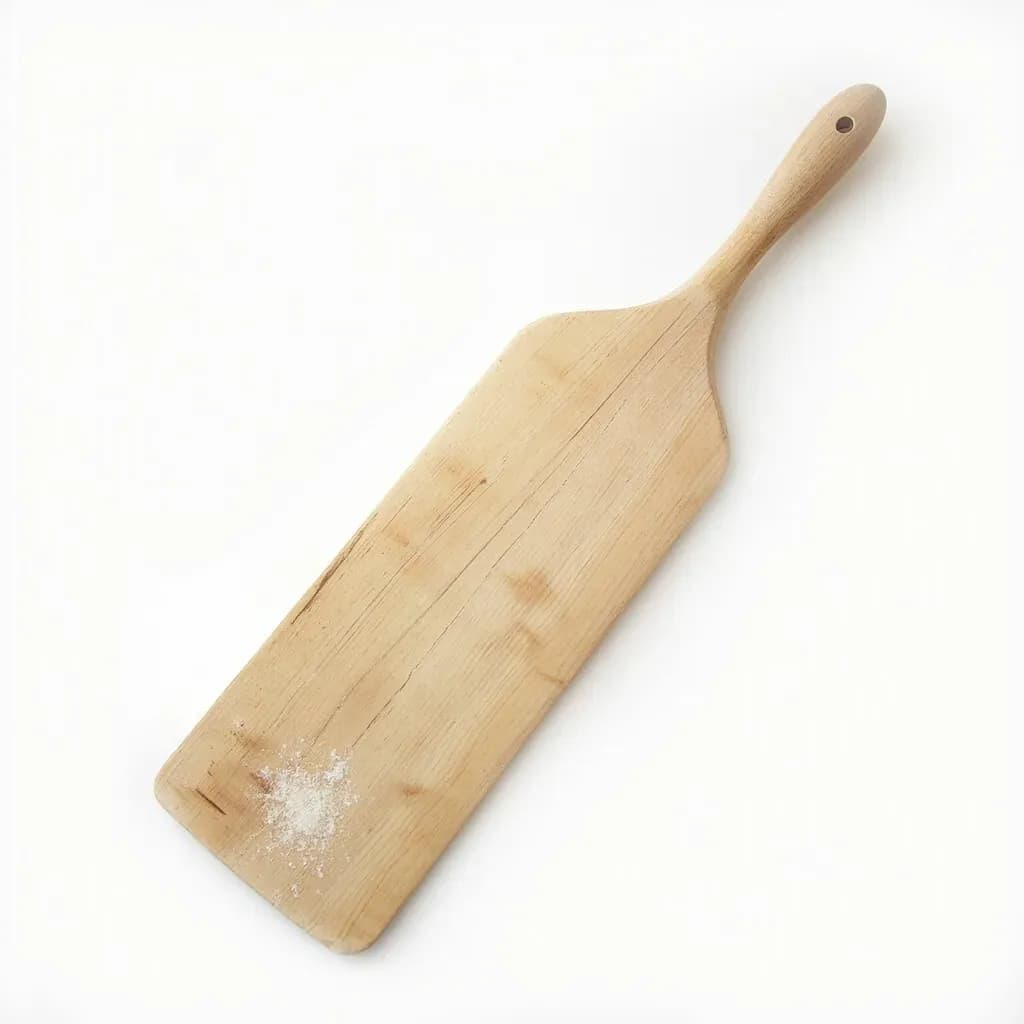
A long flat board on a handle for sliding bread and pizza into and out of a hot deck or wood oven.
A loading peel is a thin, flat paddle, usually wood or aluminum, with a long handle that lets the baker place dough deep inside a hot oven and retrieve the finished loaf. Wooden peels release raw dough cleanly, while metal peels slide easily under baked crusts. Bread and pizza bakers dust the peel with flour or semolina so the dough launches onto the stone without sticking.
The loading peel is the defining tool of deck-oven and wood-fired baking: a long flat paddle on a shaft that lets a baker deliver raw bread and pizza into an oven too hot to reach into by hand. Its length is functional, not stylistic. A wood-fired hearth runs 700–900 °F on the deck where the bake lands, and only by standing back and reaching in can the baker keep a safe distance from radiant heat. The tool predates modern sheet pans by centuries and remains irreplaceable in any bakery built around a stone or brick floor.
Two materials dominate, and they serve genuinely different jobs. A wooden loading peel — traditionally birch, maple, or beech plywood — has a slightly textured face that grips raw dough. That friction is an asset when building a topped pizza or a wet, sticky boule and needing it to stay put until the moment of launch. A metal peel (aluminum or stainless) is thin and springy and is the right choice for retrieving a finished bake or turning it, because it slides under a set crust without catching and tearing. Most serious operations keep both: wood or composite for assembly, metal for the turn and the pull.
Mastering the peel is less about the tool than about launch discipline — the back-and-forth shake, the dust of semolina, the committed slide onto a hot stone. A peel does not forgive hesitation: a dough that has sat too long on an unfloured board welds itself to the surface, and recovery is rarely clean. Done well, the entire transfer takes about two seconds.
Alternatives
Types & varieties
The classic loading peel; smooth hardwood face whose subtle grain grips raw dough, sometimes edged with a small lip or brass tacks.
Thin, light, slightly springy; the workhorse of pizzerias, often with a small front lip.
Holes vent steam from beneath the dough, reducing sticking and producing a drier, crispier base.
Small round metal paddle (8–10 in) used to rotate a bake mid-oven, not to load.
Fixed-shaft wood peel, 6–8 ft, for reaching the back of a masonry wood-fired oven.
Plastic-laminate board that is dishwasher-safe, low-friction, and does not absorb moisture like wood.
Countertop size around 24 in overall; used with deck ovens and conveyor-fed pizza setups.
The launch: how a peel actually works
The skill the tool exists for is a single, committed motion. The baker assembles the dough on a floured peel, gives it a quick shake to confirm it slides, and then runs the front edge of the peel to the back of the hot stone and jerks the peel back in one motion. The pizza stays on the stone; the peel comes back empty. Hesitation is fatal: if the dough has rested too long, the wet underside absorbs the dusting flour and bonds to the board, and the bake either lands folded or stays put entirely. A perforated metal peel or a piece of parchment underneath is the standard insurance for anyone still building confidence.
- Dust the peel with semolina or rice flour — wheat flour burns bitter at oven temperatures and turns into a cement-like paste on the board.
- Shake the assembled pizza back and forth once or twice before launching; it should slide freely.
- Aim for the back of the stone first so the pizza lands as far from the oven mouth as possible.
- Pull the peel out in a single confident motion — do not crawl it out slowly.
- If dough sticks, lift the edge with a bench scraper, re-flour, and try again; never pry with a knife on a wooden board.
- For beginners, build on parchment or a pizza screen, slide paper-and-all onto the stone, and pull the paper out after 60–90 seconds.
Common uses
Tips & pitfalls
- Keep two peels in service: wood or composite for assembling, metal for the turn and the pull.
- Perforated metal peels dramatically reduce sticking because steam vents from underneath — worth the upgrade for high-volume pizza work.
- Keep a dedicated dry brush for wooden peels; scrape off burnt residue, never soak or run through a dishwasher.
- Store wooden peels flat or hung vertically; leaning them against a wall warps them over time.
- Season a new wood peel once with a light coat of food-grade mineral oil, then never again — repeated oiling goes rancid and smokes at oven heat.
Good to know
- Also called
- Baker's peel, oven peel, paddle, pizza peel
- Traditional material
- Hardwood, typically maple, birch, or beech plywood
- Modern materials
- Aluminum, stainless steel, or HDPE composite
- Standard length
- 24–36 in (61–91 cm) overall for counter-to-oven work; 5–8 ft (1.5–2.4 m) for deep hearth ovens
- Paddle width
- 12–14 in (30–36 cm) for pizza; 8–10 in (20–25 cm) for narrow baguettes
- Heat tolerance
- Wood handles char in direct flame; metal peels tolerate full deck heat
- Dusting flour
- Semolina or rice flour; wheat flour burns bitter and cakes onto the board
- Storage
- Wooden peels stored flat or hung vertically; never soaked or dishwashed
Also called
bread peel · pizza peel · wooden peel · deck-oven loading peel · baker's peel
Related

Muffin Pan
Multi-cup pan for muffins, cupcakes, and egg bites

Bundt Pan
Fluted ring mold for showstopping cakes with a center hole

Springform Pan
Latch-release pan that frees delicate cakes without flipping

Pie Dish
Sloped round dish for crisp-bottomed pies and quiches

Tart Pan
Fluted pan with a pop-out base for clean-edged tarts

Rolling Pin
Rolls dough into even sheets for pastry and bread

Pastry Brush
Brushes on egg wash, glaze, butter, and marinades

Bench Scraper
Flat blade that divides dough and clears your work surface