Prep Tools
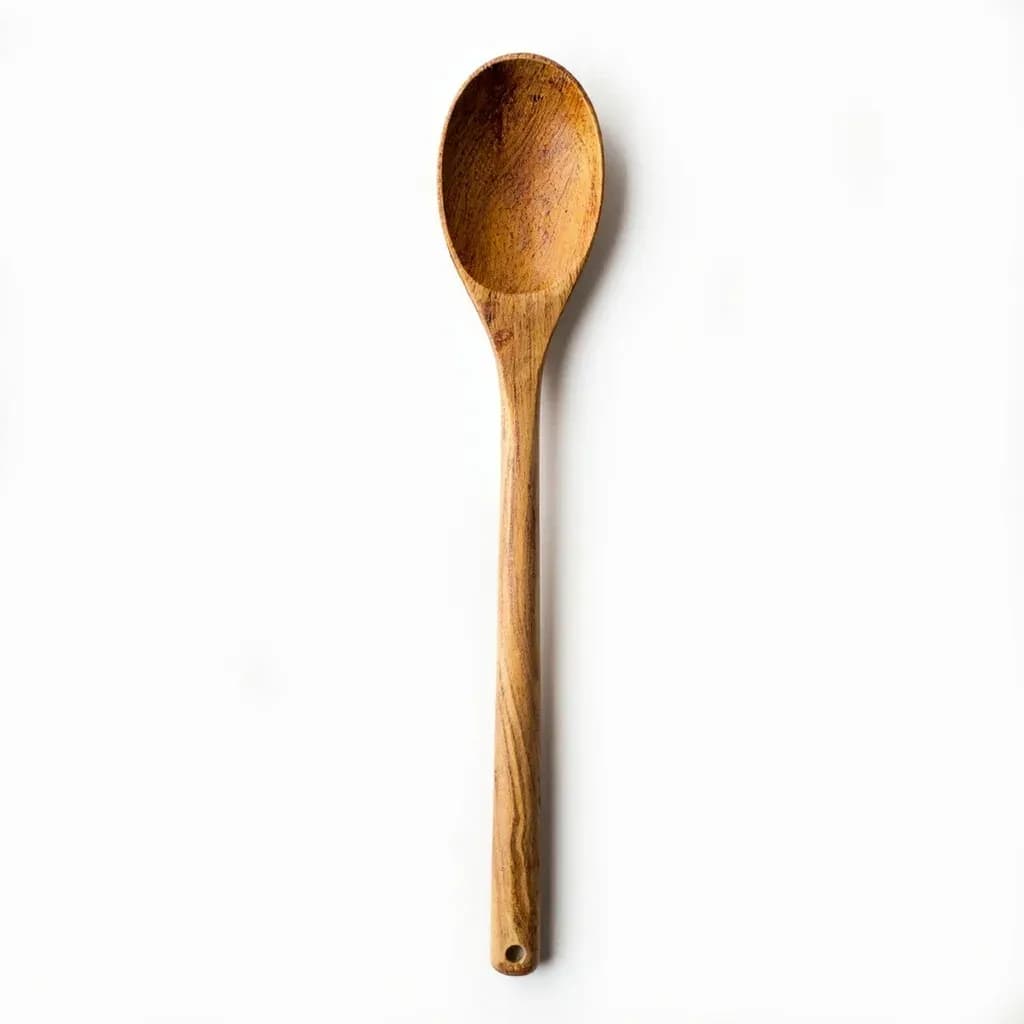
Long-Handled Stirring Spoon
An extra-long spoon or paddle for stirring deep pots, kettles, and vats without burning your hand.
A long-handled stirring spoon keeps the cook's hand safely away from heat and steam while reaching the bottom of tall stockpots, jam kettles, or cheese-making vats. It is used to keep sauces moving, scrape fond, and prevent scorching during long simmers. In larger or commercial kitchens it is often a sturdy paddle that can move thick batches of polenta, curd, or porridge.
A long-handled stirring spoon is a category of cooking implement built for the specific problem of working in deep vessels — stockpots, jam pans, brewing kettles, cheesemaking vats — where a standard spoon leaves your knuckles dangerously close to steam, splatter, or an open flame. What sets these tools apart is less the shape of the bowl than the reach: home versions run 16 to 24 inches, commercial ones 30 to 48 inches or more, giving the cook a safe working distance from boiling sugar, scalded milk, or hot mash. The bowl varies with the job — round for general stirring, flat for scraping corners, slightly lipped for skimming — but the principle is the same: keep the hand out of the danger zone while the working end of the spoon does the work.
The most consequential choice in buying one is the material, more than the length. Wood, usually beech or maple, is gentle on enameled cast iron and nonstick, doesn't conduct heat up the handle, and has a satisfying tactile weight, but it is porous, must be hand-washed, and will eventually crack if neglected. Stainless steel, often one-piece forged with a hook end for resting on the pot rim, is the workhorse of the professional kitchen — sanitary, exceptionally durable, and stiff enough to muscle through a thick pot of caramel or polenta. High-heat silicone, typically a nylon-cored head with a silicone overmold, splits the difference: dishwasher-safe, gentle on cookware, and color-coded in many restaurants to prevent cross-contamination. The right pick depends on the cookware, the viscosity of what you're stirring, and how disciplined you are about tool care.
In practice, the long handle changes how you stir. A short spoon is an extension of your wrist; a long one is a lever, and leverage is the whole point. You push from the shoulder, rest the hook on the pot rim when the viscosity peaks, and let the bowl do the work at the far end. That geometry is why a 16-inch wooden paddle and a 40-inch brewing paddle feel like different tools even when both are, technically, spoons.
Alternatives
Types & varieties
Traditional European and American spoon, usually beech or maple. Gentle on enameled cast iron and nonstick, but cannot go in the dishwasher and should not be left to soak in liquid.
One-piece forged, the workhorse of commercial kitchens. Fully sanitary, stiff enough for heavy viscous stirring, and dishwasher-safe. Heavier than wood, and the handle can conduct heat during very hot work.
Modern nylon-cored head with a silicone overmold. Often color-coded in commercial kitchens to prevent cross-contamination. Safe to roughly 400–600 °F depending on formulation.
A long flat blade (wood or stainless) rather than a rounded bowl, used to scrape the bottom of stockpots and reach the corners of rectangular hotel pans.
A short, slender wooden stick traditionally used to stir oatmeal porridge; typically only 10–14 inches long, more of a cousin than a true long-handled spoon.
A long-handled spoon with a flat or slightly lipped bowl, used to skim and stir boiling preserves while keeping the hand away from steam and sugar splatter.
Long stainless or food-safe plastic paddle used in beer and whisky production to stir the mash; usually 36–48 inches with a broad flat blade.
Long stainless or food-grade plastic paddle for stirring milk and curds in large vats.
Choosing the Right Material
Material matters more than length, because each option trades off gentleness, stiffness, heat conduction, and care requirements in different ways.
- Wood (beech or maple): the traditional choice. Soft on enameled cast iron and nonstick, doesn't carry heat up the handle, feels good in the hand. Downside: porous, must be hand-washed, and will split if soaked or run through the dishwasher.
- Stainless steel (typically 18/10 or 18/8): the professional workhorse. One-piece forged, rigid, sanitary, dishwasher-safe, and stiff enough to push through a heavy pot of caramel or polenta. Downside: it conducts heat up the handle and can be too aggressive for nonstick surfaces.
- High-heat silicone: a modern compromise. A nylon core gives stiffness; the silicone head is gentle, dishwasher-safe, and rated to 400–600 °F. Color-coded versions are standard in commercial kitchens.
- Flat-blade stock paddles, in wood or stainless, are a separate subcategory: they reach corners a round bowl cannot, which matters for jam and stock work.
Length and Leverage
A long-handled spoon works as a lever, not a wrist tool, and that changes your stirring technique.
- Home cooks usually need 16–24 inches: enough to clear the rim of a 4- to 8-quart pot, not so long that you lose control.
- Anything over 30 inches is for deep commercial kettles, brewing vessels, or cheesemaking vats where the cook stands back from a large tank.
- A hook or notch on the handle end (common on stainless versions) lets you brace the spoon on the pot rim, which is the cleanest way to stir a heavy pot one-handed while the other hand holds a thermometer or skimmer.
- A hanging hole at the tip is not just a storage convenience — it keeps wood dry between uses, which prevents the cracking that ends most wooden spoons.
Care by Material
How you clean and store the spoon has more effect on its lifespan than how you use it.
- Wood: wipe clean, rinse briefly under hot water, dry upright or hanging, and condition every few months with food-grade mineral oil. Never soak, never dishwasher. A fuzzy or roughened paddle can often be rescued with a light sanding and a fresh oiling.
- Stainless: dishwasher-safe. The one maintenance issue is that the handle conducts heat during very hot work; let it cool before gripping tightly after stirring boiling sugar.
- Silicone: dishwasher-safe. Inspect the head periodically; once the silicone splits from the nylon core it should be replaced, since the gap harbors residue.
- Cross-contamination: in a commercial setting, color-coded heads (red for raw meat, green for produce, etc.) are the simplest food-safety system a long-handled spoon will ever participate in.
Common uses
Tips & pitfalls
- Match the material to the cookware: wood for enameled cast iron and nonstick, stainless for speed and sanitation, silicone as a general-purpose compromise.
- Do not soak wooden spoons — wipe clean, rinse briefly, dry upright, and condition occasionally with food-grade mineral oil to prevent cracking and bacterial absorption.
- Choose a stiffer material for very thick mixtures (jams, polenta, risotto); a flexible silicone head can fold over under heavy resistance.
- Brace the hook end of a stainless long-handled spoon on the pot rim to gain leverage when the mixture gets heavy — this turns one-handed stirring into a controlled, steady motion.
- Avoid using a long-handled spoon in shallow pans: the leverage is poor and you will splash. Reach for a shorter spoon or a whisk instead.
- For very hot sugar work, remember that stainless conducts heat up the handle; wood or silicone insulates better and is more comfortable at 250 °F+.
- A flat-edge paddle reaches pot corners that a round-bowled spoon cannot — useful for jam and stock work, and for scraping down the sides of a preserve pot to prevent sugar crystals from forming.
- Sand and re-oil an old wooden paddle that has become rough or fuzzy rather than replacing it; a well-maintained old spoon often out-performs a new one.
Good to know
- Category
- Stirring and mixing implement for deep vessels
- Typical lengths (home)
- 16–24 inches (40–60 cm)
- Typical lengths (commercial)
- 30–48 inches (75–120 cm), including vat paddles
- Common materials
- Beech or maple wood; 18/10 or 18/8 stainless steel; food-grade silicone; high-heat nylon
- Heat tolerance
- Stainless: effectively unlimited for cooking. Silicone/nylon: typically 400–600 °F (200–315 °C). Wood: not for direct flame or sustained high heat.
- Construction
- Wooden: solid turned or carved. Stainless: one-piece forged, often with a hook end for the pot rim. Silicone: nylon core with silicone head.
- Dishwasher safety
- Wooden: not recommended (will crack or split). Stainless and silicone: usually dishwasher-safe.
- Sanitation
- Stainless is most hygienic; wood is porous and must be hand-washed, dried immediately, and periodically oiled with food-grade mineral oil.
Also called
mash paddle · stirring paddle · coagulation ladle · kettle spoon
Related

Peeler
Swift blade for stripping skin off fruit and vegetables

Grater
Sharp-toothed surface for shredding cheese and vegetables

Microplane
Ultra-fine rasp for citrus zest, garlic, and hard cheese

Mixing Bowl
All-purpose bowl for combining, whisking, and tossing

Whisk
Looped wires that beat air into eggs, cream, and sauces

Spatula
Flat blade for flipping, lifting, and scraping

Slotted Spoon
Pierced spoon that lifts solids and drains the liquid behind

Wooden Spoon
Gentle, heat-friendly spoon for stirring anything