Prep Tools
Long-Handled Tongs
Extended scissor-action tongs for gripping and turning food over high heat or open flame.
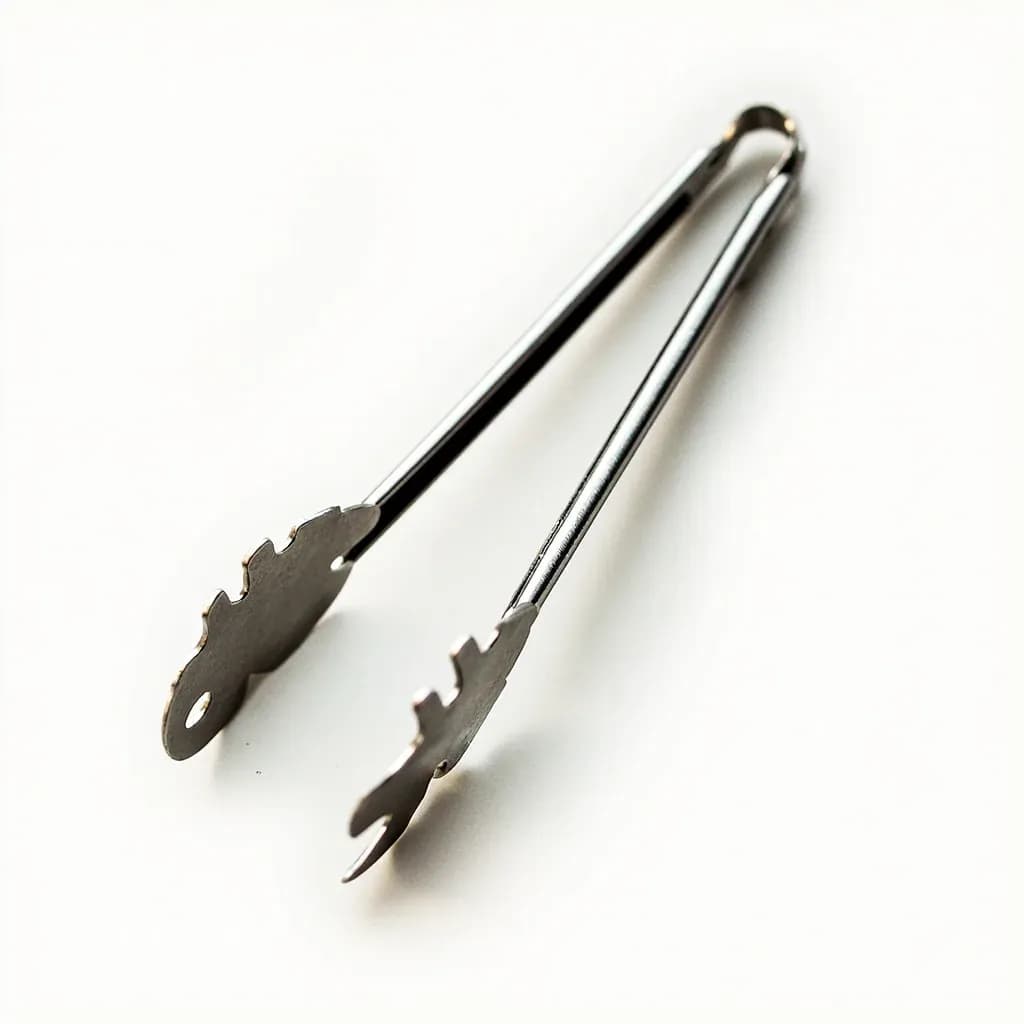
Long-handled tongs are spring-loaded scissor-action grippers with extended arms that keep hands well clear of high heat. They are used to turn meat on a grill, flip frying foods, plate delicate items, and handle hot tortillas or vegetables over an open flame. The length and locking mechanism make them indispensable for barbecue, deep frying, and stovetop searing.
Long-handled tongs are scissor-action gripping tools in the 12-to-16-inch range (specialty grill models reach 18 inches and beyond) whose entire purpose is to extend the cook's reach and keep fingers out of the heat zone. The extra length is a functional choice, not a vanity — it creates clearance over open flame, deep stockpots, and the back of a hot oven where a typical 9-inch pair would put fingertips squarely in danger. The spring-loaded hinge holds the arms open until you squeeze, so the tool behaves like an extension of the hand rather than something you actively manipulate.
The biggest decision when buying is tip material, since it governs both heat tolerance and cookware compatibility. Solid stainless tips are the most durable, sanitary, and heat-resistant, but they will scar non-stick and enameled surfaces in a single pass. Silicone-tipped versions (rated to roughly 600°F / 315°C) sacrifice a little rigidity for full non-stick compatibility, while nylon tips (~400°F / 200°C) are the economy option for moderate-heat work. For most home cooks, a single 12-inch silicone-tipped locking pair covers everyday stovetop and pan work, while a separate 16-inch solid-stainless pair handles grilling and high-heat jobs where bare metal is welcome and grip strength matters more than surface protection.
Alternatives
Types & varieties
The classic hinged, spring-loaded design that opens when released; the standard for grilling and stovetop work.
Add a pull-ring, lever, or push-button lock so the arms stay closed during drawer storage and the spring rests.
Stainless body with silicone ends; safe for non-stick and rated to roughly 600°F (315°C).
Economy option safe for non-stick coatings; lower heat tolerance than silicone, typically ~400°F (200°C).
Single-piece stamped stainless steel; no crevices for food to lodge in, easy to sanitize, the professional kitchen default.
Front arms angled upward so the knuckles clear the pan rim when flipping — useful with high-sided skillets.
Traditional look with handles that stay cool to the touch; not dishwasher safe and prone to cracking if soaked.
Often have scalloped or claw-shaped ends for gripping strands of pasta or portioning large items like corn on the cob.
Hybrid with fine pointed tips for pin-boning fillets; much shorter and not designed for high heat.
Grip and Technique
Long tongs behave like a lever, and the way you hold them changes everything about precision and effort. Most home cooks default to a tight fist around the handles, which works for heavy items but tires the hand and makes fine work clumsy. Switching grips based on the job at hand turns the tool from adequate to genuinely useful.
- Scissors grip — thumb and three fingers through the handles, palm free. The relaxed hold lets the tips act like an extension of your fingers; the right choice for everyday flipping, plating, and tossing.
- Pinch grip — palm under the hinge, thumb on top of the closed arms. Reserved for delicate items like fish fillets, where a heavy squeeze would crush the protein.
- Hammer grip — closed fist around both handles, hinge braced in the palm. Channels arm strength into the tips for levering heavy roasts or pressing meat flat against a hot grill.
Common uses
Tips & pitfalls
- Hold long tongs like a pair of scissors, not like a screwdriver — a relaxed scissors grip keeps the tips responsive and prevents hand fatigue over a long cook.
- Never use bare stainless-steel tips on non-stick or enameled cookware; the metal will scar the coating in a single pass. Choose silicone- or nylon-tipped versions instead, or keep a dedicated non-stick pair.
- Do not pinch meat with the tips to test doneness — squeezing forces juices out of the cut and leaves visible marks on presentation sides. Use an instant-read thermometer instead.
- Give the tips a squeeze test on a folded paper towel before use: if they leave a deep crease the spring is too stiff for delicate food; if they gape the spring is worn and grip is weak.
- Clean the hinge spring every few uses by sliding a toothpick or bottle brush through it — grease and food residue collect there and can harbor bacteria, even on otherwise spotless tongs.
- Engage the lock during storage so the spring isn't under constant tension; this doubles the working life of cheap stamped tongs.
- For grill work, angle the tips so the long axis of the food is parallel to the grates — perpendicular tongs leave channel marks on delicate proteins like halibut or skin-on salmon.
- Keep a dedicated pair of stainless tongs for raw meat and a separate pair for plated or finished food; color-coded silicone tips make this easy in busy or shared kitchens.
Good to know
- Typical length
- 12–16 in (30–40 cm); specialty grill models reach 18+ in (45+ cm)
- Tip materials & heat tolerance
- Stainless steel (highest), silicone (~600°F / 315°C), nylon (~400°F / 200°C), or plastic
- Handle materials
- Stainless steel, plastic-coated steel, silicone-gripped steel, or hardwood
- Mechanism
- Scissor-action spring hinge, single-piece stamped metal, or riveted two-piece construction
- Heat clearance
- Long-handled versions keep the hand roughly 10–14 in (25–35 cm) back from the cooking surface
- Locking feature
- Most modern models include a pull-loop, lever, or thumb-tab lock that closes the arms for storage
- Weight
- A typical 12-inch stainless pair weighs 6–9 oz (170–255 g)
- Dishwasher safe
- Stainless and silicone-tipped models generally are; wooden-handled versions are not
- Also called
- Grilling tongs, BBQ tongs, scissor tongs, spring tongs
Also called
Long BBQ Tongs · BBQ Tongs · Taco Tongs · Tongs (Pinzas) · Grill Tongs
Related

Peeler
Swift blade for stripping skin off fruit and vegetables

Grater
Sharp-toothed surface for shredding cheese and vegetables

Microplane
Ultra-fine rasp for citrus zest, garlic, and hard cheese

Mixing Bowl
All-purpose bowl for combining, whisking, and tossing

Whisk
Looped wires that beat air into eggs, cream, and sauces

Spatula
Flat blade for flipping, lifting, and scraping

Slotted Spoon
Pierced spoon that lifts solids and drains the liquid behind

Wooden Spoon
Gentle, heat-friendly spoon for stirring anything