Prep Tools
Lyagan (Serving Platter)
A large round Central Asian ceramic platter for serving plov and other shared dishes.
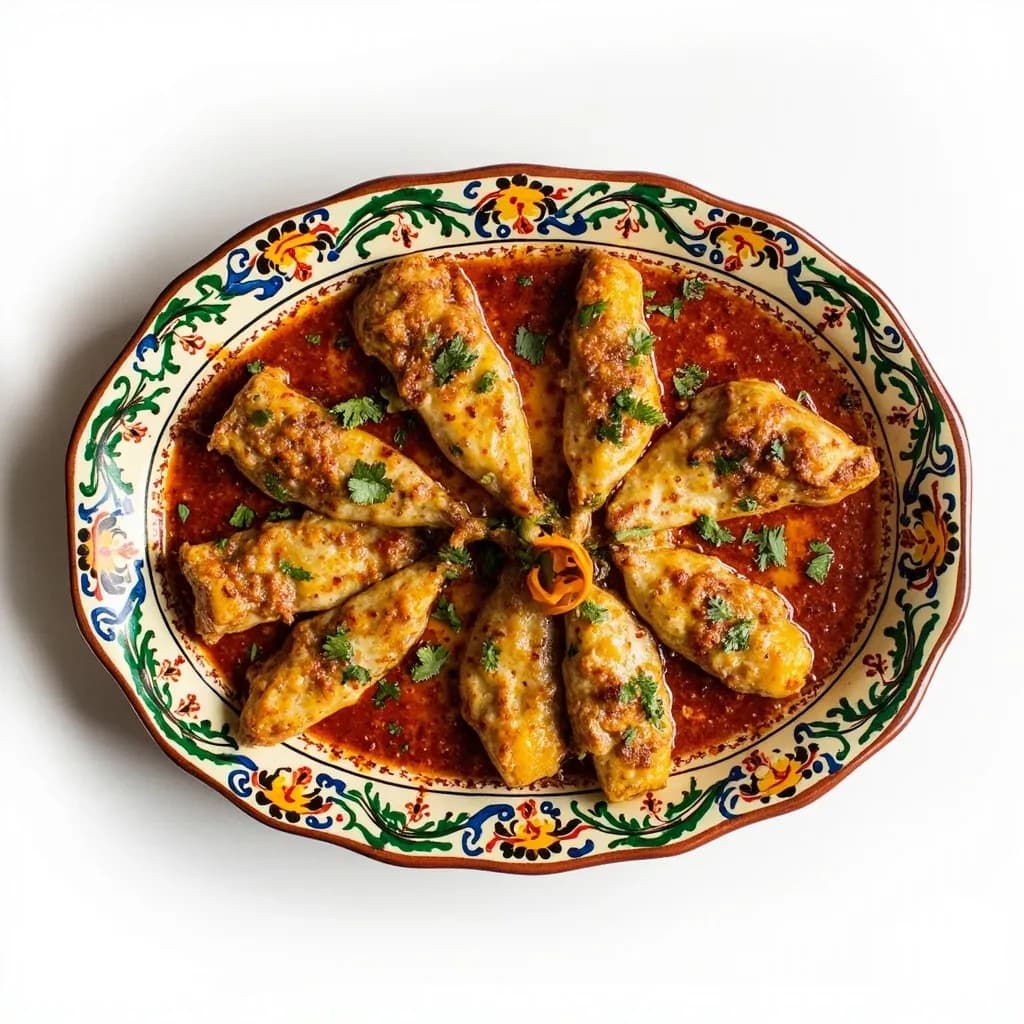
A lyagan is a wide, often hand-painted ceramic platter used across Uzbekistan and Central Asia to serve communal dishes. It is the traditional vessel for presenting plov (pilaf), mounded rice with meat and carrots, as well as manti and salads for the table. Its generous diameter suits family-style and guest dining where everyone shares from the center.
The lyagan is a large, round, shallow ceramic platter from Central Asia — most closely identified with Uzbek and Tajik tables — that carries the heaviest dish of the meal to the center of the spread. It is the traditional serving vessel for plov (osh), ladled straight from the kazan in a single steaming mound meant to be shared. A good lyagan is handmade, glazed, and hand-painted, and its wide flat rim, gently sloping center, and sheer mass (often 2–4 kg for a family-size piece) make it as much a piece of table art as a piece of cookware. The word comes from the Persian/Tajik lagan, meaning a broad shallow vessel, and the platter occupies a cultural role similar to the Italian tagliere or the Spanish paella pan: a defining object of the cuisine that is also the visual anchor of the meal.
In practical terms, the lyagan is shallow — usually only 4–7 cm deep at the center — so it does not insulate food the way a deep bowl does. Its heavy ceramic body does, however, retain heat reasonably well once warmed, and its broad surface lets steam escape so a mound of pilaf stays fluffy rather than soggy. A 50 cm family piece holds roughly 3–5 kg of plov with meat, and the platter is sized so that diners seated around it can reach the food with their hands or torn flatbread without leaning. Decoration is regional — Rishtan cobalt-on-white, Bukhara red-and-green florals, Samarkand geometric medallions, Khorezm earthy palettes — and the painted surface is part of what signals a serious table.
A lyagan is not a cooking vessel: it goes from kazan to table, not onto a burner. Traditional pieces are not designed for stovetop or oven use, and because clay bodies and glazes vary by maker, any warming should be low-temperature and verified per piece rather than assumed. Treat one as you would a wooden cutting board or a piece of cast iron — a handcrafted, hand-washed object that improves with use and should never be exposed to thermal shock, harsh detergents, or the dishwasher.
Alternatives
Types & varieties
From Rishtan in the Fergana Valley; cobalt-blue floral and arabesque patterns on a white ground, on a distinctive local clay body.
Green and red/burgundy palette with stylized pomegranates, tulips, and floral borders; often more ornately bordered.
Bold geometric and medallion patterns, frequently combining several pigments with calligraphic bands.
Earthy reds, ochres, and greens with simpler, larger motifs tied to Khorezm ceramic traditions.
Largest size, 45–60 cm, used to bring plov straight from the kazan to the table.
Smaller 20–30 cm pieces used as personal plates for pilaf in teahouses and at home.
Unglazed terracotta used in some rural traditions; imparts a faint earthy note and is meant for bread, fruit, or dry foods only.
Warming and serving plov
Plov loses temperature quickly when it hits a cold ceramic surface, and chilled rice is the single most common reason a lyagan-served plov disappoints. Warm the empty platter in a low oven (around 80–100°C / 175–212°F) for 10–15 minutes if your piece is known to tolerate oven heat, or rinse it with hot water and dry it just before the kazan is ready — the safer default. Bring it to the table on a wooden board or a thick folded cloth, ladle the plov into the center, and let the diners pull from the rim; the wide flat border is designed to keep the rice from spilling as hands and torn bread reach in.
- Pre-warming prevents the rice fat from congealing into pale patches on top of the mound.
- Ladle from the kazan in one motion; the shallow depth makes re-shaping the pile on the platter difficult without crushing the grains.
- Serve promptly while the platter is still warm; a heavy ceramic lyagan will hold the mound near eating temperature for a comfortable seated meal, but the bottom layer will eventually compact against the cool surface.
Buying and authenticating
An authentic lyagan is handmade, and the regional ceramic traditions are recognizable on sight. The most useful buying test is the tap: hold the platter at one rim and strike the opposite rim with a knuckle. A clear, high ring means sound ceramic; a dull thud means a hidden crack. Look for slight asymmetry in the painted pattern (a sign of handwork), an even glaze with no bare patches in the inner well, and a foot ring that sits flat on the table without rocking.
- Rishtan (Fergana Valley) is the source of the famous cobalt-blue-on-white style; the local clay is unusually white and the blue is distinctively deep.
- Bukhara pieces skew ornamental, with dense red-and-green floral borders and often a central medallion.
- Samarkand and Khorezm pieces tend to use warmer, earthier palettes and bolder geometric or calligraphic bands.
- Unglazed sopol pieces are rustic and intended for bread or fruit, not for plov or oily dishes.
Common uses
Tips & pitfalls
- Warm the platter in a low oven or with a rinse of hot water before ladling in freshly cooked plov — cold ceramic chills the rice and clumps the fat on contact. Confirm your piece tolerates oven heat first.
- Hand-wash only; traditional glazes (some of which may still contain lead, especially on older or unmarked pieces) and hand-painted decoration do not tolerate dishwashers or harsh detergents.
- Never set an empty cold lyagan on a hot surface or pour boiling liquid into a chilled one — thermal shock is the most common way to crack the body.
- Place a folded cloth, trivet, or wooden board under it on the table; the weight plus a hot load can mark or crack glass tabletops.
- Lift with both hands and support the rim; the wide flat rim is the weakest point under an uneven grip, especially on a heavy piece.
- When buying in Uzbekistan (Rishtan, Samarkand, Bukhara, Khiva), check that the glaze is even, there are no hairline cracks, and the piece rings clearly when tapped — a dull sound signals a hidden fracture.
- Do not confuse the lyagan with a kazan — the kazan is the cast-iron or metal cooking cauldron; the lyagan is the serving vessel that receives the cooked food.
- Avoid oily foods on unglazed sopol versions; they will stain and absorb into the porous body and never fully come out.
Good to know
- Origin
- Central Asia; strongly associated with Uzbekistan and Tajikistan
- Material
- Fired ceramic/earthenware, typically glazed and hand-painted
- Shape
- Large, round, shallow, with a wide flat rim and gently sloping center
- Typical diameter
- 35–60 cm (14–24 in) for communal plov; 20–30 cm for individual portions
- Depth
- Shallow — about 4–7 cm at the center, less at the rim
- Weight
- Heavy; a family-size lyagan commonly 2–4 kg
- Decoration styles
- Rishtan cobalt-on-white; Bukhara red-and-green floral; Samarkand geometric; Khorezm earthy palettes
- Cultural role
- Centerpiece of the dastarkhan (Central Asian table spread); shared communally from a single platter
Also called
lyagan · lagan · plov platter
Related

Peeler
Swift blade for stripping skin off fruit and vegetables

Grater
Sharp-toothed surface for shredding cheese and vegetables

Microplane
Ultra-fine rasp for citrus zest, garlic, and hard cheese

Mixing Bowl
All-purpose bowl for combining, whisking, and tossing

Whisk
Looped wires that beat air into eggs, cream, and sauces

Spatula
Flat blade for flipping, lifting, and scraping

Slotted Spoon
Pierced spoon that lifts solids and drains the liquid behind

Wooden Spoon
Gentle, heat-friendly spoon for stirring anything