Prep Tools
Mano (Metate Handstone)
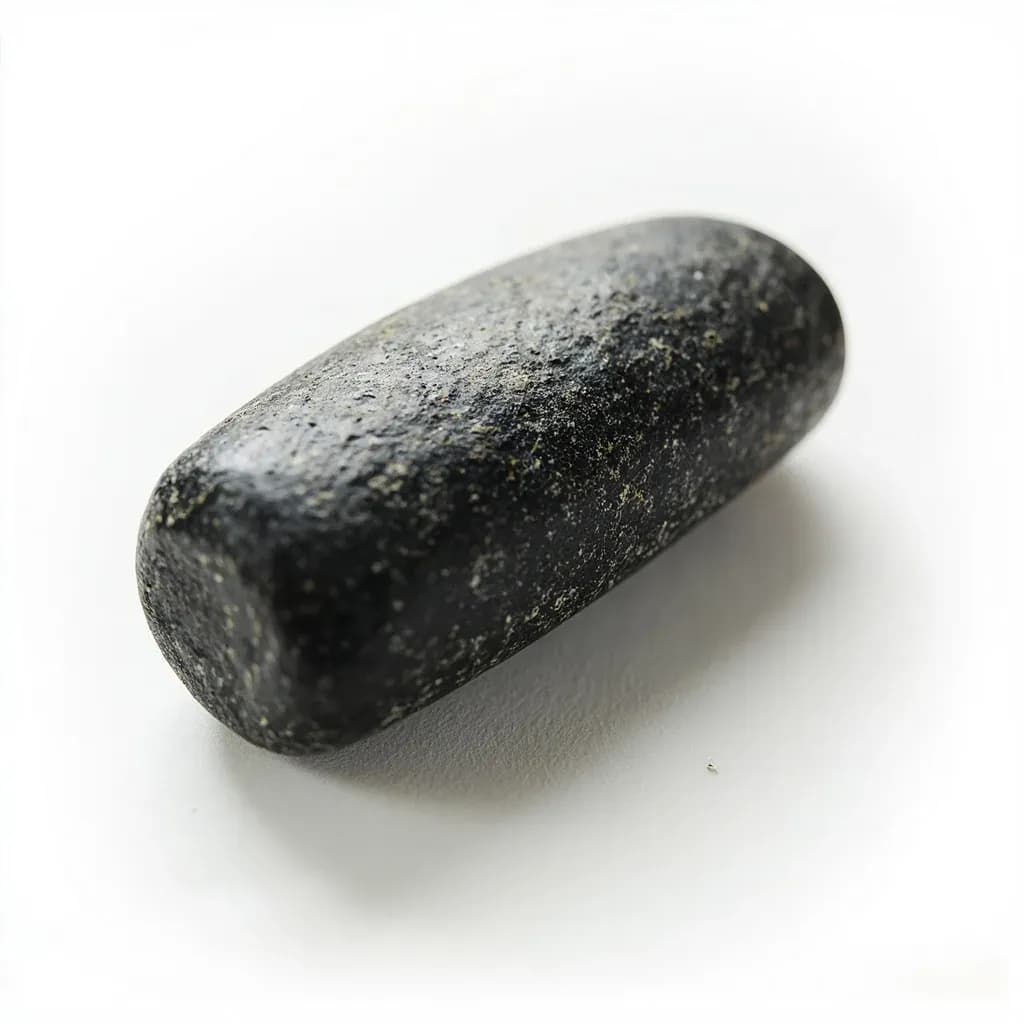
A handheld grinding stone rolled across a metate to crush corn, cacao, and spices by hand.
A mano is a smooth oblong handstone, usually carved from volcanic basalt, gripped in both hands and pushed back and forth across a metate grinding slab. The crushing and shearing action mills nixtamalized corn into masa, grinds cacao, and pulverizes chiles and spices. It is one of the oldest Mesoamerican kitchen tools, still used for masa and mole.
The mano is the hand-held stone that does the real work of Mesoamerican grinding, riding across the surface of a much larger, three-legged or trough-shaped slab called the metate. Together they form a paired grinding system with no close mechanical equivalent in Western kitchens: the metate is the passive anvil, the mano is the active grinder, and the cook supplies the rhythm. Most manos are carved from vesicular (porous) basalt — a volcanic stone chosen for the same reason it is favored for molcajetes: its gritty face grips wet dough and tears through fibrous seed coats rather than skating over them. The classic shape is a short cylinder about the size of a forearm, but loaf-shaped, rectangular, and hand-fitted forms are all common regional variations.
The tool's real distinction is the texture it produces. The abrasive volcanic rasp, combined with the slow, even pressure of a rolling stone, shears nixtamalized corn kernels into a hydrated paste in a way steel burrs and food processors cannot quite replicate — which is why traditionalists, top Mexican chefs, and serious students of regional cooking still return to the metate y mano for masa, moles, and chocolate. A single batch of masa for a dozen tortillas takes a practiced hand roughly twenty to forty minutes; the work is rhythmic and meditative, more like kneading than crushing.
A cook who only makes masa once a year has little reason to own one, but anyone serious about traditional Mexican cooking should understand the metate-y-mano system, since it remains the reference standard against which modern masa mills are judged. After a few sessions the mano is surprisingly intuitive — and far less intimidating than its weight suggests.
Alternatives
Types & varieties
The classic barrel- or rolling-pin-shaped stone; rolled end over end; the most efficient choice for wet masa work.
Squat, oblong stone with one flattened working face; rocked or pushed rather than rolled; very common in highland Mexican kitchens.
Rectangular slab with a worn working face, used with a push-pull motion; seen in parts of Oaxaca and Chiapas.
Irregular stones roughly shaped to one hand; older prehispanic and rustic village examples; rocked in a small arc or back-and-forth.
Heavier, longer stone braced with both hands or against the hip; for big batches of cacao, chiles, or mole.
The traditional standard; porous and abrasive, it grips wet dough and grinds evenly without skating.
Denser, smoother, and less porous; found in some modern or non-traditional settings; requires noticeably more downward pressure.
The mano-metate partnership
A mano is functionally useless without its metate, and the metate is awkward without the mano — the two are sold, ground, and stored as a pair, and the cook's technique is built around the relationship between the two stones. The metate is angled slightly toward the user and propped at a comfortable height; the cook works in a stable, low position, often seated on a low stool or one knee. The mano is grasped with both hands, laid flat against the metate, and moved in a long, even forward-and-back stroke — a roll in the cylindrical form, a rock in the loaf form. The metate's three legs (or trough shape) keep it rigid; the mano's weight and the cook's body weight supply the grinding pressure.
- The metate stays stationary; the mano does the traveling.
- Corn is added a small handful at a time, not dumped in bulk, so each pass can grip and shear the kernels evenly.
- Wet masa accumulates at the low end of the metate and is scraped back to the center with the mano or a shaped scraper between additions.
- A worn hollow in the metate — called a 'cajete' once it deepens — is normal and is actually prized, because it cradles the masa and improves the rhythm of the work.
Choosing and matching a mano to the work
There is no single 'correct' mano; the right stone is the one matched to your metate, your batch size, and the ingredient. A small loaf-shaped mano is plenty for grinding a kilo of nixtamal for a family meal of tortillas; a long cylindrical mano earns its keep only when you are working through three or more kilos of masa for tamales, or crushing large quantities of cacao, chiles, and seeds for mole. Stone choice matters too: traditional porous basalt 'bites' into wet dough and gives a slightly coarse, more textured masa; dense granite slides more and demands more pressure, which is tiring on the arms and slow on the metate's surface.
- Small loaves and hand-fitted stones suit small batches, dry spice work, and beginners learning the rhythm.
- Long cylindrical manos are the workhorse for serious masa production and for grinding cacao, chiles, and seeds in volume.
- Match the mano's width to the metate's working face — a stone that overhangs the metate's high end is awkward and uneven.
- If you inherit or buy an old pair, expect the metate to be dished from years of use; a heavily worn metate is not a defect but a record of how it was meant to be used.
Care, cleaning, and re-dressing
Volcanic stone is forgiving but not indestructible. Soap should never touch it: the porous surface absorbs detergent and can leach it into food for years afterward. A stiff brush or dry scrub, followed by a clear-water rinse and a long air-dry in the sun or near a window, is all the routine care the stone needs. In cold or damp climates, the stone must be fully dry before it is stored away, because trapped moisture will freeze and crack the basalt. The metate's working face will eventually polish smooth with use; a quick re-dressing with a hammer or a hard stone restores the rasp that grips the corn.
- Brush and rinse with water only — never soap on traditional volcanic stone.
- Air-dry fully before storing, especially in climates that see freezing temperatures.
- Re-dress the metate's working face with a hammer or hard stone when it starts to slip under the mano.
- Store in a covered outdoor nook, a dry pantry, or on an open kitchen shelf where air circulates.
Common uses
Tips & pitfalls
- Keep the metate very slightly damp when grinding masa — a dry stone drags on the corn and cracks the nixtamal; a quick splash of water on the working surface is the difference between silky masa and a frustrating, crumbly paste.
- Sit or kneel in a stable, low position with the metate at a comfortable angle; the work is rhythmic and weight-driven, not a feat of upper-body strength.
- Maintain a steady forward-and-back rolling (or rocking) tempo and let the stone do the work — pressing down hard wears a hollow into the metate and tires the arms without grinding faster.
- Add nixtamal to the metate in small additions rather than all at once, and scrape the accumulating masa back to the center of the slab between passes so each kernel meets the stone cleanly.
- Re-dress (re-roughen) the metate surface periodically with a hammer or hard stone; a too-smooth metate will not grip the grain and the mano will skate.
- For cacao, toast the beans lightly first and crack them into nibs between two stones or under a heavy knife before passing them over the metate; whole beans tend to roll and escape the mano.
- Clean by scraping off residue and rinsing with water only — soap clogs the porous volcanic stone and can taint future batches for a long time afterward.
- Common mistake: grinding on a bone-dry metate. The single most common reason homemade masa is sandy instead of smooth is that the stone and the corn are not wet enough; a moist metate is non-negotiable.
Good to know
- Type
- Hand-held grinding stone used in tandem with a metate
- Traditional material
- Vesicular (porous) volcanic basalt; sometimes granite in modern or non-traditional reproductions
- Origin
- Mesoamerica, with continuous use for roughly 3,000+ years
- Companion tool
- The metate — the three-legged or trough-shaped grinding slab the mano rides across
- Typical size
- About 20–30 cm (8–12 in) long; cylindrical manos are roughly 8–15 cm in diameter
- Typical weight
- Approximately 2–6 kg (4–13 lb) depending on size and stone density
- Use motion
- Forward-and-back rolling, rocking, or pushing across the metate's face
- Time per batch
- Roughly 20–40 minutes to grind about 500 g of nixtamal into masa
- Care
- Rinse with water only — no soap on porous volcanic stone — and air-dry fully before storing
Also called
Metate Handstone · Grinding Stone · Mano de Metate
Related

Peeler
Swift blade for stripping skin off fruit and vegetables

Grater
Sharp-toothed surface for shredding cheese and vegetables

Microplane
Ultra-fine rasp for citrus zest, garlic, and hard cheese

Mixing Bowl
All-purpose bowl for combining, whisking, and tossing

Whisk
Looped wires that beat air into eggs, cream, and sauces

Spatula
Flat blade for flipping, lifting, and scraping

Slotted Spoon
Pierced spoon that lifts solids and drains the liquid behind

Wooden Spoon
Gentle, heat-friendly spoon for stirring anything