Prep Tools
Masala Dabba Spice Box
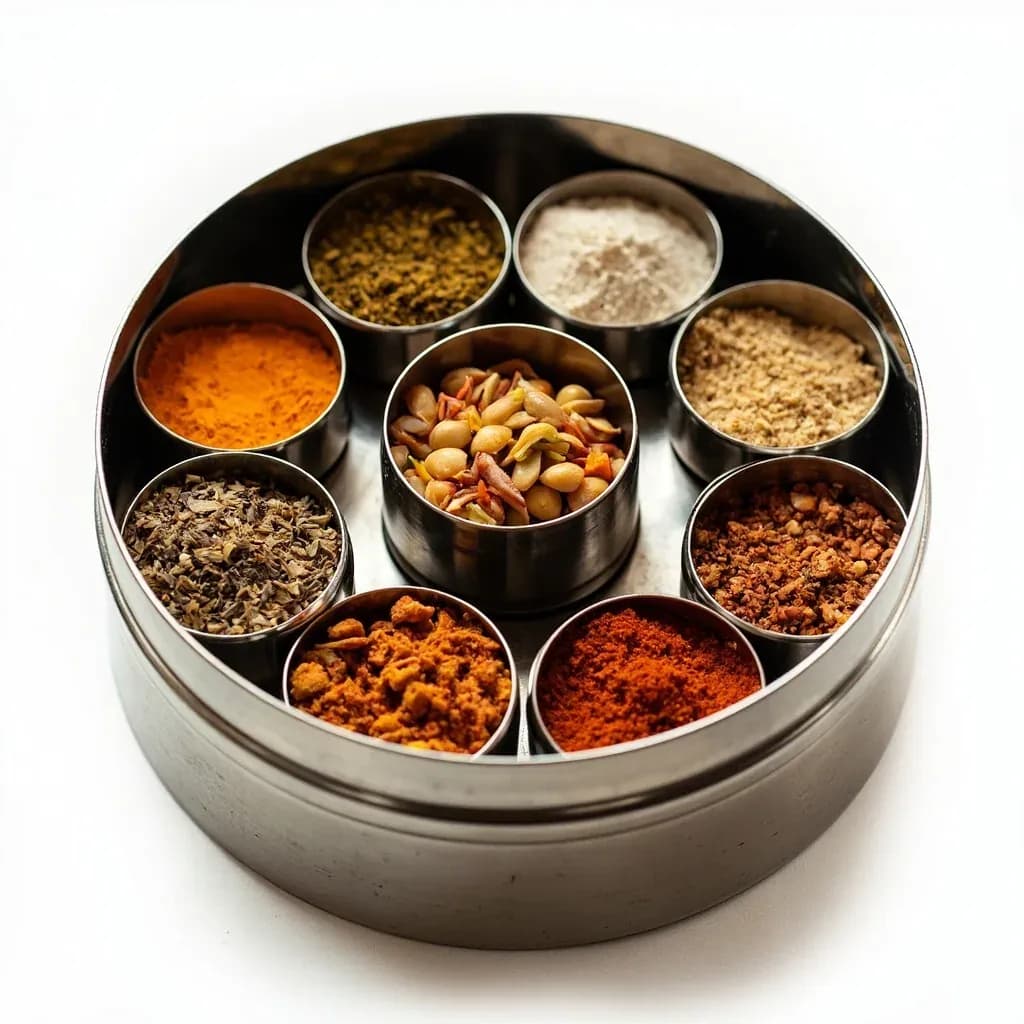
A round steel tin holding seven small bowls of the everyday spices for Indian cooking.
A masala dabba is a round stainless steel box, usually with seven inner katoris (small bowls), that keeps a cook's most-used whole and ground spices together within arm's reach of the stove. Typical contents are cumin, mustard seed, turmeric, chili, coriander, garam masala and salt. A tight inner lid and outer lid keep the spices fresh and contained.
The masala dabba is the small round tin, typically 8–10 inches across, that sits at the elbow of nearly every Indian cook who makes a daily meal. Inside its snug-fitting lid sit five to twelve little nesting bowls (called katoris) arranged like petals around a central well, and the whole thing is built to be opened with one hand, pinched with the other, and closed again in a breath. Its purpose is workflow, not storage: a good tempering (tadka) of cumin, mustard, turmeric, chili, and coriander can demand four or five spices into hot oil in under a minute, and the dabba exists so those spices are open, visible, and within thumb's reach when the oil is smoking.
In practice the dabba holds the spices you reach for every single day — ground coriander, ground cumin, turmeric, chili powder, garam masala, salt, and usually one acidic or finishing element like amchur or chaat masala — while the central well is reserved for whole seeds (cumin, mustard, fennel, cloves) that get bloomed in oil to finish a dish. Because the tin is opened dozens of times in a single cooking session, ground spices inside it lose aroma faster than spices sealed in jars, which is exactly why serious cooks treat the dabba as their daily-use kit and keep bulk, rare, or freshly opened spices in airtight containers elsewhere.
Stainless steel has largely displaced brass in urban Indian kitchens since the late twentieth century because it is non-reactive, light, and inexpensive; brass and tinned-copper versions survive mostly as gifting pieces and heirlooms. A well-made modern dabba will use food-grade 202 or 304 stainless, have bowls that sit firmly without rattling, and a lid that seats evenly so humidity cannot creep in overnight.
Alternatives
Types & varieties
The modern standard; rust-proof, lightweight, and inexpensive. Look for food-grade 202 or 304 steel and snug-fitting bowls.
Traditional material, often tin-lined; heavier in the hand and considered auspicious, making it a common wedding and housewarming gift.
Usually tinned on the interior; valued for appearance and for ceremonial display rather than everyday function.
A bridal-trousseau or heirloom piece; rare in working kitchens.
Compact version for modest spice collections, small kitchens, or cooks who keep their daily rotation tight.
Expanded layout for cooks who keep several regional blends ready at once; sometimes fitted with a transparent lid.
Stacking design with a second tray of bowls beneath the first; favored by serious home cooks and small commercial kitchens.
Houses extra bowls or a small spoon holder in the lid itself.
Anatomy of a traditional dabba
The classic seven-bowl arrangement is not a rule but a convention, and understanding the layout explains why the tin works so well in fast cooking.
- Outer tin and lid: a single round shell, deep enough that the lid clears the rims of the inner bowls and seats with a slight resistance to keep humidity out.
- Katoris: small cups that nest into the base; they should lift out cleanly for refilling but not rattle when the tin is moved.
- Central well: a small circular cavity in the middle of the bowl arrangement, traditionally used for whole spices — cumin seeds, mustard seeds, fennel, or cloves — that you finish a dish with.
- Spoons: many cooks tuck a small dry spoon into each katori to prevent flavor cross-contamination and keep fingers from introducing moisture.
Curating the seven bowls
Tailor the lineup to the cuisine you actually cook. A Punjabi kitchen and a Tamil kitchen will fill the bowls very differently, and the dabba is meant to be customized.
- Core daily-use ground spices: ground coriander, ground cumin, turmeric, red chili powder (Kashmiri for color, cayenne for heat), and garam masala are the most common residents.
- Salt: many cooks keep salt in its own bowl so they can season by the spoon without disturbing spice blends; others keep it out of the dabba entirely to avoid cross-tainting.
- An acidic or finishing element: amchur (dry mango powder), chaat masala, or sumac gives you a bright final note without reaching for a lemon.
- Regional swaps: South Indian cooks often trade garam masala for sambar powder or rasam powder; Bengali cooks may keep panch phoron in the central well and ghee nearby for finishing; Gujarati kitchens lean on a coriander–chili blend called dhana-jiru.
- Reserve one bowl: leaving one katori free lets you rotate in a seasonal or dish-specific spice (freshly opened garam masala, a particular chili, smoked paprika) without disturbing the working lineup.
Keeping spices fresh in daily use
The dabba's weakness is exactly its strength: it is opened constantly, so ground spices inside it age faster than spices in sealed jars. A few habits keep the contents lively.
- Refill in small batches — enough for two to three weeks — rather than topping off from a bulk bag every time.
- Refill a katori only when it is empty and dry; residue from the previous batch will cake and dull the new spice.
- Wipe the tin every few months with a dry cloth, then tumble a small handful of plain rice inside to absorb residual oils before discarding and refilling.
- If a lid has loosened, slip a round of parchment or food-safe silicone between the rim and lid to keep humidity out without warping the seal.
Common uses
Tips & pitfalls
- Tuck a small dry spoon in each katori; this prevents cross-contamination of flavors and stops fingers from introducing moisture that will cake the spices.
- Use only dry utensils when scooping — even a single drop of water will clump ground spices and shorten their life.
- Refill in small batches; ground spices in a frequently opened dabba lose their aroma in 4–8 weeks, much faster than spices kept sealed in jars.
- Keep the closed dabba away from the stove, direct sunlight, and the windowsill — heat and light bleach the color and dull the aroma of ground spices.
- Never store the dabba in the refrigerator; condensation forms on the cold metal the moment you bring it out, and that moisture clumps everything inside.
- Rotate the contents so older spice is used first; label the underside of each bowl with a small dot of paint or a sticker if more than one cook uses the kitchen.
- Skip the dishwasher for brass and copper versions — hand-wash and dry immediately to protect the tin lining.
- Reserve one bowl for salt only if you salt heavily by eye; mixing salt into spice blends can throw off seasoning when you reach in by the spoonful.
Good to know
- Origin
- India; a long-standing fixture of home kitchens across the subcontinent, present in both North and South Indian cooking traditions.
- Also called
- Masala box, masala dabbi, spice box, Indian spice tin, masala canister.
- Standard form
- A round metal container with a snug-fitting lid and 5–12 small inner bowls (katoris) arranged around a central well.
- Dimensions
- Outer tin roughly 8–10 in (20–25 cm) in diameter and 2–3 in (5–7.5 cm) tall; each katori holds about 2–4 tbsp of ground spice.
- Material
- Stainless steel is the modern standard; brass (often tin-lined) and copper are traditional, with silver reserved for ceremonial or trousseau pieces.
- Typical contents
- Ground coriander, ground cumin, turmeric, red chili powder, garam masala, salt, and an acidic element such as amchur or chaat masala; whole spices in the central well.
- Weight when full
- Approximately 1–2 lb (500–900 g) for a stainless-steel dabba loaded with spices.
- Care
- Hand-wash, dry thoroughly, and store closed away from the stove, sunlight, and humidity; never refrigerate.
Also called
Spice Box · Masala Dani · Spice Tin
Related

Peeler
Swift blade for stripping skin off fruit and vegetables

Grater
Sharp-toothed surface for shredding cheese and vegetables

Microplane
Ultra-fine rasp for citrus zest, garlic, and hard cheese

Mixing Bowl
All-purpose bowl for combining, whisking, and tossing

Whisk
Looped wires that beat air into eggs, cream, and sauces

Spatula
Flat blade for flipping, lifting, and scraping

Slotted Spoon
Pierced spoon that lifts solids and drains the liquid behind

Wooden Spoon
Gentle, heat-friendly spoon for stirring anything