Prep Tools
Wide-Mouth Mason Jar
A threaded glass jar with a two-piece lid used for canning, preserving, and storage.
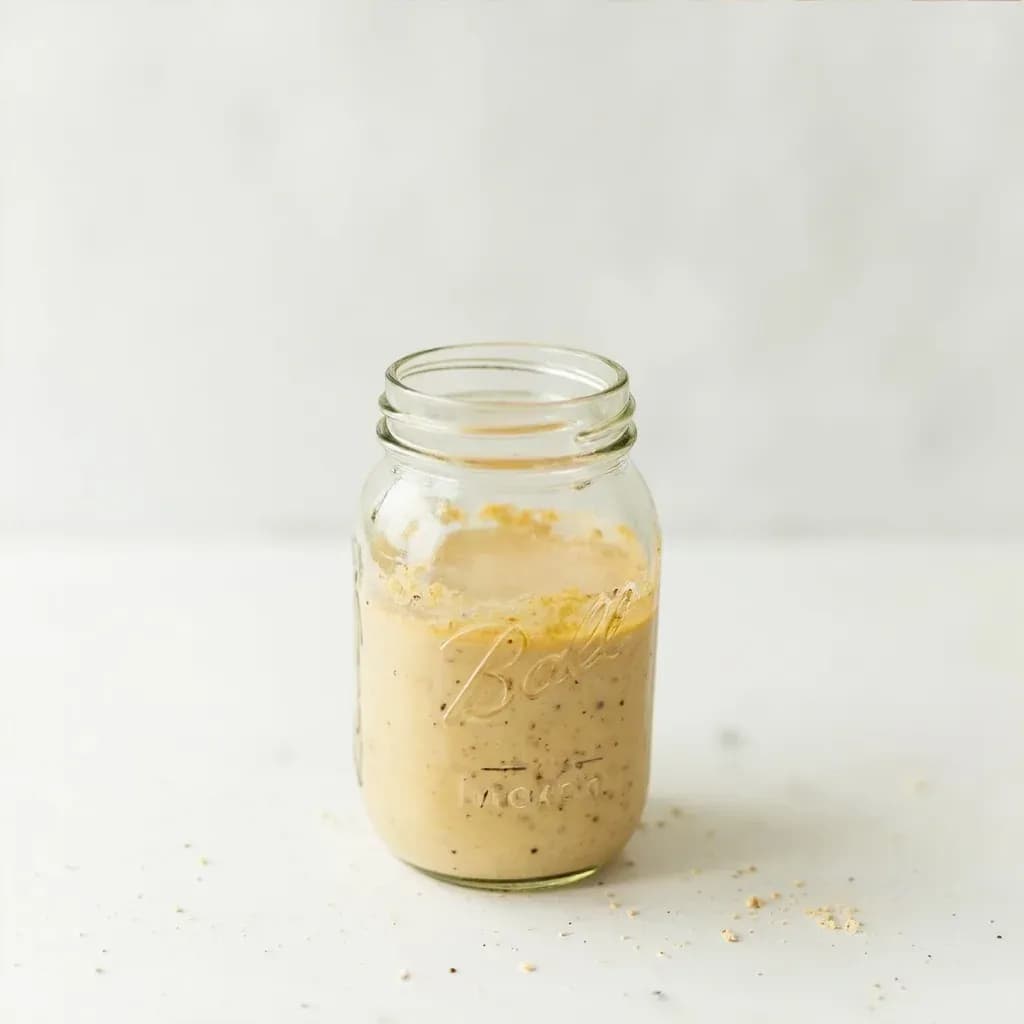
A wide-mouth mason jar is a tempered glass jar with a screw band and flat sealing lid, designed to withstand the heat of water-bath and pressure canning. Cooks use it to preserve jams, pickles, and sauces, to ferment and store dry goods, and as a shaker for dressings. The wide opening makes filling and packing whole fruits or vegetables easier than narrow-neck jars.
The wide-mouth Mason jar is a threaded soda-lime glass jar with a roughly 3-inch inner opening, paired with a two-piece metal lid: a flat disc with a sealing gasket and a separate screw band. Patented in 1858 by New York tinsmith John Landis Mason, it solved the central problem of home preservation — getting a reliable, reusable airtight seal on glass — and the screw-threaded mouth and replaceable flat lid became the de facto standard for North American home canning, now synonymous with the Ball and Kerr brands, which began producing jars in the 1880s and 1903 respectively.
In the kitchen, the wide opening is the decisive feature over the narrower "regular mouth" jar: it is easier to pack whole fruits, fish out ferments, scrape the last of a sauce, and clean by hand. The standardized sizes (half-pint through half-gallon) double as measuring vessels — a wide-mouth pint holds 2 U.S. cups and a quart holds 4 — which makes the jar as useful for ratio work as it is for storage. Ball and Kerr lids are cross-compatible; European formats (Le Parfait, Weck, Fido) use gaskets and bail or clamp closures and are not interchangeable.
Beyond canning, the wide-mouth jar has become a multi-purpose vessel: a fermenter you can weight down to keep vegetables submerged, a freezer container for stocks, a drinking glass for cocktails, a vessel for cold brew and infusions, and a sealed pantry bin for dry goods. Its limits are worth respecting — soda-lime glass is susceptible to thermal shock, and the flat sealing lids are designed for a single heat-processed seal — but used within those bounds, few pieces of kitchen equipment earn their shelf space the way a stack of quart jars does.
Alternatives
Types & varieties
Same jar bodies in the same volume sizes; the ≈3 in opening is easier to fill, empty, and clean, and is preferred for whole fruits, ferments, and chunky pickles.
The dominant North American brand (now Newell Brands); lines include Quilted Crystal, the painted Heritage Collection, and the Elite wide-mouth.
Founded 1903 by Bernard Kerr; sizes and lids are cross-compatible with Ball.
Uses a rubber gasket and a glass bail/lever lid rather than the two-piece screw system; favored in Europe for ferments and pâté.
Tapered jars with rubber rings and glass lids clamped with metal clips; reusable lids and a European home-canning favorite.
Swing-top (bail) jar with a rubber gasket; decorative and functional for dry storage and fermentation.
Filters UV light; used for light-sensitive infusions, tinctures, and homemade extracts.
Painted or colored exteriors (Ball Heritage, both mouth sizes); decorative only — never heat-process painted jars, as the finish can flake.
The two-piece lid and how a seal forms
The flat disc is the part that actually seals. Its underside is coated with a ring of plastisol — a soft, food-grade compound that softens at canning temperatures and conforms to the rim of the jar, then cools and bonds to the glass as the jar cools and a vacuum forms inside. The screw band's only job during processing is to hold the disc flat against the rim so the plastisol can flow and seal. Once the jar is hot-packed and the lid applied fingertip-tight, the air inside expands and pushes out around the partially open band, and as the jar cools that escaped space becomes a partial vacuum that pulls the lid down tight.
- Apply the band 'fingertip tight' — snug, but not torqued. Air must be able to escape during processing.
- Single-use flat lids are designed for one heat seal; bands are reusable indefinitely.
- After 12–24 hours of undisturbed cooling, press the center of the lid. If it does not flex, the jar is sealed; remove the band for long-term storage.
Common uses
Tips & pitfalls
- Inspect the rim of every jar before filling — even a small chip will prevent a vacuum seal and cause spoilage.
- Sterilize empty jars in boiling water for 10 minutes (or run them through a dishwasher with a heated dry cycle) and keep them hot until you fill them; cold glass plus hot food is the most common cause of cracking.
- Never reuse single-use flat canning lids for heat-processed canning — the plastisol gasket is designed for one seal. Bands are reusable indefinitely.
- Apply bands 'fingertip tight,' not wrench tight. Air must escape during processing for the vacuum to form as the jar cools.
- After 12–24 hours of cooling, confirm the seal by pressing the lid's center. A 'pop' during cooling is not a guarantee — the center-press test is.
- Don't pour boiling liquid into a cold jar, and don't set a hot jar on a cold stone counter or wet towel; thermal shock cracks soda-lime glass.
- For freezing, leave at least 1 inch of headspace (1½ in for liquids) and stick to straight-sided wide-mouth jars, which are far less likely to crack from expansion than tapered or shoulder-walled shapes.
- Label contents, date, and batch on the lid or side with a paint pen — canning ink smears; freezer tape peels off cleanly.
Good to know
- Inventor
- John Landis Mason, a New York tinsmith, patented the screw-threaded glass jar in 1858 (U.S. Patent 22,186).
- Lid system
- Two-piece: a flat metal disc with a plastisol sealing compound on the underside, plus a separate screw band that holds it down during processing.
- Wide-mouth opening
- Approximately 3 inches (76 mm) inner diameter — about 1 inch wider than the standard/regular mouth (≈2-3/8 in / 60 mm).
- Common U.S. sizes
- Half-pint (8 oz), pint (16 oz), quart (32 oz), and half-gallon (64 oz); 4 oz jelly jars are also made.
- Measuring
- A wide-mouth pint holds 2 U.S. cups; a wide-mouth quart holds 4 U.S. cups.
- Headspace (canning)
- 1/4 in for jams and jellies, 1/2 in for fruits and pickles, 1 in for low-acid pressure-canned foods.
- Processing methods
- High-acid foods (fruits, pickles, jams): water-bath canning at 212°F/100°C. Low-acid foods (vegetables, meats, soups): pressure canning at 240°F/116°C (10 psi for weighted-gauge canners at sea level).
- Temperature tolerance
- Rated for thermal shock within USDA canning guidelines; never pour boiling liquid into a cold jar or set a hot jar on a cold or wet surface.
Also called
Mason Jar · Canning Jar · Preserving Jar · Ball Jar
Related

Peeler
Swift blade for stripping skin off fruit and vegetables

Grater
Sharp-toothed surface for shredding cheese and vegetables

Microplane
Ultra-fine rasp for citrus zest, garlic, and hard cheese

Mixing Bowl
All-purpose bowl for combining, whisking, and tossing

Whisk
Looped wires that beat air into eggs, cream, and sauces

Spatula
Flat blade for flipping, lifting, and scraping

Slotted Spoon
Pierced spoon that lifts solids and drains the liquid behind

Wooden Spoon
Gentle, heat-friendly spoon for stirring anything