Baking & Pastry
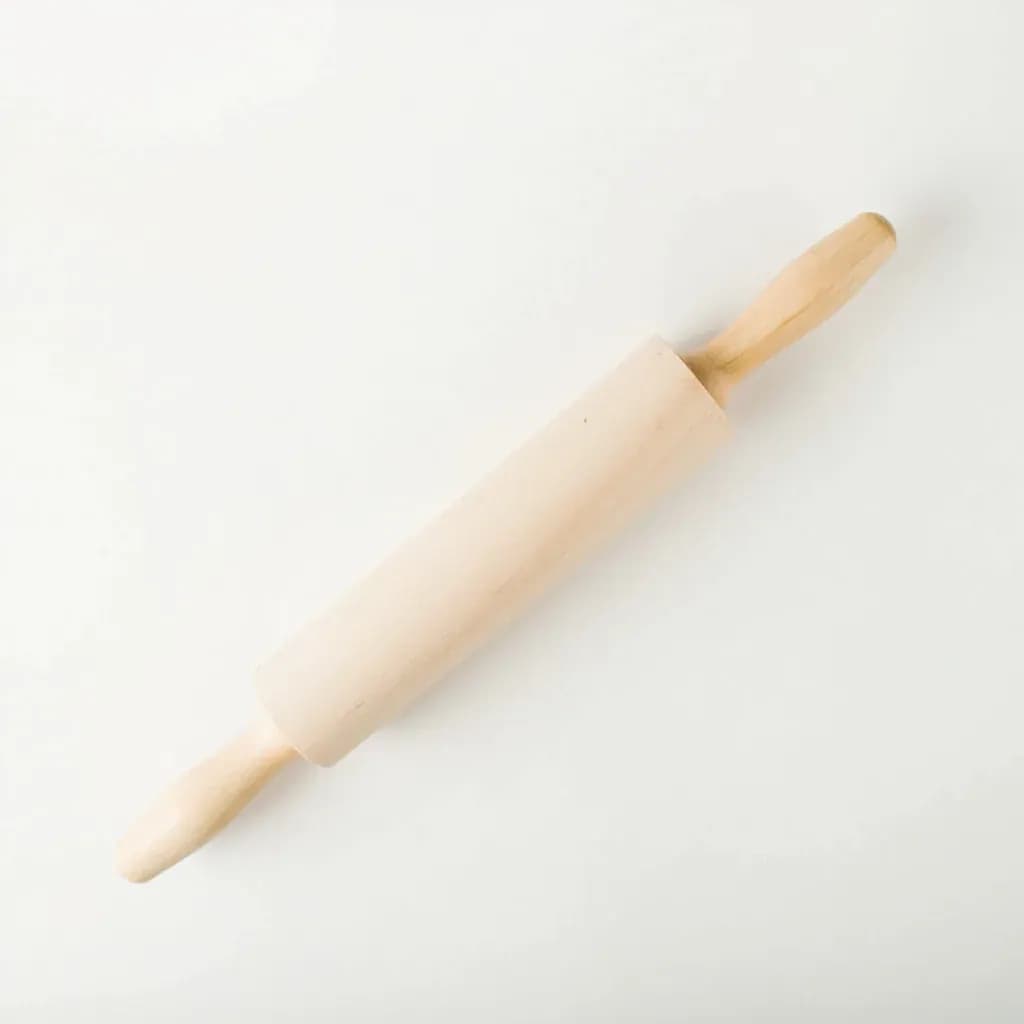
Long Rolling Pin (Matterello)
A long, slim Italian rolling pin for stretching fresh pasta dough into wide, thin sheets.
A matterello is a long, slender, handleless wooden rolling pin used to roll fresh egg pasta into a single broad, even sheet, or sfoglia. Its length lets the cook wrap and stretch the dough across a large board in one continuous motion. It is the classic tool of the Emilian sfoglina for tagliatelle, lasagne, and stuffed pastas.
The matterello is the long, slim, handle-free rolling pin that has anchored Italian pastry and pasta work for generations. Where the common American pin has two stubby handles and a fat barrel, the matterello is a single straight dowel — most often turned from close-grained beechwood (faggio), roughly 60–80 cm long and only 2–3 cm in diameter, with no grips at either end. The look is austere, but the design is deliberate: with the cook's hands resting directly on the wood, every shift in the dough's resistance is felt in the palms, which is exactly what is needed to coax a sheet of fresh egg pasta into a paper-thin, even sfoglia without tearing it.
In use, the matterello behaves less like a lever and more like an extension of the forearm. Pressure comes from the shoulders and upper back rather than the wrists, and the pin rolls freely under the hands as it travels across the bench. That freedom is what allows the sheet to be stretched — first rolled flat, then draped over the pin and pulled outward by gravity and the backs of the hands — into the long, gossamer sheets that define fresh tagliatelle, lasagne, and filled pastas like ravioli and tortelli. It is also the everyday pin for rolling out crostata dough, pasta frolla, and puff pastry, where a smooth, evenly weighted tool produces a flatter, more uniform sheet than a handled pin can manage.
Alternatives
Types & varieties
The standard straight dowel, 60–80 cm, beechwood; the everyday pasta and pastry pin in Italian kitchens.
Extra-long (80–100 cm), thinner dowel designed for stretching lasagna sheets and very large pastry cases.
A shorter (30–40 cm) version for small tasks — single portions, cookies, or rolling small disks of dough for filled pasta.
Marble version, heavier and naturally cool; favored in some southern Italian pastry work for keeping butter firm in laminated doughs.
Often grouped with the matterello; tapered ends with no handles, otherwise used the same way; the standard outside Italy for croissants and puff pastry.
Not a rolling pin but a pasta-cutting frame strung with thin wires; the matterello is what rolls the sheet that gets draped across it for cutting.
Why no handles?
The absence of handles is not minimalism or thrift — it is the entire point. With a handled pin, force is applied by squeezing the grips, which forces the wrists and forearms to do the work. That pressure is uneven: the middle of the pin sinks and the edges lift, so the dough thins in a fat oval rather than an even rectangle. With the matterello, the palms rest on the wood itself, the pin rolls freely under the hands, and the cook can feel exactly where the dough is resisting. Pressure can be lightened in the center, increased at the edges, or shifted sideways with almost no conscious thought. The result is the uniformly thin, rectangular sheet — the sfoglia — that defines fresh Italian pasta and is very hard to achieve any other way.
Care and feeding
A matterello should outlast its owner if treated like a piece of fine kitchen furniture. Wood and standing water are enemies: never soak the pin, never run it through a dishwasher, and never leave it resting on a damp cloth. Wipe it down with a dry or barely damp cloth after use, stand it upright or hang it so air circulates on all sides, and keep it out of direct sunlight.
- Once a year (or whenever the surface looks thirsty), sand very lightly with fine 220+ grit paper and rub in a thin coat of food-safe mineral oil; wipe off any excess after 20 minutes.
- If the pin picks up a faint odor from heavy use, rub it with a paste of baking soda and water, let it sit briefly, wipe clean, and re-oil.
- Never store a matterello leaning in a damp corner — a warped pin will rock on the bench and will never give an even sheet again.
- If a hairline crack opens at the end grain, sand it smooth and oil well; small cracks are cosmetic and do not affect rolling performance.
Common uses
Tips & pitfalls
- Grip the pin near the center and let it roll under your palms; push from the shoulders and upper back, not the wrists, so pressure stays even across the sheet.
- Always start from the center of the dough and work outward — never roll back and forth across the edges or the sheet will buckle and trap air.
- Turn the dough a quarter turn (90°) every few passes to keep it roughly square and to redistribute the flour underneath.
- Dust the bench (and the pin very lightly) with semolina flour or a semolina–00 mix; pure 00 can turn gummy and make the dough cling.
- Flour the pin lightly, not heavily — a thick coat dries the dough's surface and stops pasta sheets from adhering to one another when cut and stacked.
- For ultra-thin sfoglia, drape the rolled sheet over the pin and gently stretch it outward with the backs of the hands; gravity and a steady pull do much of the thinning.
- Let the dough rest 30–60 minutes at room temperature, wrapped in plastic, before rolling — rested dough stretches without springing back.
- Common mistake: reaching for an American-style handled pin to roll sfoglia. The grips force wrist pressure, the middle sinks, and you end up with a thick-centered oval that fights every attempt to stretch it even.
Good to know
- Origin
- Italy
- Material
- Traditionally beechwood (faggio); also maple, walnut, or other close-grained hardwoods
- Typical length
- 60–80 cm (24–32 in); pasta-specific and pastry versions reach 90–100 cm
- Diameter
- Approximately 2–3 cm (¾–1¼ in), uniform end to end
- Handles
- None — a single solid dowel, the defining feature
- Weight
- Light to moderate (roughly 300–600 g), chosen so the cook's pressure, not the pin's mass, does the work
- Surface
- Smooth, sanded finish; left unfinished or rubbed with food-safe mineral oil
- Storage
- Dry, flat or hung; never soak — water swells and warps the wood
- Best paired with
- Large wooden pastry board (tagliere) and a semolina-dusted surface
- Skill level
- Beginner-friendly tool, but technique for thin sfoglia takes practice
Also called
Matterello · Pasta Rolling Pin · Italian Rolling Pin
Related

Muffin Pan
Multi-cup pan for muffins, cupcakes, and egg bites

Bundt Pan
Fluted ring mold for showstopping cakes with a center hole

Springform Pan
Latch-release pan that frees delicate cakes without flipping

Pie Dish
Sloped round dish for crisp-bottomed pies and quiches

Tart Pan
Fluted pan with a pop-out base for clean-edged tarts

Rolling Pin
Rolls dough into even sheets for pastry and bread

Pastry Brush
Brushes on egg wash, glaze, butter, and marinades

Bench Scraper
Flat blade that divides dough and clears your work surface