Prep Tools
Measuring Pipette
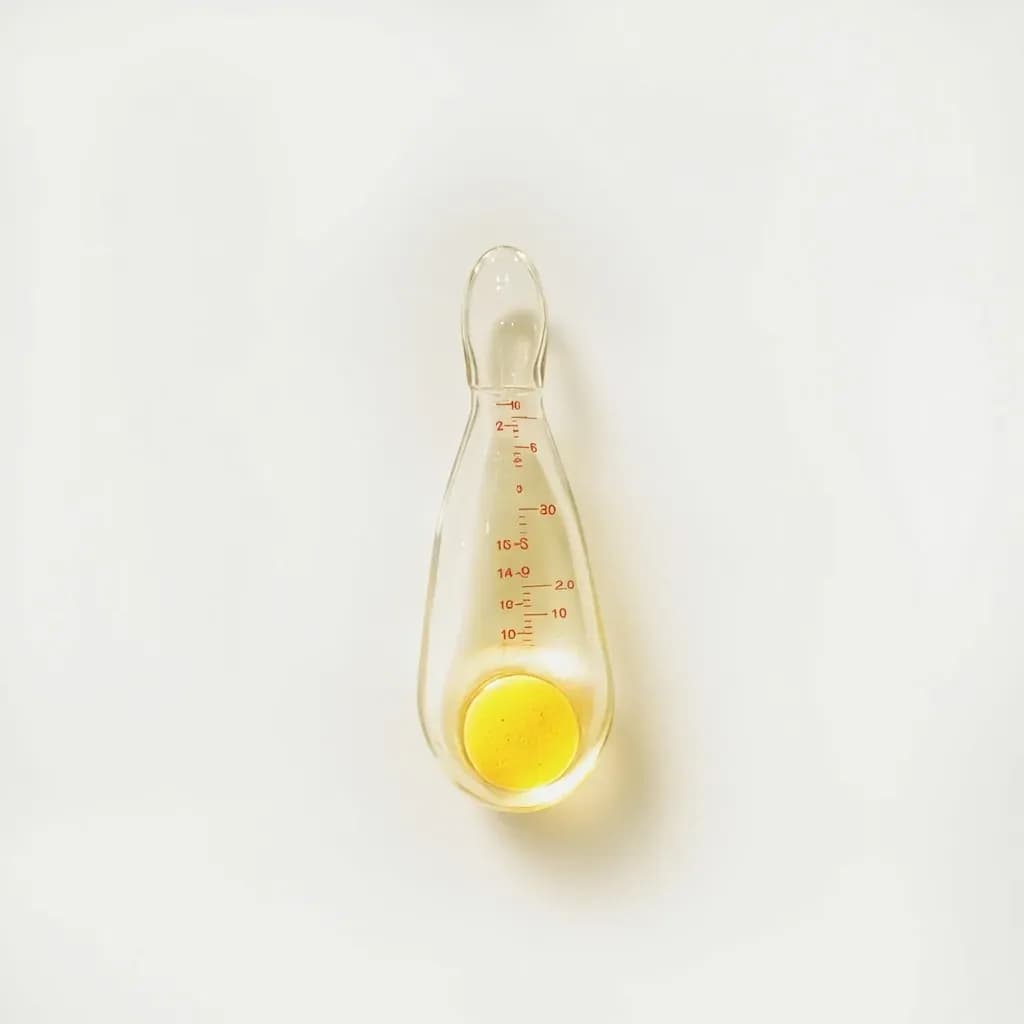
A graduated dropper for measuring and transferring tiny, precise volumes of liquid.
A measuring pipette draws up and dispenses small, exact amounts of liquid, used in modernist and pastry kitchens for dosing extracts, colorings, acids or flavor oils by the drop or milliliter. Micropipettes with disposable tips give sub-milliliter accuracy for sensitive recipes. They make it easy to repeat very small measurements that a spoon cannot.
A measuring pipette is a slender, graduated tube — borrowed from the laboratory — that lets a cook measure and transfer liquids in volumes too small for a teaspoon to resolve with any confidence. The familiar glass version is drawn from borosilicate, marked with fine graduations, and topped with a rubber bulb, a manual valve, or an electronic controller that draws liquid up by suction. In a kitchen the pipette's job is precision: dosing a milliliter of lemon juice into a sauce, hydrating a small amount of xanthan into a liter of stock, or seeding a ferment with a measured splash of starter. Nothing else in the drawer delivers that combination of accuracy, repeatability, and control at sub-teaspoon volumes.
The pipette earned its place at the prep station with the rise of modernist cooking in the early 2000s, when chefs began treating the kitchen like a lab bench. Before then, cooks relied on squeeze bottles, syringes, and a steady hand; after, they reached for 1 mL, 5 mL, and 10 mL graduated glass pipettes the way a pastry cook reaches for a scale. Most kitchen pipettes are "TD" (to deliver), meaning the small amount of liquid that wets the inside wall after draining is already accounted for in the graduations — you never blow it out. Reading is done at the bottom of the meniscus, eye level, against a contrasting background, the same way a bartender reads a jigger.
For cooks working in the microliter range — enzyme dosing, certain reverse spherification work, koji inoculation — the glass pipette gives way to a piston micropipette with disposable plastic tips, the same tool found on every biology bench. It is more expensive and tip-hungry, but it is the only way to deliver 10 µL or 100 µL by hand with any confidence. For everything else, a small set of glass pipettes plus a box of cheap disposable transfer pipettes covers the vast majority of precision tasks a working kitchen will face.
Alternatives
Types & varieties
Straight glass tube with printed graduation marks along its length; the versatile workhorse for variable small volumes, calibrated TD
Bulb-shaped glass tube calibrated to a single fixed volume (e.g., exactly 5.00 mL); the most accurate pipette type, used when a recipe calls for a precise single dose
Long, straight graduated pipette, often 5–25 mL; useful for slightly larger precise volumes and for reaching into deep vessels
Simple two-piece glass tube with a rubber teat and no graduations; used for drops and rough transfer rather than measurement
Plastic, often graduated in 0.5 mL increments; cheap, single-use, ideal for tasting, plating dots, or cross-contamination–sensitive work
Bench-style tool with a spring plunger and disposable plastic tip; the only accurate option for sub-milliliter (µL) volumes such as enzyme and inoculant dosing
Building a Kitchen Set
For most professional and serious home kitchens, a modest three-pipette set covers the great majority of precision work. A 1 mL graduated pipette handles acid corrections, bitters, and tincture dosing where a drop or two of error is a lot. A 5 mL graduated pipette is the daily workhorse for hydrocolloid hydration, enzyme work, and plating sauces by the milliliter. A 10 mL graduated pipette covers starter culture inoculation, larger dilution steps, and any volume too small to bother with a measuring cup. Add a box of disposable transfer pipettes for tasting, plating dots, and one-off transfers, and a single 100–1000 µL piston micropipette with a box of tips for the rare task that demands microliter accuracy.
- Buy Class A or Class B borosilicate glass; cheaper soda-lime glass chips and clouds with repeated autoclaving.
- Get a proper rubber bulb or a dedicated pipette controller (manual valve, Pipetube, or electronic) rather than relying on a homemade syringe bulb — it gives finer control and won't snap the tip.
- Reserve one clearly labeled pipette for acids, one for fats and oils, and one for aromatics to prevent flavor carryover between uses.
- Store pipettes vertically in a dedicated cylinder or rack; laying them across a drawer is the fastest way to snap a tip.
Common uses
Tips & pitfalls
- Choose the smallest pipette that comfortably holds your target volume — accuracy drops as a percentage of volume when you use an oversized pipette, and a 1 mL pipette is far more accurate at 0.5 mL than a 5 mL is at the same dose
- Always read the bottom of the meniscus at eye level; a piece of dark tape or a dark line on the bench behind the pipette makes clear liquids much easier to read
- For viscous liquids such as syrups, purées, and hydrocolloid dispersions, pre-wet the pipette with the same liquid (draw and discard once) so the wetting film is already accounted for
- Do not blow out a TD (to deliver) pipette — the calibration already accounts for the small amount that remains in the tip; blowing it out throws off the measurement and can aerosolize hazardous liquids
- Rinse the pipette once with the solution you are about to measure when absolute accuracy matters, especially with concentrated acids, brines, or sugar syrups
- Autoclave glass pipettes between uses for fermentation and long-shelf-life work; replace disposable micropipette tips after every draw to avoid cross-contamination
- For plating dots, snip the tip of a disposable transfer pipette with scissors to enlarge and vary the drop size
- Never pipette by mouth — always use a bulb, valve, or electronic controller, both for safety and for the reproducibility that comes from a controlled draw
Good to know
- Also known as
- Graduated pipette; Mohr or serological pipette in lab contexts
- Primary material
- Borosilicate glass (reusable, autoclavable); polypropylene plastic (disposable transfer pipettes)
- Typical kitchen sizes
- 1 mL, 2 mL, 5 mL, and 10 mL graduated; 1–10 µL, 10–100 µL, and 100–1000 µL for piston micropipettes
- Calibration modes
- TD (to deliver) is standard for kitchen use; TC (to contain) pipettes must be blown or rinsed out to deliver the marked volume
- Reading technique
- Bottom of the meniscus, eye level, with a light or dark background behind the column for clarity
- Accuracy
- Class A 5 mL volumetric pipette is accurate to ±0.01 mL; graduated pipettes lose precision as you move away from their nominal volume
- Cleaning and sterilization
- Glass pipettes are dishwasher- and autoclave-safe (121 °C / 20 min); plastic transfer pipettes are single-use
- Cost range
- Roughly $3–$15 per glass pipette with bulb; $150–$400 for a piston micropipette, with disposable tips sold separately
Also called
Micropipette · Graduated Pipette · Dropper
Related

Peeler
Swift blade for stripping skin off fruit and vegetables

Grater
Sharp-toothed surface for shredding cheese and vegetables

Microplane
Ultra-fine rasp for citrus zest, garlic, and hard cheese

Mixing Bowl
All-purpose bowl for combining, whisking, and tossing

Whisk
Looped wires that beat air into eggs, cream, and sauces

Spatula
Flat blade for flipping, lifting, and scraping

Slotted Spoon
Pierced spoon that lifts solids and drains the liquid behind

Wooden Spoon
Gentle, heat-friendly spoon for stirring anything