Prep Tools
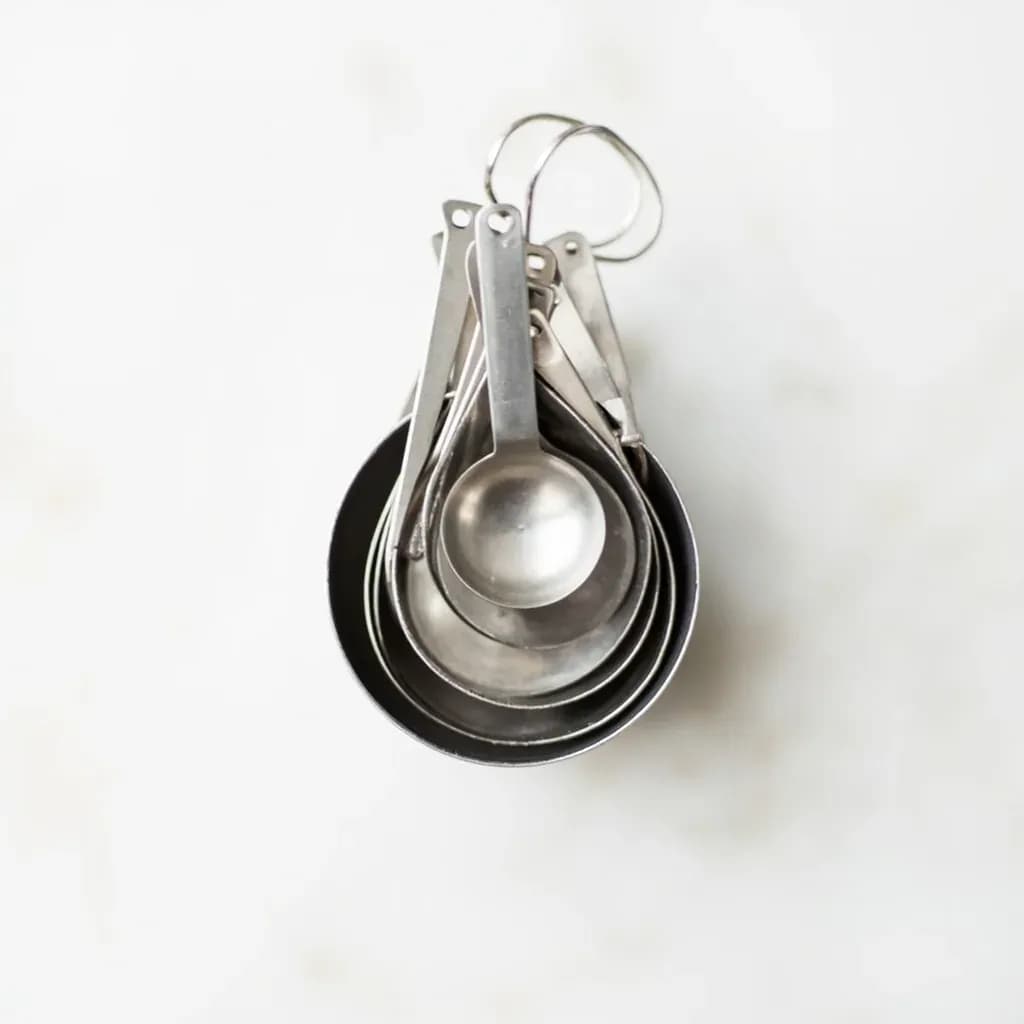
Measuring Spoon
A set of fixed-size spoons for measuring small amounts of ingredients accurately.
A measuring spoon is one of a nested set of spoons in standardized sizes, from a pinch up to a tablespoon, used to portion small quantities of ingredients precisely. They are essential for measuring spices, leavening agents, salt, extracts, and oils where exact small amounts matter to a recipe. Dry ingredients are leveled flush across the top for accuracy.
A set of measuring spoons is the cook's most-used precision tool for the smallest volumes in the kitchen — anywhere a 'pinch' or 'splash' would otherwise do. They matter most in baking, where ratios of leavening (baking powder, baking soda, yeast), salt, and spices directly determine whether a cake rises, a cookie spreads, or a loaf holds its shape. Unlike tableware spoons or 'about a spoonful' estimates, a measuring spoon's bowl is calibrated to hold a fixed volume when filled to the rim and leveled, so even a half teaspoon of baking powder can be dispensed with confidence rather than guesswork.
The American standard set has been essentially unchanged since Fannie Farmer standardized it in her 1896 Boston Cooking-School Cook Book: four spoons measuring 1 tablespoon, 1 teaspoon, 1/2 teaspoon, and 1/4 teaspoon, usually joined by a ring or chain. The US customary tablespoon is exactly 14.78676 mL (1/2 US fluid ounce) and the teaspoon is 4.92892 mL, though the FDA rounds these to 15 mL and 5 mL for nutrition labeling. Outside the US, sizes diverge — an imperial UK tablespoon is 17.7582 mL, an Australian tablespoon is 20 mL, and metric sets commonly run 1, 2, 5, 15, 25, and 50 mL — so a recipe from London or Sydney needs a quick conversion before measuring.
The single most important habit when using a measuring spoon is leveling dry ingredients flush with the rim using the flat back of a knife. A heaping teaspoon of baking soda can carry roughly 50% more material than a leveled one, and that excess is often the difference between a tender cake and a bitter, soapy one. For liquids, fill to the rim and pour out — or, for volumes above a few tablespoons, switch to a small liquid measuring cup where the meniscus is easier to read.
Alternatives
Types & varieties
Four spoons — 1 tbsp, 1 tsp, 1/2 tsp, 1/4 tsp — joined by a ring, chain, or clip
Six spoons adding 1/2 tbsp and 1/8 tsp for precision baking and spice work
Common sizes 1, 2, 5, 15, 25, 50 mL; used for international recipes and small doses of extracts or supplements
Rare-earth magnets in the handles stick to metal cans, mixing bowls, or a wall strip so nothing goes missing
Single handle with a sliding or rotating bar that resizes the bowl to replace a full set
Extended shafts built to reach into tall jars of spices, vanilla extract, or active dry yeast
Each size fits inside the next and clicks together; saves drawer space
Spring-loaded thumb-lever spoons for portioning cookie dough, melon balls, or muffin batter evenly; size-coded by number and color, and not calibrated to true volume measures
Leveling and Filling: Where Accuracy Actually Lives
Most measurement errors with measuring spoons come from how the spoon is filled and emptied, not from the spoon itself. A heaping spoon, a packed spoon, or a wet spoon can quietly add 20–50% more material than the recipe intends, and in baking that margin is the difference between a tender crumb and a chemical-tasting one. Treat the spoon as a calibrated scoop, not a casual scoop, and your recipes will hold up across batches and across cooks.
- Dry powders (flour, sugar, baking powder, cocoa, salt): dip the spoon, lift, and sweep the flat back of a knife or a bench scraper across the rim so the surface is flush — no mound, no dip.
- Packed ingredients (brown sugar, shortening, peanut butter): press firmly into the spoon with your fingers or the back of a spoon, then level. Pack only when the recipe explicitly says 'packed.'
- Liquids (vanilla, vinegar, lemon juice): fill to the very rim, or switch to a glass liquid measure for anything over 2 tablespoons — the meniscus is far easier to read there.
- Sticky pastes (honey, molasses, miso, vanilla paste): mist the spoon with cooking spray or measure a little oil first; the ingredient will slide out cleanly and the spoon won't waste half its volume to sticking.
- Sub-1/8-tsp amounts: rely on a 'pinch' (thumb and forefinger, roughly 1/16 tsp) for salt in doughs, or switch to a kitchen scale and measure by grams for true precision.
Common uses
Tips & pitfalls
- Use real measuring spoons, never tableware. A dining spoon's bowl can run anywhere from roughly 5 to 15 mL depending on the pattern, and there is no way to tell from above.
- Level dry ingredients with the flat back of a knife, a bench scraper, or even the edge of a credit card. Packing flour or cocoa into the spoon adds 20–30% more than the recipe calls for.
- For sticky ingredients like honey, molasses, peanut butter, or vanilla paste, mist the spoon with cooking spray or measure a neutral oil first; the ingredient slides out and the spoon reads true.
- A wet or oily measuring spoon will make dry ingredients clump and read high. Wash and dry between uses, especially when moving from butter or oil to flour or salt.
- A 'pinch' between thumb and forefinger is roughly 1/16 teaspoon — the right tool when a recipe calls for less than your smallest spoon can deliver, especially salt in yeasted doughs.
- Stainless steel outlasts plastic by years and resists stains from turmeric, paprika, and curry. Plastic is gentler on nonstick pans and cheaper, but high dishwasher heat can warp the bowl and quietly throw off the volume.
- Always confirm whether a recipe means a US, imperial, or metric tablespoon before scaling. Swapping an Australian 20 mL tablespoon for a US 15 mL one overshoots by a third — usually fatal for baking soda or baking powder.
- Store the set on a ring, chain, or magnetic strip. The 1/8 teaspoon is the spoon that disappears first, and a missing spoon will silently shrink every recipe that uses it.
Good to know
- Standard US sizes
- 1 tablespoon, 1 teaspoon, 1/2 teaspoon, 1/4 teaspoon; many sets add 1/8 teaspoon and 1/2 tablespoon
- US tablespoon
- Exactly 14.78676 mL (US customary, 1/2 fluid ounce); rounded to 15 mL in FDA nutrition labeling
- US teaspoon
- Exactly 4.92892 mL (US customary, 1/6 fluid ounce); rounded to 5 mL in FDA nutrition labeling
- UK tablespoon
- 17.7582 mL (imperial) or 15 mL (metric) — not interchangeable with the US measure
- Australian tablespoon
- 20 mL (metric); one of the largest standard tablespoons in common use
- Metric set sizes
- Common configurations include 1, 2, 5, 15, 25, and 50 mL, or 1, 2.5, 5, 10, 15, 20, 25 mL
- Standard ratios
- 3 teaspoons = 1 tablespoon; 4 tablespoons = 1/4 cup; 16 tablespoons = 1 cup
- Origin
- Standardized for American home cooks by Fannie Farmer in the 1896 Boston Cooking-School Cook Book
Also called
Measuring Spoons
Related

Peeler
Swift blade for stripping skin off fruit and vegetables

Grater
Sharp-toothed surface for shredding cheese and vegetables

Microplane
Ultra-fine rasp for citrus zest, garlic, and hard cheese

Mixing Bowl
All-purpose bowl for combining, whisking, and tossing

Whisk
Looped wires that beat air into eggs, cream, and sauces

Spatula
Flat blade for flipping, lifting, and scraping

Slotted Spoon
Pierced spoon that lifts solids and drains the liquid behind

Wooden Spoon
Gentle, heat-friendly spoon for stirring anything