Knives & Cutting
Meat Cleaver
Heavy rectangular blade that chops through bone, joints, and tough cuts of meat.
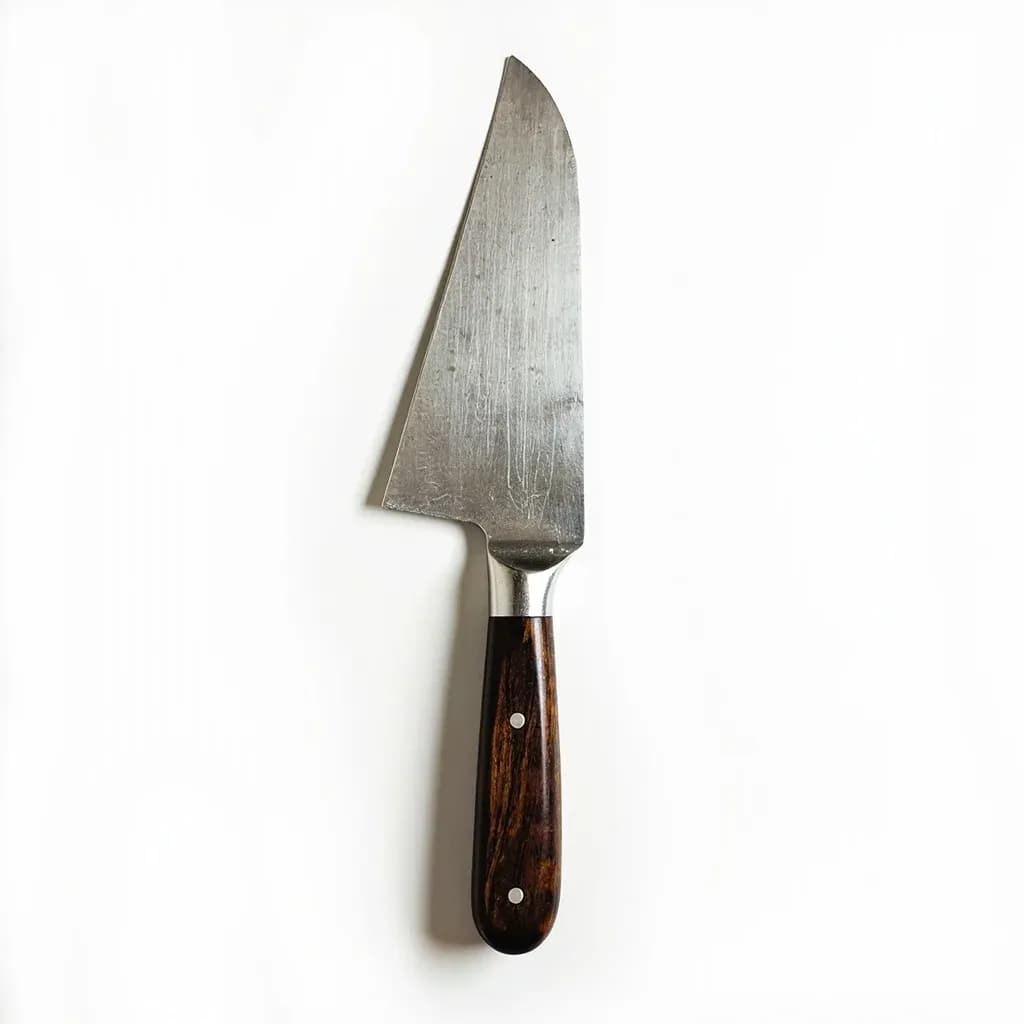
A meat cleaver is a thick, heavy knife with a broad rectangular blade designed to cut through bone and cartilage with downward force. Butchers and cooks use it to break down poultry, split ribs, and portion large cuts, and the flat side can crush garlic or ginger. Its weight does much of the work, letting the blade cleave rather than slice.
A meat cleaver is a thick, rectangular-bladed knife that relies on its own mass rather than a slicing motion to cut through bone, cartilage, and tough meat. The spine runs 4–6 mm thick—several times thicker than a chef's knife's spine—and the blade is short (6–9 inches) so the weight sits close to the hand. That geometry turns the tool into a small axe: raise it, let it fall, and the momentum does the cutting. It is the only standard kitchen knife designed to work this way, and treating it like a chef's knife is the fastest way to chip the edge or tire your wrist.
Cleavers come in two broad families. The Chinese caidao is a tall, relatively thin, all-purpose blade that slices, smashes, scoops, and only occasionally meets bone—effectively a chef's knife that can also break down a chicken or crack a rack of ribs. The Western butchers' cleaver is heavier, thicker, and dedicated to splitting joints and chopping through cartilage; it is not used for vegetables at all. The Japanese deba falls between them, with a single-bevel edge and a thick heel built for fish heads and small poultry joints.
In a modern home kitchen, a single 7-inch Chinese-style cleaver covers more everyday tasks than a dedicated Western cleaver: slicing, smashing garlic, disjointing a bird, and cracking ribs. A dedicated Western cleaver earns its place only when whole birds, pork shoulder, or oxtail come through the door regularly. The principle that ties every variant together is the same: control the weight, aim for the joint, and let gravity do the work your arm would otherwise force through bone.
Alternatives
Types & varieties
Tall, thin, rectangular blade 7–9 inches; functions as a chef's knife, slicer, and light cleaver for vegetables, herbs, boneless meat, and small bones.
Thicker, heavier, blunter-edged version of the caidao, made for splitting poultry bones and pork ribs without chipping.
Square or rectangular head, very thick spine, 6–8 inch blade. Built for cracking beef shanks, oxtail, and halving poultry.
Single-bevel, wedge-shaped Japanese knife; the thick heel chops through fish heads and small chicken joints while the tip does fine work.
Smaller, lighter cleaver with a rounded tip, used in Thai kitchens for crushing aromatics and breaking down small proteins.
Forged single-piece steel with a polymer or hardwood handle, often 2–3 lbs; standard in butcher shops and high-volume restaurant kitchens.
Letting the Weight Work
A cleaver is a controlled fall, not a swing. The standard motion is to lift the blade straight up just a few inches, then let it drop with the handle loosely gripped—your fingers guide, they do not drive. Trying to force the cut by hammering or pushing bends the edge, chips the corner, and tires the wrist. A 1.5 lb cleaver dropped cleanly through a chicken breastbone will outperform a 3 lb cleaver powered by a full arm swing, and it will leave the edge intact. The exception is dense long bone (beef femur, ham shank, large knuckle), where a cleaver simply is not the right tool—reach for a bone saw instead.
Choosing the Right Cleaver
For most home cooks, a 7- to 8-inch Chinese-style cleaver is the best first cleaver because it does the work of a chef's knife plus light bone tasks. A dedicated Western butcher's cleaver earns its spot only if you regularly break down whole birds, pork shoulder, or beef shanks. Weight matters more than people think: a heavier blade is not automatically better, because it demands more control and exposes any flaw in your aim.
- Blade length: 7–8 inches covers most home tasks; longer blades get unwieldy on a standard cutting board.
- Weight: 1–1.5 lbs is plenty for joints and ribs; anything heavier demands deliberate, controlled strokes.
- Steel: high-carbon stainless for low maintenance; plain carbon steel takes a keener edge but develops patina and rusts if left wet.
- Tang and handle: full-tang with riveted hardwood or polymer. Round or oval shapes fit a Western grip; flat or D-shapes suit a pinch grip.
- Avoid thin-stamped 'cleavers' with a partial tang—they flex or snap under heavy bone work, even if they look the part.
Common uses
Tips & pitfalls
- Let gravity do the work: raise the cleaver and let it fall. Pushing, hammering, or swinging with the arm chips the edge and risks snapping the corner.
- Aim for the joint, not the bone. Cleavers split cartilage and small bones more cleanly than dense long bone; locate the soft spot between joints first.
- Use a thick end-grain wood or high-density polyethylene board. Glass, marble, and bamboo will chip the edge and wreck the board.
- Hand-wash and dry the edge immediately. The thick blade traps moisture against the bolster and rivets, which can pit stainless steel and rust carbon steel.
- Hone on a 1000-grit whetstone a couple of times a year and do not over-polish. A robust micro-bevel holds up to bone work better than a razor edge.
- For whole poultry, place it skin-side down and chop straight down through the breastbone in one confident stroke, then finish the back with kitchen shears.
- Curl your guide-hand fingers into a claw with the knuckles forward; the flat side of the blade protects them if your aim drifts.
- Avoid twisting the blade in the cut—lift straight up. Twisting levers the edge sideways and is the most common cause of a chipped corner.
- Store on a magnetic strip or in a saya/sheath. The heavy blade rattling around in a drawer damages itself and anything next to it.
Good to know
- Origin
- The Chinese cleaver (caidao 菜刀) has been the everyday Chinese kitchen knife for centuries; the heavy Western butchers' cleaver became standardized in 19th-century European and North American professional butchery.
- Typical Blade Length
- 6 to 9 inches (15–23 cm); Chinese cleavers usually 7–9 inches, Western cleavers 6–8 inches.
- Total Weight
- 1 to 2.5 lbs (450 g–1.1 kg) for most home and pro cleavers; commercial shop cleavers can exceed 3 lbs.
- Blade Material
- High-carbon stainless steel is standard; traditional Chinese cleavers are plain carbon steel; premium models are Damascus-clad.
- Edge Angle
- Roughly 20–25° per side—a robust, slightly obtuse edge rather than a razor slicing edge.
- Spine Thickness
- Often 4–6 mm at the heel, several times thicker than a chef's knife, to absorb impact on bone and cartilage.
- Tang
- Full-tang construction with riveted hardwood or polymer handles is the norm; the heavy blade needs a continuous steel tang for balance and strength.
Also called
sanba-cleaver · Cleaver · Bone Chopper
Related

Knife
The fundamental cutting tool every kitchen is built around

Chef's Knife
The do-everything blade for chopping, slicing, and mincing

Paring Knife
Small, nimble blade for peeling and detailed in-hand work

Serrated Knife
Saw-toothed blade that slices crusty bread without crushing

Cleaver
Heavy broad blade for chopping through bone and bulk prep

Cutting Board
The stable surface every cut starts on

Mandoline
Adjustable blade for paper-thin, perfectly even slices

Kitchen Shears
Heavy-duty scissors for poultry, herbs, and packaging