Prep Tools
Meat Lug / Tote
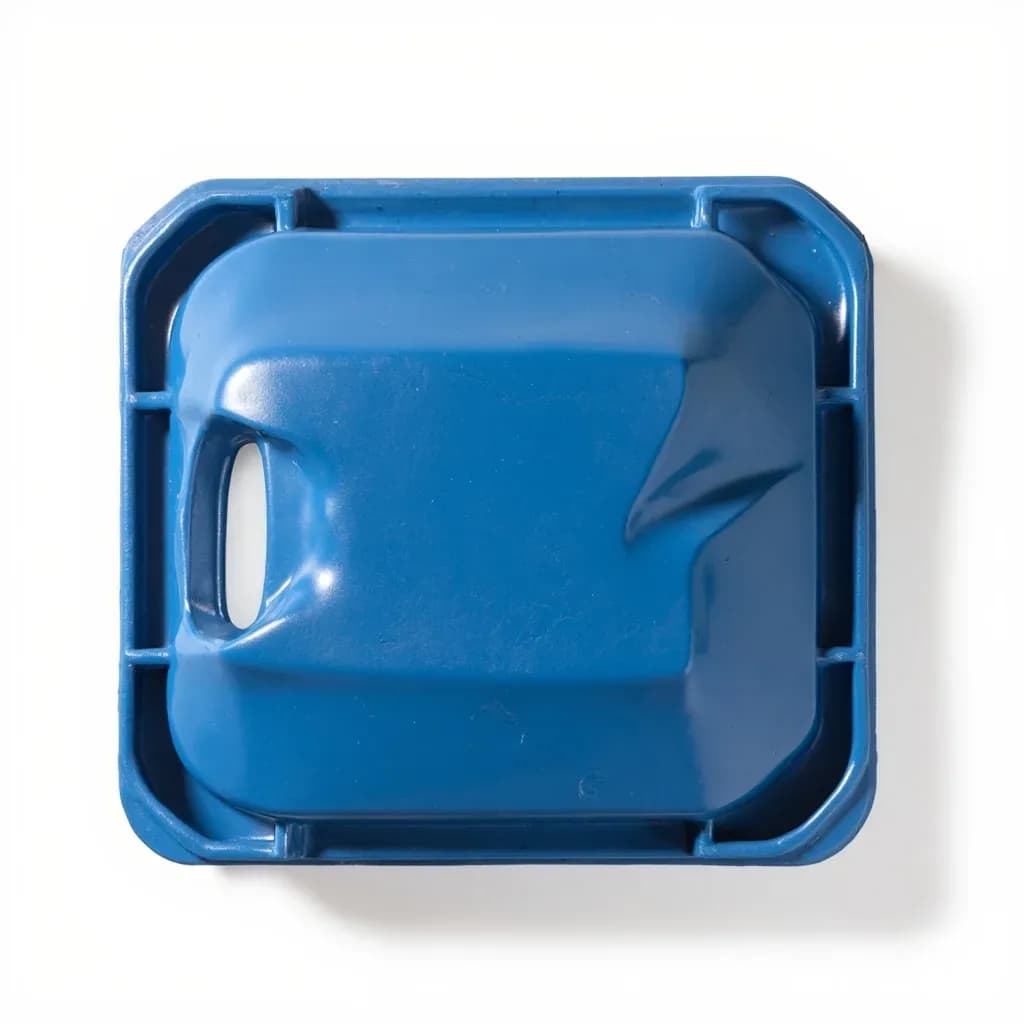
A stackable food-grade tub for transporting and storing bulk meat and prep.
A meat lug is a sturdy, often blue, food-grade plastic tote used to move and hold raw meat, sausage, and bulk ingredients. Butchers and processors stack them to carry product between stations, into coolers, and out for delivery. The smooth design and color coding make them easy to sanitize and to keep raw meat separate from other foods.
A meat lug (also called a meat tote) is a stackable, food-grade plastic tub designed for moving, holding, and storing bulk product — most often raw meat, poultry, and seafood — through the steps of a commercial kitchen or processing plant. The standard model is molded from high-density polyethylene (HDPE) with a reinforced rim that lets loaded tubs stack securely and molded hand-holes on the short sides for two-handed carrying. Capacities are rated by weight of meat rather than liquid volume: 25, 50, and 100 lb are common, with heavy-duty processing versions going to 200 lb. A 50 lb lug runs roughly 24 by 18 by 12 inches, with a volume around 12–15 gallons — much smaller than a similarly rated beverage tub — so the weight arrives fast once the tub is loaded with primals.
What separates a meat lug from a generic bus tub or storage bin is the combination of three things: a food-safe rating that survives commercial dishwashing, rim geometry engineered to stack safely when fully loaded, and the choice between solid and perforated bottoms. The perforated version is the workhorse of brining, wet-marinating, salted curing, and ice-chilling — the holes let brine, purge, and meltwater drain away so the product is not sitting in its own liquid. Color-coded versions, sorted by HACCP convention (red for raw meat, yellow for poultry, blue for raw fish, green for produce, white for general), are standard in any operation that takes cross-contamination seriously. HDPE versions began replacing the wooden meat trucks and galvanized metal tubs that dominated packinghouses in the 1960s and 1970s because they do not splinter, do not rust, are lighter, and survive repeated commercial dishwashing.
For a serious home cook, a meat lug is rarely a daily tool, but it earns its keep the moment a project scales up: a 20-pound prime rib, a whole hog broken into primals, a batch of Thanksgiving turkeys, a fishing-trip cooler drop, or a wholesale-club run. Most home cooks first encounter one as the container a butcher hands over at pickup, but owning a pair — one solid, one perforated — pays off for big-batch brining, dry-aging experiments, and any operation where a roasting pan simply is not big enough.
Alternatives
Types & varieties
General-purpose version for receiving, holding, and transporting product; traps liquids, useful for collecting purge or wet marinating work.
Bottom (and sometimes lower sides) pierced with 1/4–1/2 in holes for draining brine, marinade, blood, or meltwater; the right choice for brining, wet-marinating, and ice-chilling.
Reinforced rim geometry that locks loaded tubs together safely; the standard for receiving and cold storage.
Designed to nest inside one another when empty to save shelf space; stacking stability when loaded is sometimes reduced compared with dedicated stackable models.
Paired with a snap-on flat or hinged cover (usually sold separately) for protecting product in cold storage or during transport.
Tinted to match a kitchen or plant's cross-contamination plan; keeps raw meat, poultry, fish, and produce physically separated by container.
Thicker walls, 100–200 lb capacity, reinforced corners rated for forklift handling; common in large plant settings.
Internal divider keeps two products or two marinades separate in a single container — useful for separating trim grades or running two cures at once.
Choosing the Right Lug
The first decision is capacity, and the rule of thumb is to size up rather than down: an overfilled lug is harder to lift, harder to wash, and more likely to fail at the stacking rim. The second decision is bottom type — every operation benefits from owning at least one of each. Material is non-negotiable: confirm the food-grade rating is stamped on the tote and that the resin is NSF-listed for foodservice. Cheap knockoffs with flimsy stacking tabs are a false economy; the tabs shear off under load and the lugs end up in the trash. Common foodservice suppliers include Cambro, Carlisle, and the commercial Rubbermaid line, with regional manufacturers dominant in specific meatpacking regions.
- Pick capacity by the largest single batch you actually handle, then add 20% headroom.
- Buy at least one perforated and one solid bottom; they are not interchangeable in use.
- Look for a smooth, non-porous interior surface — matte or textured finishes hold onto odors and pigments.
- Confirm the stacking rim is a separate reinforced bead, not just a folded-over wall edge.
- Check the hand-hole size: it should accommodate a gloved hand comfortably, not pinch at the base of the thumb.
HACCP Color Conventions
Color coding is the simplest, cheapest cross-contamination control a kitchen can implement. A red lug never leaves the raw-meat zone; a yellow lug never leaves poultry; a blue lug never leaves raw fish. If a red lug is found anywhere near a prep line handling ready-to-eat food, it triggers an investigation. The system only works if the colors are enforced — write the protocol into the opening and closing checklists and replace faded or stained lugs so the visual cue remains unmistakable.
- Red — raw meat (beef, pork, lamb, game)
- Yellow — raw poultry
- Blue — raw fish and seafood
- Green — produce, herbs, and vegetables
- White or natural — general use, ready-to-eat, allergens
- Brown or black — often used for soiled or in-wash containers; keep these physically separate from food-contact stacks
Common uses
Tips & pitfalls
- Verify the 'food-grade' rating stamped or molded into the tote before first use — never repurpose a non-food-grade industrial salvage tote, even if it looks clean, because residues and plasticizers can migrate into fatty foods.
- Color-code to your HACCP plan and never let a red (raw meat) lug touch ready-to-eat zones; a single misrouted lug can void an entire service's food-safety audit.
- Use a perforated lug any time the product needs to drain — brining, wet-marinating, ice-chilling, salted curing. A solid lug will pool liquid, dilute flavor, and turn into a contamination risk.
- Air-dry lugs completely after washing before nesting or stacking. Trapped moisture breeds mildew, sour odors, and bacterial colonies in the seams and around the hand-holes.
- Do not exceed the rated weight. Overloading bows the rim, breaks the stacking geometry, and turns a stack of lugs into a workplace safety hazard — particularly on slick cooler floors.
- Avoid direct heat sources (stovetops, hot ovens, salamanders, open flame). Food-grade HDPE has a real thermal ceiling and will deform, warp, or release volatiles well before it melts visibly.
- Inspect for cracks, deep gouges, warping, and broken stacking tabs before each use; damaged plastic harbors bacteria in scratches and fails unpredictably under load.
- Replace lugs that have absorbed deep red-meat pigment or persistent odor, and consider a dedicated white or natural-color lug for ground-meat operations so any leftover speck of red or pink is immediately visible during cleaning checks.
Good to know
- Category
- Bulk food handling / meat processing container
- Material
- Food-grade high-density polyethylene (HDPE); some models in polypropylene
- Typical capacities
- 25 lb, 50 lb (most common), and 100 lb; heavy-duty versions to 200 lb
- Approximate dimensions (50 lb model)
- Roughly 24 in long × 18 in wide × 12 in deep; volume ~12–15 gallons
- Temperature range
- Generally -20°F to 160°F; exact rating depends on manufacturer and resin
- Bottom options
- Solid (storage, transport, wet marinating) or perforated (drainage, brining, ice-chilling)
- Color coding
- HACCP convention: red raw meat, yellow poultry, blue raw fish, green produce, white general
- Cleaning
- Most are commercial-dishwasher safe; many carry NSF certification for foodservice
Also called
meat lug · meat tote · food lug · butcher tub
Related

Peeler
Swift blade for stripping skin off fruit and vegetables

Grater
Sharp-toothed surface for shredding cheese and vegetables

Microplane
Ultra-fine rasp for citrus zest, garlic, and hard cheese

Mixing Bowl
All-purpose bowl for combining, whisking, and tossing

Whisk
Looped wires that beat air into eggs, cream, and sauces

Spatula
Flat blade for flipping, lifting, and scraping

Slotted Spoon
Pierced spoon that lifts solids and drains the liquid behind

Wooden Spoon
Gentle, heat-friendly spoon for stirring anything