Prep Tools
Metal Chopsticks (Jeotgarak)
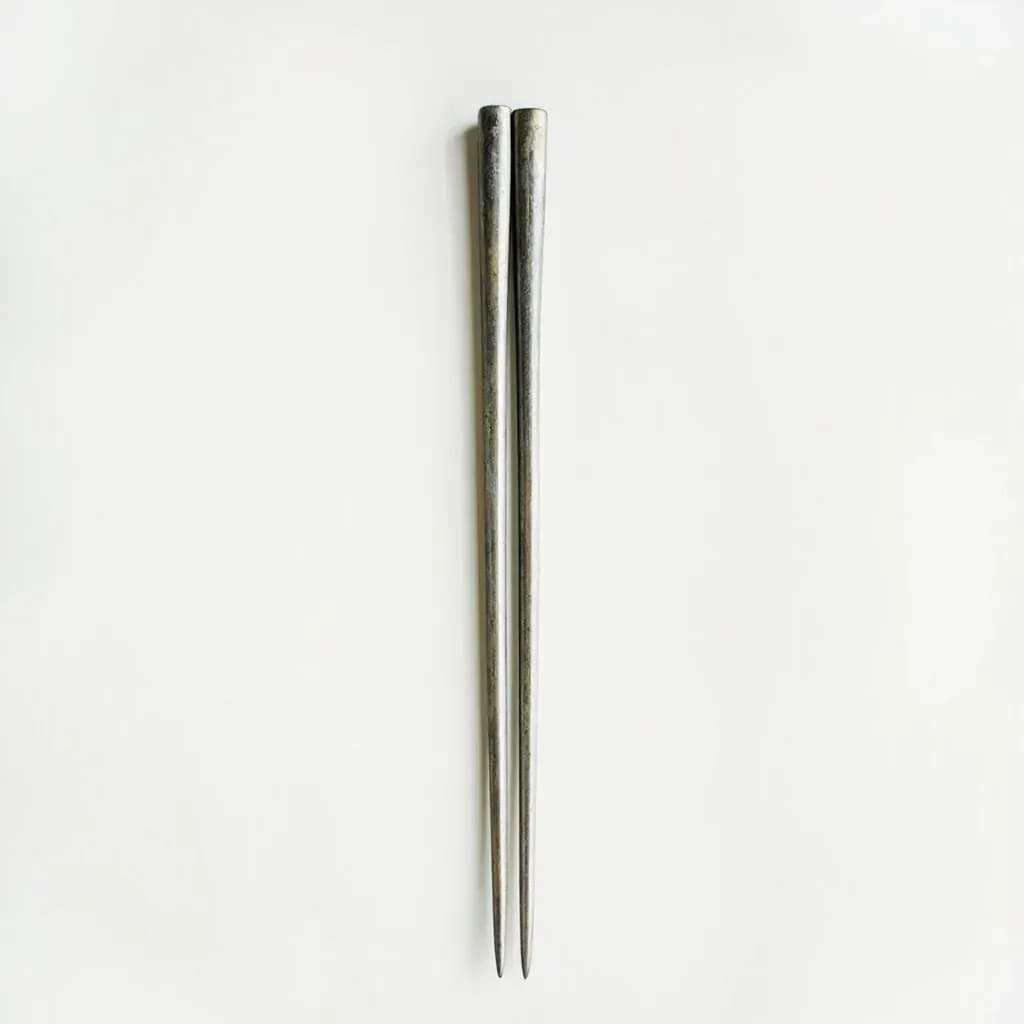
Flat stainless Korean chopsticks for picking up food and turning items while cooking.
Metal chopsticks, or jeotgarak, are the flat stainless utensils used throughout Korea for eating and for handling food at the stove. Cooks use them to flip small items, lift noodles, arrange banchan, and pluck pieces from hot broth. The flattened, sometimes textured tips grip slippery food, and the metal stands up to high heat and repeated washing.
Jeotgarak are the flat, metal chopsticks used across Korea — and the only chopsticks in the traditional East Asian trio (Chinese, Japanese, Korean) made primarily of metal. Where Chinese chopsticks run long and tapered and Japanese chopsticks sit short and finely pointed, Korean chopsticks are flat from handle to tip with a squared or rectangular cross-section. That shape, paired with stainless steel (or, historically, brass and silver), gives them a sturdiness, weight, and grip that the wood, bamboo, and lacquered chopsticks of neighboring cuisines cannot match.
The same sturdiness is why a pair of jeotgarak lives as much by the stove as at the table. The squared edge doubles as a small blade for nudging, scraping, and even slicing softer ingredients directly in the pan. Metal conducts heat readily, so a longer cooking pair keeps fingers back from the flame, and the broad flat sides clamp onto slippery noodles and grilled meat far more securely than rounded chopsticks can. In a working Korean kitchen they are used to turn meat on a grill, flip pancakes, stir stew, plate banchan, and eat the finished dish — one tool, front to back.
On the table, jeotgarak almost always appear with their partner utensil, the sutgarak (the long-handled, flat-bottomed Korean spoon). Together the two pieces form a matched set used at nearly every meal, from a quick bowl of ramyeon to a multi-course banchan spread.
Alternatives
Types & varieties
Modern everyday standard; thin, light, hygienic, and dishwasher-safe
Traditional Korean metal chopsticks; heavier with a warm golden tone and a softer feel in the hand
Historically used in royal court cuisine and for special occasions; tarnishes without occasional polishing
Stainless versions with engraved or embossed handles for grip and decoration
Slightly longer gauge versions sold specifically for grilling and stovetop work
Why the flat, squared shape matters at the stove
The geometry of jeotgarak is not a styling choice — it is a working-tool choice. The squared profile changes what the chopsticks can do once heat and grease are involved, and it is the main reason Korean cooks keep a pair within arm's reach of the burner rather than only at the table.
- The squared edge acts as a built-in scraper and spatula for lifting seared meat off a grill or cast-iron pan without tearing the crust.
- Flat sides give more surface contact on slippery foods (glass noodles, raw fish, saeu) than rounded chopsticks — clamp with the flats, not the tips.
- Uniform width means the midsection grips as firmly as the tip, which is useful for lifting a tangle of japchae or a folded piece of twigim in one motion.
- The blunt tip is safer in a hot pan and less likely to score nonstick coatings than the fine points of Japanese-style chopsticks.
- Metal draws heat away from food quickly once lifted, so bites cool a touch faster than off wooden chopsticks — a small but useful signal that something is too hot to eat.
Common uses
Tips & pitfalls
- Use the flat edge to slice through soft items like scallions, fish cake, or tteok directly in the pan — the squared tip gives a clean cut without a knife.
- Rest the tips on the rim of the grill between turns, or switch to a slightly longer cooking pair so your hand stays back from the heat.
- Press the chopsticks together in a scissoring clamp for noodles and slippery foods rather than pinching tip-to-tip — the flat sides carry far more grip than a point.
- Keep a dedicated cooking pair separate from your table set; that saves decorative or silver pairs from heat warping, grease, and tarnish.
- Do not soak brass or silver pairs — prolonged moisture speeds tarnish. Wipe them dry right after washing.
- Avoid steel wool or harsh abrasives on etched or plated handles; a soft sponge and mild detergent preserve the finish.
- Hold them like small tongs rather than tweezers: the flat, parallel edges are designed to clamp, not pinch to a point.
- Do not pry or scrape against enameled cast iron at full force — the steel tip will mark the enamel.
Good to know
- Origin
- Korea
- Length
- Typically 20–23 cm (8–9 in); cooking pairs run slightly longer than table pairs
- Material
- Stainless steel (modern standard); traditionally brass, bronze, or silver
- Shape
- Flat cross-section, rectangular or squared; uniform width from tip to handle
- Tip
- Blunt to slightly squared — not finely pointed
- Heat conductivity
- High; tips warm quickly over direct flame
- Care
- Dishwasher-safe for plain stainless; hand-wash decorated or plated pieces to protect the finish
- Paired utensil
- Sutgarak (long-handled Korean spoon)
Also called
jeotgarak · Korean chopsticks · stainless chopsticks
Related

Peeler
Swift blade for stripping skin off fruit and vegetables

Grater
Sharp-toothed surface for shredding cheese and vegetables

Microplane
Ultra-fine rasp for citrus zest, garlic, and hard cheese

Mixing Bowl
All-purpose bowl for combining, whisking, and tossing

Whisk
Looped wires that beat air into eggs, cream, and sauces

Spatula
Flat blade for flipping, lifting, and scraping

Slotted Spoon
Pierced spoon that lifts solids and drains the liquid behind

Wooden Spoon
Gentle, heat-friendly spoon for stirring anything