Prep Tools
Milk Steaming Pitcher
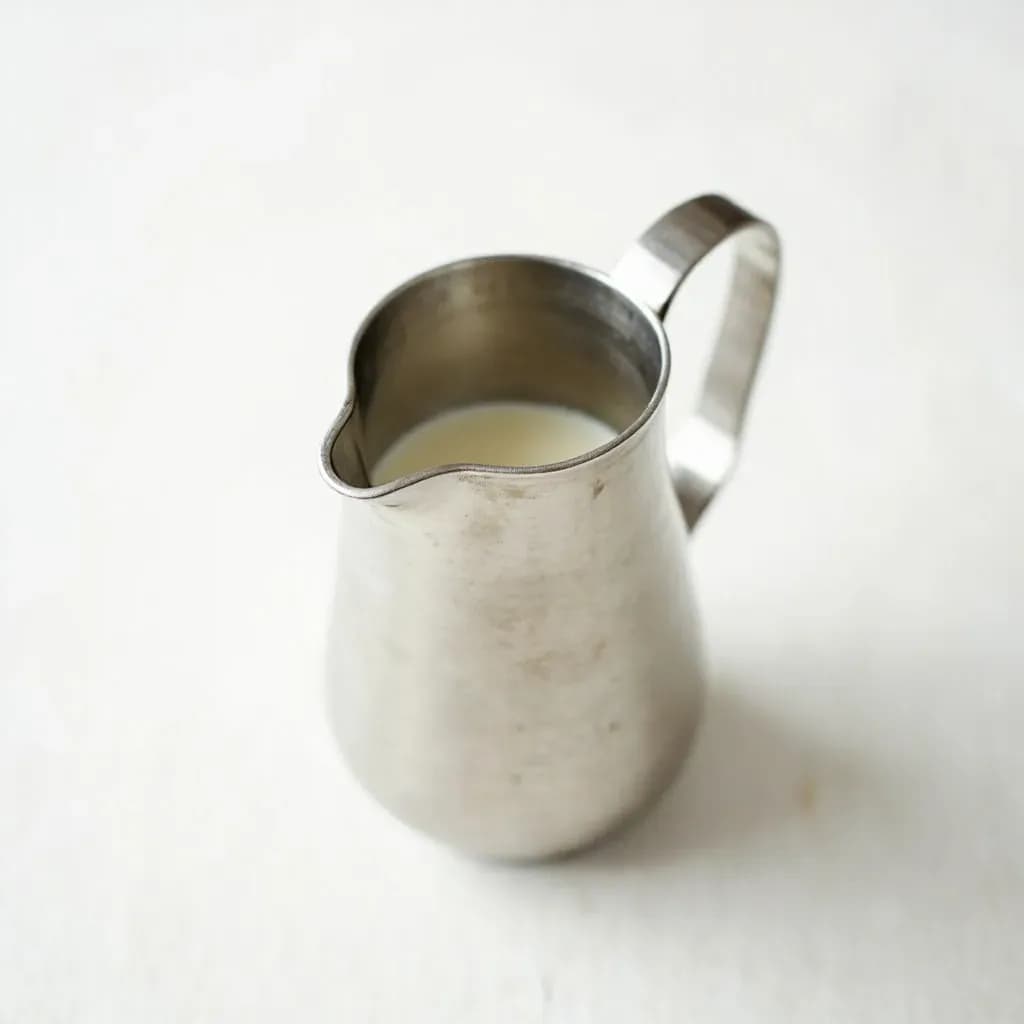
A stainless jug with a pointed spout for steaming and pouring textured milk for espresso drinks.
A milk steaming pitcher is a stainless-steel jug used to froth and texture milk under an espresso machine's steam wand. Its rounded base helps create a swirling whirlpool that produces smooth microfoam, and the tapered spout gives the precise control needed for latte art. Sizes are chosen to match the number and volume of drinks being made.
The milk steaming pitcher—called a milk jug in café vernacular—is the small stainless-steel vessel that sits beneath an espresso machine's steam wand to receive, heat, and texture milk for cappuccinos, lattes, flat whites, and cortados. Its narrow job description hides a great deal of physics: the shape of the body, the angle and bore of the spout, and the weight in the hand all determine whether the barista can stretch and roll milk into a glossy microfoam and then pour that foam as a clean, controlled line for latte art. Stainless steel is the universal material because it conducts heat quickly enough that an experienced barista can read milk temperature through the wall of the pitcher, and because it shrugs off the daily punishment of hot milk, alkaline cleaners, and the occasional drop onto a bar mat.
Capacity clusters around three useful sizes—12 fl oz (350 ml), 20 fl oz (600 ml), and 32 fl oz (950 ml)—and the rule of thumb is to match the pitcher to the drink rather than the reverse. A pitcher that is too large makes it hard to feel the vortex forming or to judge when the milk has reached body temperature; one that is too small overflows before aeration is complete, since milk expands 20–30% as air is incorporated. The other defining choice is the spout. Sharp, narrow spouts give precise flow control for detailed patterns—rosettas, tulips, swans—while rounded or wide spouts are more forgiving and faster to pour, which is why they dominate in high-volume cafés where speed trumps fine line work.
The tool evolved in Italy alongside the lever and pump espresso machines of the early-to-mid twentieth century, and despite a steady stream of boutique redesigns from makers like Bellux, Pesado, Barista Hustle, and Rhino Coffee Gear, its core form—tapered body, welded or riveted handle, shaped pouring lip—has changed remarkably little. What has changed is fit and finish: etched interior volume lines, optional thermometer strips, double-wall insulation, and powder-coated exteriors in matte black, white, or copper are now common upgrades aimed at home baristas and training cafés.
Alternatives
Types & varieties
Pointed, often laser-cut tip; favored for tulips, swans, and fine rosetta pours.
Shorter and blunter opening; more forgiving flow, ideal for beginners and simple heart patterns.
Funnels milk in a broader stream; typical of Bellux and many traditional Italian cafés.
Painted exterior in matte black, white, copper, etc.; performance matches plain steel but the coating can chip if dropped.
Two layers of steel; holds temperature longer and feels cooler to hold, but slightly harder to read milk temperature by touch.
Internal graduations (often 4 oz / 8 oz) for repeatable dosing across baristas.
Stick-on or built-in indicator; useful in cafés training new baristas who haven't yet learned to read temperature by feel.
Used for cortados, piccolos, and very small lattes.
Café workhorse for steaming multiple servings at once during rush service.
Sizing the pitcher to the drink
A common beginner mistake is to steam milk in the largest pitcher available. The problem is twofold: in a 32 oz pitcher the vortex is harder to feel and the steam wand tip sits far from the milk surface, so aeration becomes uneven; in a 12 oz pitcher filled to the brim, the milk has no room to expand and climbs straight over the rim. As a working rule, fill the pitcher to roughly the level of the steam wand's lower edge and leave at least an inch of headspace. The standard café kit usually contains three pitchers (12, 20, and 32 oz) precisely so the barista can grab the right one for the order: a cortado goes in the 12, a single latte or two cappuccinos in the 20, and a round of four cappuccinos in the 32.
Spout geometry and latte art
The spout is doing two jobs at once: metering the milk as it leaves the pitcher and shaping the stream where it hits the espresso. Sharp, narrow spouts cut a thin, fast ribbon of milk that can be dragged through crema to draw fine lines—rosettas, tulips, and swans all depend on this control. Rounded or wide spouts pour a fuller, slower stream that resists precise cutting but lays down a wider base for hearts and simple layered patterns. Most professional baristas keep at least one of each: a sharp-spouted 12 oz pitcher for single drinks where art matters, and a rounded 20 or 32 oz for bulk service where speed and consistency win.
Cleaning and care
Milk fat and protein bond to hot stainless steel quickly and become very difficult to remove once cooled and dried. The reliable routine is to rinse the pitcher with cold water the moment it is emptied, then wash in hot soapy water with a non-abrasive cloth or brush; the milk residue should lift in seconds. Dishwashers are technically possible but generally avoided in serious cafés because the alkaline detergent dulls polished finishes and erodes etched volume lines and thermometer strips over time. Pitchers with powder-coated exteriors are especially worth keeping out of the dishwasher—the coating chips at the rim and handle first.
Common uses
Tips & pitfalls
- Fill the pitcher only to about ⅓ full before steaming — milk expands 20–30% as it aerates, and a full pitcher will overflow the rim.
- Match pitcher size to the drink: 12 oz for a single flat white or cortado, 20 oz for one latte or two cappuccinos, 32 oz for multiple drinks.
- Purge the steam wand and wipe it dry before and after each use; milk residue on the wand tip ruins the next drink and clogs the small aerator holes at the end of the wand.
- Hold the pitcher so the steam wand tip sits just below the milk surface for the first 3–5 seconds (the stretching phase), then lower the pitcher slightly to submerge the tip (the rolling phase) — skipping either phase produces flat milk or stiff, dry foam.
- Tap the pitcher firmly on the counter and swirl to pop large bubbles and integrate the foam; the goal is a wet-paint gloss, not stiff peaks that hold their shape.
- Aim for a milk temperature of about 140–150 °F (60–65 °C); above 160 °F the milk scorches, tastes burnt, and loses its natural sweetness.
- Rinse the pitcher with cold water immediately after pouring — milk proteins bond to hot steel and become very hard to remove once they've dried.
- Pre-warm the pitcher with hot water if you are steaming many drinks in a row; cold steel drops the milk temperature faster and slows the stretch phase.
Good to know
- Material
- 18/10 or 18/8 stainless steel is standard; budget models occasionally use aluminum with a steel plating.
- Common capacities
- 12 fl oz / 350 ml (single drink), 20 fl oz / 600 ml (one to two drinks), 32 fl oz / 950 ml (multiple servings).
- Weight (empty, 20 oz)
- Roughly 250–350 g depending on steel gauge.
- Origin
- Italy, evolved alongside commercial espresso machines in the early-to-mid 20th century.
- Spout geometry
- Sharp/precision spout for detailed latte art; rounded or wide spout for bulk steaming and beginner pours.
- Interior markings
- Many models carry etched volume guides (minimum fill, 4 oz, 8 oz) for consistent dosing.
- Care
- Hand-wash recommended; dishwasher cycles dull the finish and erode etched markings.
- Typical price range
- Entry-level $10–15; prosumer $20–40; specialty brands $35–70.
Also called
Milk Frothing Pitcher · Steaming Jug · Milk Jug · Frothing Pitcher
Related

Peeler
Swift blade for stripping skin off fruit and vegetables

Grater
Sharp-toothed surface for shredding cheese and vegetables

Microplane
Ultra-fine rasp for citrus zest, garlic, and hard cheese

Mixing Bowl
All-purpose bowl for combining, whisking, and tossing

Whisk
Looped wires that beat air into eggs, cream, and sauces

Spatula
Flat blade for flipping, lifting, and scraping

Slotted Spoon
Pierced spoon that lifts solids and drains the liquid behind

Wooden Spoon
Gentle, heat-friendly spoon for stirring anything